Search
 Element Search
 Structure Search


Thermo Scientific Chemicals
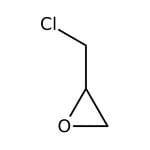
(±)-Epichlorohydrin, 99%
CAS: 106-89-8 | C3H5ClO | 92.522 g/mol
Have Questions?
Change view



Catalog number A15823.0E
also known as A15823-0E
Price (EUR)
99,65
Online Exclusive
110,00Save 10,35 (9%)
Each
Quantity:
2500 g
Price (EUR)
99,65
Online Exclusive
110,00Save 10,35 (9%)
Each
Chemical Identifiers
CAS106-89-8
IUPAC Name2-(chloromethyl)oxirane
Molecular FormulaC3H5ClO
InChI KeyBRLQWZUYTZBJKN-UHFFFAOYNA-N
SMILESClCC1CO1
View more
Specifications Specification Sheet
Specification SheetRefractive Index1.4365-1.4395 @ 20°C (UK-sourced material)
CommentMaterial Sourced in UK and US
Assay (GC)≥98.5% (UK-sourced material)
Appearance (Color)Clear colorless
FormLiquid
View more
Epichlorohydrin is used in the manufacture of polyamines and polyquaternary ammonium salts, as flocculents in water and wastewater treatment. It is used in the synthesis of surface active agents for washing products and toiletries. Polyamine-epichlorohydrin resin is used in paper industry to improve paper wet-strength. It acts as a chemical intermediate and widely used in the manufacture of epoxy resins, epichlorohydrin elastomers and polyamide-epichlorohydrin resins.
This Thermo Scientific Chemicals brand product was originally part of the Alfa Aesar product portfolio. Some documentation and label information may refer to the legacy brand. The original Alfa Aesar product / item code or SKU reference has not changed as a part of the brand transition to Thermo Scientific Chemicals.
Applications
Epichlorohydrin is used in the manufacture of polyamines and polyquaternary ammonium salts, as flocculents in water and wastewater treatment. It is used in the synthesis of surface active agents for washing products and toiletries. Polyamine-epichlorohydrin resin is used in paper industry to improve paper wet-strength. It acts as a chemical intermediate and widely used in the manufacture of epoxy resins, epichlorohydrin elastomers and polyamide-epichlorohydrin resins.
Solubility
Miscible with water and organic polar solvents.
Notes
Keep away from sources of ignition. Keep container tightly closed in a dry and well-ventilated place.
Epichlorohydrin is used in the manufacture of polyamines and polyquaternary ammonium salts, as flocculents in water and wastewater treatment. It is used in the synthesis of surface active agents for washing products and toiletries. Polyamine-epichlorohydrin resin is used in paper industry to improve paper wet-strength. It acts as a chemical intermediate and widely used in the manufacture of epoxy resins, epichlorohydrin elastomers and polyamide-epichlorohydrin resins.
Solubility
Miscible with water and organic polar solvents.
Notes
Keep away from sources of ignition. Keep container tightly closed in a dry and well-ventilated place.
RUO – Research Use Only
General References:
- For use as an acid scavenger in bromination reactions, see: J. Am. Chem. Soc., 95, 4419 (1973).
- The preparation of glycidyl ethers, often carried out in two steps, via the ring-opened chlorohydrin ether and subsequent ring-closure with base, can be achieved as a single step, under phase-transfer conditions: Synthesis, 117 (1983). For extension to diglycidyl ethers of diols, see: Synthesis, 649 (1985).
- Reaction with primary amines provides a one-step route to 3-azetidinols: J. Org. Chem., 55, 2920 (1990):
- Zhang, Y.; Tan, Z.; Liu, B.; Mao, D.; Xiong, C. Coconut shell activated carbon tethered ionic liquids for continuous cycloaddition of CO2 to epichlorohydrin in packed bed reactor. Catal. Commun. 2015, 68, 73-76.
- Xiao, S.; Zhang, C.; Chen, R.; Chen, F. Selective oxidation of benzyl alcohol to benzaldehyde with H2O2 in water on epichlorohydrin-modified Fe3O4 microspheres. New. J. Chem. 2015, 39 (6), 4924-4932.