Search
 Element Search
 Structure Search

Thermo Scientific Chemicals
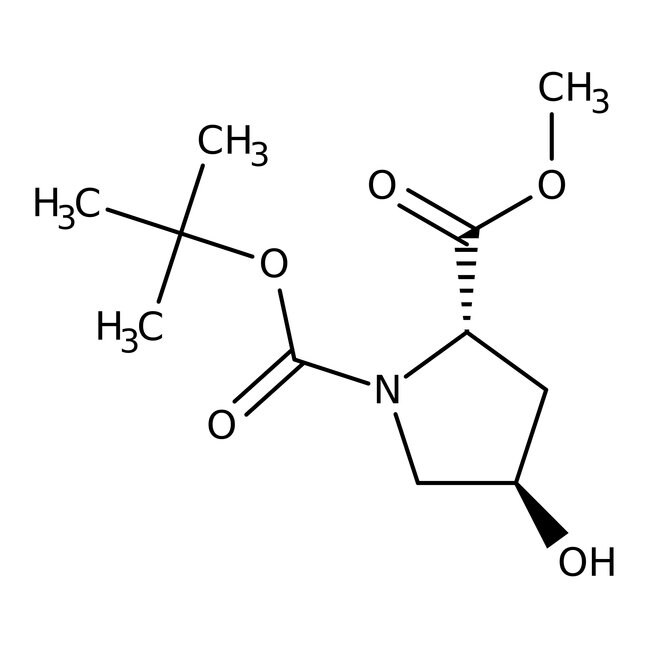
N-Boc-trans-4-hydroxy-L-proline methyl ester, 97%
CAS: 74844-91-0 | C11H19NO5 | 245.28 g/mol
Have Questions?
Change view



Catalog number H59027.03
also known as H59027-03
Price (EUR)
40,10
Each
Quantity:
1 g
Price (EUR)
40,10
Each
Chemical Identifiers
CAS74844-91-0
IUPAC Name1-tert-butyl 2-methyl (2S,4R)-4-hydroxypyrrolidine-1,2-dicarboxylate
Molecular FormulaC11H19NO5
InChI KeyMZMNEDXVUJLQAF-SFYZADRCSA-N
SMILESCOC(=O)[C@@H]1C[C@@H](O)CN1C(=O)OC(C)(C)C
View more
 Specification Sheet
It is used in the synthesis of For-Met-Leu-Phe-OMe (fMLF-OMe) analogues based on Met residue replacement by 4-amino-proline scaffold.
This Thermo Scientific Chemicals brand product was originally part of the Alfa Aesar product portfolio. Some documentation and label information may refer to the legacy brand. The original Alfa Aesar product / item code or SKU reference has not changed as a part of the brand transition to Thermo Scientific Chemicals.
Applications
It is used in the synthesis of For-Met-Leu-Phe-OMe (fMLF-OMe) analogues based on Met residue replacement by 4-amino-proline scaffold.
Solubility
Soluble in chloroform, dichloromethane and ethyl acetate.
Notes
Store in cool place. Keep container tightly closed in a dry and well-ventilated place. Store away from oxidizing agent.
It is used in the synthesis of For-Met-Leu-Phe-OMe (fMLF-OMe) analogues based on Met residue replacement by 4-amino-proline scaffold.
Solubility
Soluble in chloroform, dichloromethane and ethyl acetate.
Notes
Store in cool place. Keep container tightly closed in a dry and well-ventilated place. Store away from oxidizing agent.
RUO – Research Use Only
General References:
- Richard J. Freer; Alan R. Day; Natesa Muthukumaraswamy; Delia Pinon; Arthur Wu; Henry J. Showell; Elmer L. Becker. Formyl peptide chemoattractants: a model of the receptor on rabbit neutrophils. Biochemistry,1982, 21(2), 257-263.
- Higgins, J., et al. N-Terminus Urea-Substituted Chemotactic Peptides: New Potent Agonists and Antagonists toward the Neutrophil fMLF Receptor. J. Med. Chem,1996, 39(5), 1013-1015.