Search
 Element Search
 Structure Search
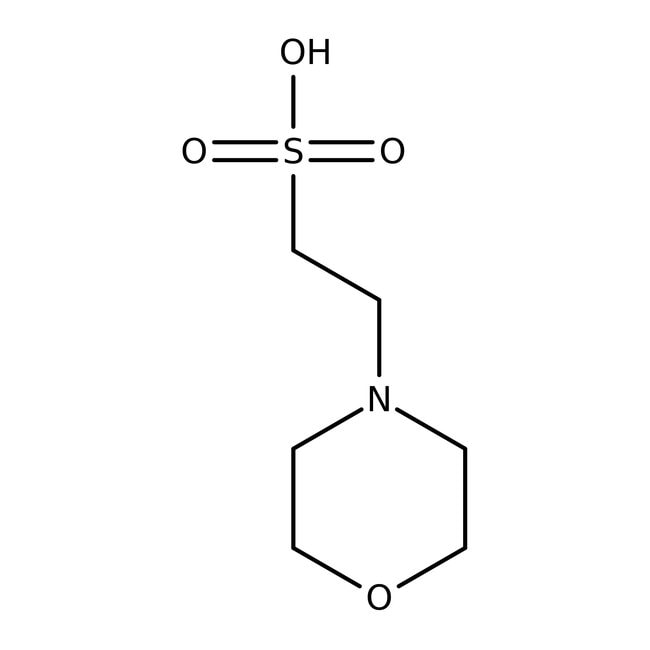

Thermo Scientific Chemicals
MES, 1.0M buffer soln., pH 5.0
CAS: 145224-94-8 | C6H15NO5S | 213.248 g/mol
Have Questions?
Change view


Catalog number J61960.AP
also known as J61960-AP
Price (EUR)
170,00
Online Exclusive
200,00Save 30,00 (15%)
Each
Quantity:
500 mL
Price (EUR)
170,00
Online Exclusive
200,00Save 30,00 (15%)
Each
Specifications
CAS145224-94-8
Chemical Name or MaterialMES buffer soln.
Health Hazard 1H315-H319-H335
Health Hazard 2GHS H Statement
H315-H319-H335
Causes skin irritation.
Causes serious eye irritation.
May cause respiratory irritation.
H315-H319-H335
Causes skin irritation.
Causes serious eye irritation.
May cause respiratory irritation.
Health Hazard 3P261-P264b-P271-P280-P302+P352-P304+P340-P305+P351+P338-P312-P332+P313-P362-P501c
View more
MES is used as a buffering agent in biology and biochemistry. It is utilized for resolving very small proteins on bis-tris gels. It is mainly used as a biological buffer in plant cell cultures. Buffer solutions are used as a means of keeping pH at a nearly constant value in a wide variety of chemical applications.
This Thermo Scientific Chemicals brand product was originally part of the Alfa Aesar product portfolio. Some documentation and label information may refer to the legacy brand. The original Alfa Aesar product / item code or SKU reference has not changed as a part of the brand transition to Thermo Scientific Chemicals.
Applications
MES is used as a buffering agent in biology and biochemistry. It is utilized for resolving very small proteins on bis-tris gels. It is mainly used as a biological buffer in plant cell cultures. Buffer solutions are used as a means of keeping pH at a nearly constant value in a wide variety of chemical applications.
Solubility
Miscible with water.
Notes
Incompatible with strong oxidizing agents.
MES is used as a buffering agent in biology and biochemistry. It is utilized for resolving very small proteins on bis-tris gels. It is mainly used as a biological buffer in plant cell cultures. Buffer solutions are used as a means of keeping pH at a nearly constant value in a wide variety of chemical applications.
Solubility
Miscible with water.
Notes
Incompatible with strong oxidizing agents.
RUO – Research Use Only
General References:
- Pagan, M.; Suazo, D.; del Toro, N.; Griebenow, K. A comparative study of different protein immobilization methods for the construction of an efficient nano-structured lactate oxidase-SWCNT-biosensor. Biosens. Bioelectron. 2015, 64, 138-146.
- Ojeda, I.; Barrejon, M.; Arellano, L. M.; Cortes, A. G.; Sedeno, P. Y., Langa, F.; Pingarrón, J. M. Grafted-double walled carbon nanotubes as electrochemical platforms for immobilization of antibodies using a metallic-complex chelating polymer: Application to the determination of adiponectin cytokine in serum. Biosens. Bioelectron. 2015, 74, 24-29.