Search


Citations & References (28)
Invitrogen™
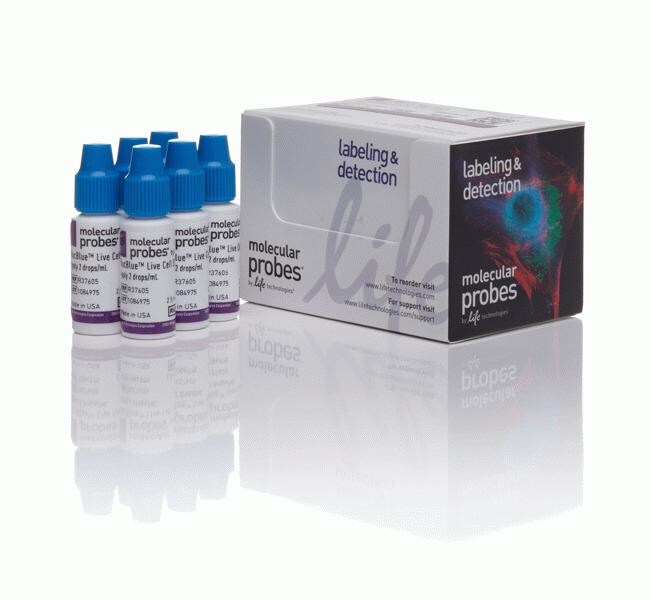
NucBlue™ Live ReadyProbes™ Reagent (Hoechst 33342)
Hoechst 33342 is a popular cell-permeant nuclear counterstain that emits blue fluorescence when bound to DNA. With NucBlue Live ReadyProbesRead more
| Catalog Number | Quantity |
|---|---|
| R37605 | 1 kit |
Catalog number R37605
Price (EUR)
192,00
Each
Quantity:
1 kit
Price (EUR)
192,00
Each
Hoechst 33342 is a popular cell-permeant nuclear counterstain that emits blue fluorescence when bound to DNA. With NucBlue Live ReadyProbes Reagent we have formulated this classic stain in a room temperature-stable solution that is provided in a convenient-to-use dropper bottle. Just tip and drip two drops per ml to stain your cells.
• No need to dilute, weigh, or pipette
• Convenient dropper bottle—just use two drops per mL
• Stable at room temperature—keep handy at your scope or cell culture area
• Excited by UV light and emits blue fluorescence at 460 nm when bound to DNA nm
See other ReadyProbes reagents for cell staining
See other nuclear stains for imaging
Cell imaging applications
The spectral properties of Hoechst 33342 (2'-[4-ethoxyphenyl]-5-[4-methyl-1-piperazinyl]-2,5'-bi-1H-benzimidazole), including a large Stokes shift, make it ideal for use with green (Alexa Fluor 488, FITC, GFP) and red (Alexa Fluor 594, Texas Red, rhodamine, mCherry, mKate-2) fluorophores in multicolor experiments. Because of its high affinity to DNA, Hoechst 33342 is also frequently used in cell counting, cell cycle, and cell replication studies to distinguish condensed nuclei in apoptotic cells, for cell-cycle studies in combination with Click-iT EdU or BrdU staining, as a nuclear segmentation tool in high content imaging analysis, and to sort cells based on their DNA content.
Suggestions for use
NucBlue Live Cell Stain may be added directly to cells in full media, or buffer solutions.
• In most cases 2 drops/ml and an incubation of 15 to 30 minutes will give bright nuclear staining; however, optimization may be needed for some cell types, conditions, and applications. In such cases simply add more, or fewer, drops until the optimal staining intensity is obtained. In most cases, staining intensity increases with time if cells are not washed prior to imaging.
• NucBlue Live Cell Stain is excited by UV light at 360 nm when bound to DNA, with an emission maximum at 460 nm. It is detected through a blue/cyan filter, such as a DAPI filter, blue GFP filters, or the Semrock BrightLine Alexa Fluor 350 Dye filter set.
Visualize staining your cell without wasting your reagents, antibodies, or time with our new Stain-iT Cell Staining Simulator.
For Research Use Only. Not for use in diagnostic procedures.
Specifications
ColorBlue
Detection MethodFluorescence
Dye TypeHoechst 33342
EmissionVisible
Excitation Wavelength Range360⁄460
For Use With (Equipment)Fluorescence Microscope, Flow Cytometer
FormLiquid
Product LineMolecular Probes
Quantity1 kit
Shipping ConditionRoom Temperature
Label TypeFluorescent Dye
Product TypeNucleic Acid Stain
Sub Cellular LocalizationNucleus
Unit SizeEach
Contents & Storage
6 × 2.5 mL dropper bottles
Store at ≤ 25°C
Store at ≤ 25°C
Frequently asked questions (FAQs)
Can I use the ReadyProbes reagents for flow cytometry?
What is the difference between NucBlue Live reagents stain and NucGreen Dead reagents stain?
Citations & References (28)
Citations & References
Abstract
Cooperativity among Rev-Associated Nuclear Export Signals Regulates HIV-1 Gene Expression and Is a Determinant of Virus Species Tropism.
Journal:
PubMed ID:25275125
'Murine cells exhibit a profound block to HIV-1 virion production that was recently mapped to a species-specific structural attribute of the murine version of the chromosomal region maintenance 1 (mCRM1) nuclear export receptor and rescued by the expression of human CRM1 (hCRM1). In human cells, the HIV-1 Rev protein recruits
Discovery of Enzyme Modulators via High-Throughput Time-Resolved FRET in Living Cells.
Journal:
PubMed ID:24436077
'We have used a '
Veterinary services in disasters and emergencies.
Journal:Mil Med
PubMed ID:2493606
'Potential man-made or natural disasters could overwhelm the residual medical and surgical capacity. Veterinarians have the training and experience to augment physicians in caring for human casualties, and dispersed veterinary hospitals constitute survivable facilities that are equipped to provide medical and surgical care. Veterinarians can also serve public health and
Small-Molecule Probes Targeting the Viral PPxY-Host Nedd4 Interface Block Egress of a Broad Range of RNA Viruses.
Journal:
PubMed ID:24741084
'Budding of filoviruses, arenaviruses, and rhabdoviruses is facilitated by subversion of host proteins, such as Nedd4 E3 ubiquitin ligase, by viral PPxY late (L) budding domains expressed within the matrix proteins of these RNA viruses. As L domains are important for budding and are highly conserved in a wide array
Overcoming mutation-based resistance to antiandrogens with rational drug design.
Journal:Elife
PubMed ID:23580326
'The second-generation antiandrogen enzalutamide was recently approved for patients with castration-resistant prostate cancer. Despite its success, the duration of response is often limited. For previous antiandrogens, one mechanism of resistance is mutation of the androgen receptor (AR). To prospectively identify AR mutations that might confer resistance to enzalutamide, we performed