Search


Citations & References (2)
Gibco™
Versene Solution
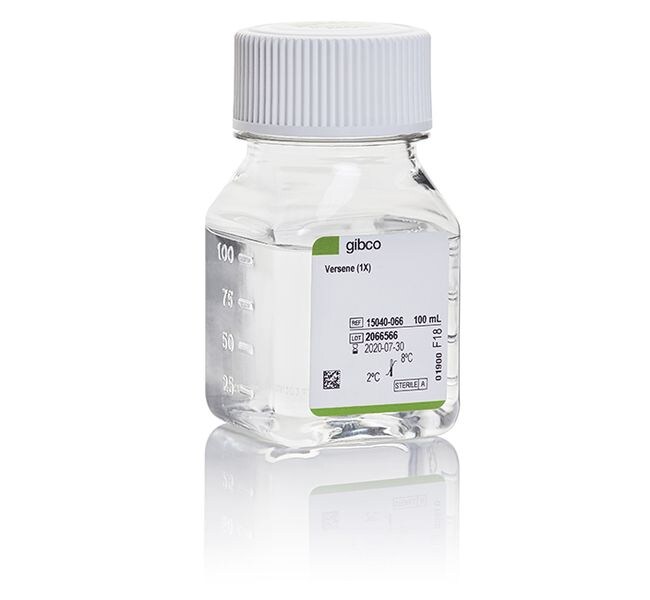
Versene is an EDTA solution for use as a gentle non-enzymatic cell dissociation reagent. Gibco Versene Solution (0.48 mM) isRead more
| Catalog Number | Quantity |
|---|---|
| 15040066 | 100 mL |
Catalog number 15040066
Price (HKD)
140.00
Each
Quantity:
100 mL
Price (HKD)
140.00
Each
Versene is an EDTA solution for use as a gentle non-enzymatic cell dissociation reagent. Gibco Versene Solution (0.48 mM) is formulated as 0.2 g EDTA(Na4) per liter of Phosphate Buffered Saline (PBS).
Product Use
For Research Use Only. Not for use in diagnostic procedures.
cGMP Manufacturing and Quality System
For supply chain continuity, we manufacture Gibco Versene Solution at two separate facilities located in Grand Island, NY and Scotland, UK. Both sites are compliant with cGMP manufacturing requirements and are certified to the ISO 13485 standard.
For Research Use Only. Not for use in diagnostic procedures.
Specifications
ChelatorsEDTA
Manufacturing QualitycGMP for medical devices, 21 CFR Part 820 and ISO 13485
Quantity100 mL
Shelf Life18 Months
Shipping ConditionRoom Temperature
ClassificationAnimal Origin-free
Product TypeCell Culture Dissociation Reagent
SterilitySterile-filtered
With AdditivesEDTA
Unit SizeEach
Contents & Storage
Storage conditions: 2 to 8°C
Shipping conditions: Ambient
Shelf life: 18 months from date of manufacture
Shipping conditions: Ambient
Shelf life: 18 months from date of manufacture
Frequently asked questions (FAQs)
Can PSCs transitioned over into Essential 8 Medium on recombinant human laminin-521 (rhLaminin-521) from feeder-dependent cultures, then be transferred onto vitronectin (VTN-N)?
What are the main differences to be taken into consideration when culturing cells in Gibco Essential 8 Medium on Gibco Vitronectin (VTN-N) compared to other feeder-free systems?
Can pluripotent stem cells (PSCs) previously cultured in other media and on other substrates be cultured in Gibco Essential 8 Medium and on Gibco Vitronectin?
What is the recommended passaging method to use with Gibco Essential 8 Medium and on Gibco Vitronectin (VTN-N)?
I currently use mTeSR1. How difficult would it be to adapt my cells to the StemFlex Medium system?
Citations & References (2)
Citations & References
Abstract
Decreased metallation and activity in subsets of mutant superoxide dismutases associated with familial amyotrophic lateral sclerosis.
Journal:J Biol Chem
PubMed ID:11854284
Over 90 different mutations in the gene encoding copper/zinc superoxide dismutase (SOD1) cause approximately 2% of amyotrophic lateral sclerosis (ALS) cases by an unknown mechanism. We engineered 14 different human ALS-related SOD1 mutants and obtained high yields of biologically metallated proteins from an Sf21 insect cell expression system. Both the
Molecular determinants of receptor binding and signaling by the CX3C chemokine fractalkine.
Journal:J Biol Chem
PubMed ID:11432858
Fractalkine/CX3CL1 is a membrane-tethered chemokine that functions as a chemoattractant and adhesion protein by interacting with the receptor CX3CR1. To understand the molecular basis for the interaction, an extensive mutagenesis study of fractalkine's chemokine domain was undertaken. The results reveal a cluster of basic residues (Lys-8, Lys-15, Lys-37, Arg-45, and