Search


Citations & References (19)
Invitrogen™
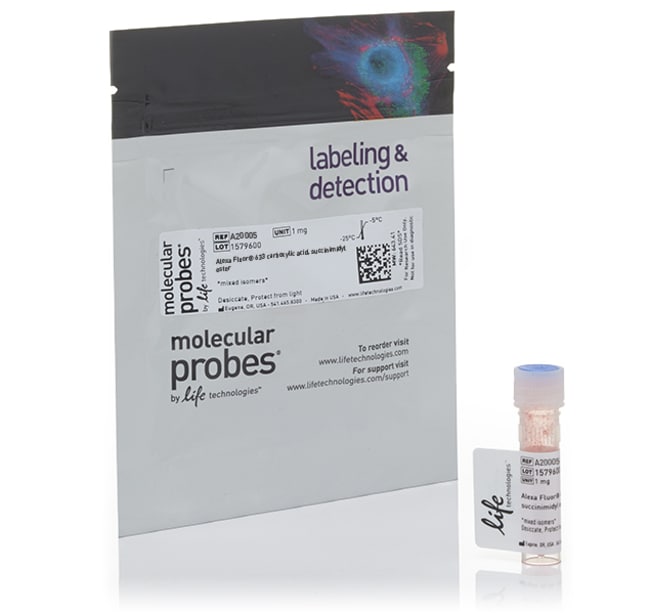
Alexa Fluor™ 633 NHS Ester (Succinimidyl Ester)
Alexa Fluor™ 633 is a bright and photostable far-red dye with excitation ideally suited to the 633 nm laser line.Read more
Have Questions?
Change view

| Catalog Number | Quantity |
|---|---|
| A20005 | 1 mg |
| A20105 | 5 mg |
Catalog number A20005
Price (HKD)
4,032.00
Each
Quantity:
1 mg
Price (HKD)
4,032.00
Each
Alexa Fluor™ 633 is a bright and photostable far-red dye with excitation ideally suited to the 633 nm laser line. Used for stable signal generation in imaging and flow cytometry, Alexa Fluor™ 633 dye is water soluble and pH-insensitive from pH 4 to pH 10. Fluorescence of this long-wavelength Alexa Fluor™ dye is not visible to the human eye but is readily detected by most imaging systems. In addition to reactive dye formulations, we offer Alexa Fluor™ 633 dye conjugated to a variety of antibodies, peptides, proteins, tracers, and amplification substrates optimized for cellular labeling and detection. The NHS ester (or succinimidyl ester) of Alexa Fluor™ 633 is the most popular tool for conjugating this dye to a protein or antibody. NHS esters can be used to label to the primary amines (R-NH2) of proteins, amine-modified oligonucleotides, and other amine-containing molecules. The resulting Alexa Fluor™ conjugate will exhibit brighter fluorescence and greater photostability than the conjugates of other spectrally similar fluorophores.
Detailed information about this AlexaFluor™ NHS ester:
Fluorophore label: Alexa Fluor™ 633 dye
Reactive group: NHS ester
Reactivity: Primary amines on proteins and ligands, amine-modified oligonucleotides
Ex/Em of the conjugate: 621/639 nm
Extinction coefficient: 159,000 cm-1M-1
Spectrally similar dyes: Cy5™
Molecular weight: ∼1200
Typical Conjugation Reaction
You can conjugate amine-reactive reagents with virtually any protein or peptide (the provided protocol is optimized for IgG antibodies). You can scale the reaction for any amount of protein, but the concentration of the protein should be at least 2 mg/mL for optimal results. We recommend trying three different degrees of labeling, using three different molar ratios of the reactive reagent to protein.
The Alexa Fluor™ NHS ester is typically dissolved in high-quality anhydrous dimethylformamide (DMF) or dimethylsulfoxide (DMSO) (D12345), and the reaction is carried out in 0.1–0.2 M sodium bicarbonate buffer, pH 8.3, at room temperature for 1 hour. Because the pKa of the terminal amine is lower than that of the lysine epsilon-amino group, you may achieve more selective labeling of the amine terminus using a buffer closer to neutral pH.
Conjugate Purification
Labeled antibodies are typically separated from free Alexa Fluor™ dye using a gel filtration column, such as Sephadex™ G-25, BioGel™ P-30, or equivalent. For much larger or smaller proteins, select a gel filtration media with an appropriate molecular weight cut-off or purify by dialysis. We offer several purification kits optimized for different quantities of antibody conjugate:
Antibody Conjugate Purification Kit for 0.5-1 mg (A33086)
Antibody Conjugate Purification Kit for 20-50 μg (A33087)
Antibody Conjugate Purification kit for 50-100 μg (A33088)
Learn More About Protein and Antibody Labeling
We offer a wide selection of Molecular Probes™ antibody and protein labeling kits to fit your starting material and your experimental setup. See our Antibody Labeling kits or use our Labeling Chemistry Selection Tool for other choices. To learn more about our labeling kits, read Kits for Labeling Proteins and Nucleic Acids—Section 1.2 in The Molecular Probes™ Handbook.
We’ll Make a Custom Conjugate for You
If you can’t find what you’re looking for in our online catalog, we’ll prepare a custom antibody or protein conjugate for you. Our custom conjugation service is efficient and confidential, and we stand by the quality of our work. We are ISO 13485:2000 certified.
For Research Use Only. Not for use in diagnostic procedures.
Specifications
Chemical ReactivityAmine
Emission639 nm
Excitation621 nm
Label or DyeAlexa Fluor™ 633
Product TypeNHS Ester (Succinimidyl Ester)
Quantity1 mg
Reactive MoietyActive Ester, Succinimidyl Ester
Shipping ConditionRoom Temperature
Label TypeAlexa Fluor
Product LineAlexa Fluor
Unit SizeEach
Contents & Storage
Store in freezer (-5 to -30°C) and protect from light.
Frequently asked questions (FAQs)
I am labeling a protein with Alexa Fluor 488 SDP ester. The manual recommends using a sodium bicarbonate buffer at pH 8.3. Can I use a different buffer instead?
I am not going to use all of my Alexa Fluor succinimidyl ester reactive dye. Can I just make it up in DMSO and store aliquots at -20 degrees C?
Citations & References (19)
Citations & References
Abstract
Fluorescence imaging for monitoring the colocalization of two single molecules in living cells.
Journal:Biophys J
PubMed ID:15596511
The interaction, binding, and colocalization of two or more molecules in living cells are essential aspects of many biological molecular processes, and single-molecule technologies for investigating these processes in live cells, if successfully developed, would become very powerful tools. Here, we developed simultaneous, dual-color, single fluorescent molecule colocalization imaging, to
Quantitative comparison of long-wavelength Alexa Fluor dyes to Cy dyes: fluorescence of the dyes and their bioconjugates.
Journal:J Histochem Cytochem
PubMed ID:14623938
'Amine-reactive N-hydroxysuccinimidyl esters of Alexa Fluor fluorescent dyes with principal absorption maxima at about 555 nm, 633 nm, 647 nm, 660 nm, 680 nm, 700 nm, and 750 nm were conjugated to antibodies and other selected proteins. These conjugates were compared with spectrally similar protein conjugates of the Cy3, Cy5,
Practical guidelines for dual-color fluorescence cross-correlation spectroscopy.
Journal:Nat Protoc
PubMed ID:18007619
'Dual-color fluorescence cross-correlation spectroscopy (FCCS) allows for the determination of molecular mobility and concentrations and for the quantitative analysis of molecular interactions such as binding or cleavage at very low concentrations. This protocol discusses considerations for preparing a biological system for FCCS experiments and offers practical advice for performing FCCS
Virtual and biomolecular screening converge on a selective agonist for GPR30.
Journal:Nat Chem Biol
PubMed ID:16520733
'Estrogen is a hormone critical in the development, normal physiology and pathophysiology of numerous human tissues. The effects of estrogen have traditionally been solely ascribed to estrogen receptor alpha (ERalpha) and more recently ERbeta, members of the soluble, nuclear ligand-activated family of transcription factors. We have recently shown that the
Biologically-active laminin-111 fragment that modulates the epithelial-to-mesenchymal transition in embryonic stem cells.
Journal:
PubMed ID:24706882
'The dynamic interplay between the extracellular matrix and embryonic stem cells (ESCs) constitutes one of the key steps in understanding stem cell differentiation in vitro. Here we report a biologically-active laminin-111 fragment generated by matrix metalloproteinase 2 (MMP2) processing, which is highly up-regulated during differentiation. We show that the ß1-chain-derived