Search


Citations & References (9)
Invitrogen™
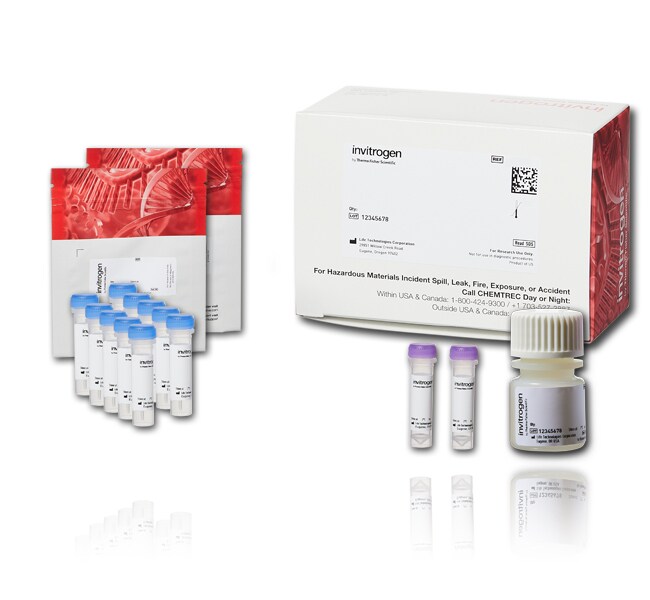
ARES™ Alexa Fluor™ 647 DNA Labeling Kit
The ARES™ Alexa Fluor™ DNA Labeling Kit provides a versatile, two-step method for labeling DNA with our Alexa Fluor™ dyes.Read more
| Catalog Number | Quantity |
|---|---|
| A21676 | 1 kit |
Catalog number A21676
Price (HKD)
5,366.00
Each
Quantity:
1 kit
Price (HKD)
5,366.00
Each
The ARES™ Alexa Fluor™ DNA Labeling Kit provides a versatile, two-step method for labeling DNA with our Alexa Fluor™ dyes. In the first step, an amine-modified nucleotide is incorporated into DNA using conventional enzymatic labeling methods. In the second step, the amine-modified DNA is chemically labeled using our proprietary amine-reactive Alexa Fluor™ 647 dye. The labeled probes can be used for fluorescence in situ hybridization (FISH) and microarray techniques. We offer ARES™ Alexa Fluor™ DNA Labeling Kits in five fluorescent colors, and each kit provides sufficient reagents for 5 to 10 labeling reactions of 1 to 5 μg DNA each.
ARES™ Alexa Fluor™ Labeling Kit Specifications:
• Dye (Ex/Em): Alexa Fluor™ 647 (650/670 nm)
• Achieves more uniform, consistent labeling than techniques for enzymatic incorporation of labeled nucleotides
• Typically produces one dye per 12–20 bases
• Optimal for FISH and microarrays
More Uniform Labeling With ARES™ Labeling Kits
ARES™ Alexa Fluor™ Labeling Kits employ a two-step labeling technology—nick translation to enzymatically incorporate an amine-modified nucleotide (aminoallyl dUTP) followed by chemical labeling with Alexa Fluor™ dyes. This method achieves uniformity and consistency of labeling that is difficult to obtain with conventional enzymatic incorporation of labeled nucleotides.
We also offer this two-step labeling technology in our FISH Tag™ DNA and FISH Tag™ RNA Kits, which provide a complete workflow solution for FISH applications, including all of the reagents for probe synthesis, labeling, purification and an anti-fade reagent to help protect the signal during fluorescence microscopy.
More Options for Nucleic Acid Labeling
To review various options for nucleic acid labeling (including DNA and RNA FISH), review Labeling Oligonucleotides and Nucleic Acids—Section 8.2 in the Molecular Probes™ Handbook.
For Research Use Only. Not intended for human or animal therapeutic or diagnostic use.
ARES™ Alexa Fluor™ Labeling Kit Specifications:
• Dye (Ex/Em): Alexa Fluor™ 647 (650/670 nm)
• Achieves more uniform, consistent labeling than techniques for enzymatic incorporation of labeled nucleotides
• Typically produces one dye per 12–20 bases
• Optimal for FISH and microarrays
More Uniform Labeling With ARES™ Labeling Kits
ARES™ Alexa Fluor™ Labeling Kits employ a two-step labeling technology—nick translation to enzymatically incorporate an amine-modified nucleotide (aminoallyl dUTP) followed by chemical labeling with Alexa Fluor™ dyes. This method achieves uniformity and consistency of labeling that is difficult to obtain with conventional enzymatic incorporation of labeled nucleotides.
We also offer this two-step labeling technology in our FISH Tag™ DNA and FISH Tag™ RNA Kits, which provide a complete workflow solution for FISH applications, including all of the reagents for probe synthesis, labeling, purification and an anti-fade reagent to help protect the signal during fluorescence microscopy.
More Options for Nucleic Acid Labeling
To review various options for nucleic acid labeling (including DNA and RNA FISH), review Labeling Oligonucleotides and Nucleic Acids—Section 8.2 in the Molecular Probes™ Handbook.
For Research Use Only. Not intended for human or animal therapeutic or diagnostic use.
For Research Use Only. Not for use in diagnostic procedures.
Specifications
Includes Label or DyeYes
Labeling MethodIndirect Labeling
Product LineARES, Alexa Fluor
Product TypeDNA Labeling Kit
Quantity1 kit
Shipping ConditionRoom Temperature
Detection MethodFluorescence
Final Product TypeProbes (Labeled DNA), cDNA (Labeled)
FormatKit
Labeling TargetDNA (General), cDNA
Label or DyeAlexa Fluor 647
Unit SizeEach
Contents & Storage
Store in freezer (-5 to -30°C) and protect from light.
Frequently asked questions (FAQs)
My purified RNA comes from multiple sources, but I am getting variable efficiency of labeling with the same ARES kit. What can cause this?
Could you make an ARES Alexa Fluor 633 DNA Labeling Kit? This would be a good fit with my 633 nm laser.
How stable is the ARES-labeled DNA to high temperature?
Can probes labeled using the ARES Alexa Fluor DNA Labeling Kits be stored for later use?
How do the Alexa Fluor dyes used in the ARES Alexa Fluor DNA Labeling Kits compare to Cy dyes for fluorescence intensity at different labeling ratios?
Citations & References (9)
Citations & References
Abstract
Induction of Id1 and Id3 by latent membrane protein 1 of Epstein-Barr virus and regulation of p27/Kip and cyclin-dependent kinase 2 in rodent fibroblast transformation.
Journal:J Virol
PubMed ID:15564458
Latent membrane protein 1 (LMP1), the Epstein-Barr virus oncoprotein, activates NF-kappaB, phosphatidylinositol 3-kinase, mitogen-activated protein kinase, and c-Jun N-terminal kinase signaling. To determine global transcriptional changes induced by LMP1 in epithelial cells, genomic analysis of C33A cells stably expressing LMP1 was performed. Relatively few genes were induced by LMP1. Expression
Effects of rottlerin on silica-exacerbated systemic autoimmune disease in New Zealand mixed mice.
Journal:Am J Physiol Lung Cell Mol Physiol
PubMed ID:16040631
'Environmental crystalline silica exposure has been associated with formation of autoantibodies and development of systemic autoimmune disease, but the mechanisms leading to these events are unknown. Silica exposure in autoimmune-prone New Zealand mixed (NZM) mice results in a significant exacerbation of systemic autoimmunity as measured by increases in autoantibodies and
Development of microarray and multiplex polymerase chain reaction assays for identification of serovars and virulence genes in Salmonella enterica of human or animal origin.
Journal:J Vet Diagn Invest
PubMed ID:20622226
'Salmonella enterica is an important enteric pathogen consisting of many serovars that can cause severe clinical diseases in animals and humans. Rapid identification of Salmonella isolates is especially important for epidemiologic monitoring and controlling outbreaks of disease. Although immunologic and DNA-based serovar identification methods are available for rapid identification of
Specific discrimination of three pathogenic Salmonella enterica subsp. enterica serotypes by carB-based oligonucleotide microarray.
Journal:
PubMed ID:24185846
'It is important to rapidly and selectively detect and analyze pathogenic Salmonella enterica subsp. enterica in contaminated food to reduce the morbidity and mortality of Salmonella infection and to guarantee food safety. In the present work, we developed an oligonucleotide microarray containing duplicate specific capture probes based on the carB
Multiplex detection of RNA expression in Drosophila embryos.
Journal:Science
PubMed ID:15297669
We present a fluorescence-based, multiplex in situ hybridization method that permits the simultaneous detection of five differently labeled antisense RNA probes and up to seven differ-ent transcripts in a single Drosophila embryo. We also show that it should be possible to increase the number of detected transcripts substantially with nascent