Search

Applied Biosystems™
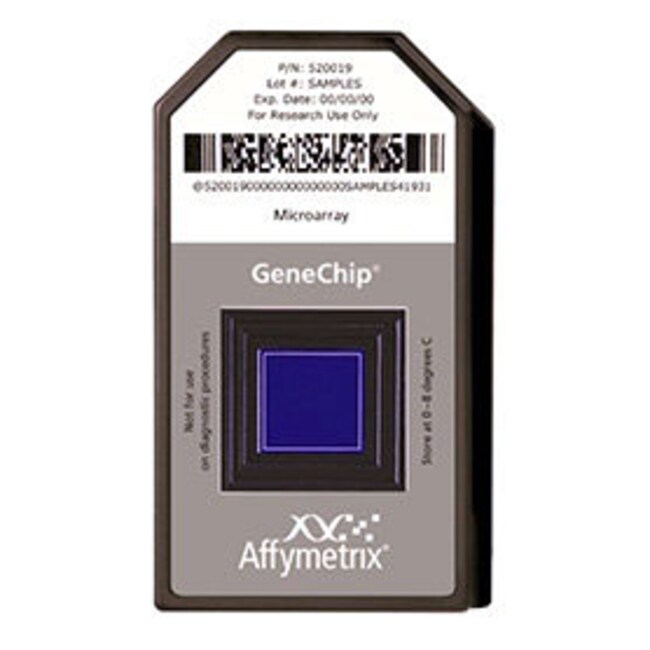
GeneChip™ Human Genome U133A 2.0 Array
The GeneChip™ Human Genome U133A 2.0 Array is a single array representing 14,500 well-characterized human genes that can be usedRead more
Have Questions?
Change view

| Catalog Number | Number of Arrays |
|---|---|
| 900468 | 6 arrays |
| 900471 | 2 arrays |
| 900469 | 30 arrays |
Catalog number 900468
Price (INR)
-
Number of Arrays:
6 arrays
The GeneChip™ Human Genome U133A 2.0 Array is a single array representing 14,500 well-characterized human genes that can be used to explore human biology and disease processes.
The GeneChip™ Human Genome U133A 2.0 Array is a single array representing 14,500 well-characterized human genes that can be used to explore human biology and disease processes. New design and reduced feature size mean that you can use smaller sample volumes than the previous HG™U133A Array without compromising performance.
•Provides coverage of well-substantiated genes in the transcribed human genome on a single array
•Analyzes the expression level of 18,400 transcripts and variants, including 14,500 well-characterized human genes
•Comprised of more than 22,000 probe sets and 500,000 distinct oligonucleotide features
•Use the Power of the Probe Set and get multiple independent measurements for each transcript that deliver the greatest accuracy and reproducibility of any microarray platform
•All probe sets represented on the GeneChip™ Human Genome U133A Array are identically replicated on the GeneChip Human Genome U133A 2.0 Array
Array Profile
Sequences used in the design of the array were selected from GenBank™, dbEST, and RefSeq. The sequence clusters were created from the UniGene database (Build 133, April 20, 2001) and then were refined by analysis and comparison with a number of other publicly available databases including the Washington University EST trace repository and the University of California, Santa Cruz Golden-Path human genome database (April 2001 release).
Instrument and Software Requirements
•GeneChip™ Scanner 3000, enabled for High-Resolution Scanning*
•GeneChip™ Command Console™ Software (AGCC) including the GeneChip™ Scanner 3000 High-Resolution Scanning Patch
*GeneChip Scanner 3000 High-Resolution Update is standard on all instruments shipped starting in September 2003 with serial number series 502. Previous versions, serial number series 501, will require the 00-0110 GeneChip Scanner 3000 High-Resolution Update to be installed.
The GeneChip™ Human Genome U133A 2.0 Array is a single array representing 14,500 well-characterized human genes that can be used to explore human biology and disease processes. New design and reduced feature size mean that you can use smaller sample volumes than the previous HG™U133A Array without compromising performance.
•Provides coverage of well-substantiated genes in the transcribed human genome on a single array
•Analyzes the expression level of 18,400 transcripts and variants, including 14,500 well-characterized human genes
•Comprised of more than 22,000 probe sets and 500,000 distinct oligonucleotide features
•Use the Power of the Probe Set and get multiple independent measurements for each transcript that deliver the greatest accuracy and reproducibility of any microarray platform
•All probe sets represented on the GeneChip™ Human Genome U133A Array are identically replicated on the GeneChip Human Genome U133A 2.0 Array
Array Profile
Sequences used in the design of the array were selected from GenBank™, dbEST, and RefSeq. The sequence clusters were created from the UniGene database (Build 133, April 20, 2001) and then were refined by analysis and comparison with a number of other publicly available databases including the Washington University EST trace repository and the University of California, Santa Cruz Golden-Path human genome database (April 2001 release).
Instrument and Software Requirements
•GeneChip™ Scanner 3000, enabled for High-Resolution Scanning*
•GeneChip™ Command Console™ Software (AGCC) including the GeneChip™ Scanner 3000 High-Resolution Scanning Patch
*GeneChip Scanner 3000 High-Resolution Update is standard on all instruments shipped starting in September 2003 with serial number series 502. Previous versions, serial number series 501, will require the 00-0110 GeneChip Scanner 3000 High-Resolution Update to be installed.
For Research Use Only. Not for use in diagnostic procedures.
Specifications
Product LineGeneChip
Quantity6 arrays
TypeHuman Genome U133A 2.0 Array
ArrayTranscriptome Profiling
FormatArray Cartridge
Number of Arrays6 arrays
SpeciesHuman
Unit Size6 arrays