Search


Citations & References (28)
Invitrogen™
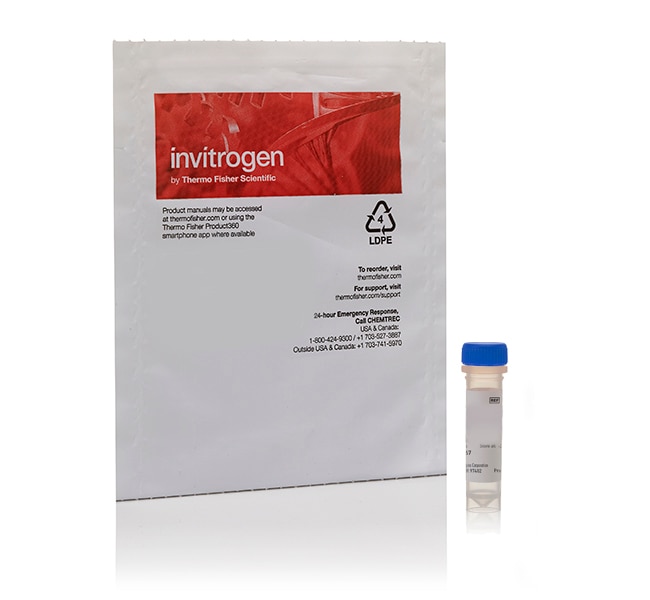
TetraSpeck™ Microspheres, 0.2 μm, fluorescent blue/green/orange/dark red
The 0.2 μm TetraSpeck™ microspheres are stained throughout with four different fluorescent dyes, yielding beads that each display four well-separatedRead more
| Catalog Number | Quantity |
|---|---|
| T7280 | 0.5 mL |
Catalog number T7280
Price (INR)
-
Quantity:
0.5 mL
The 0.2 μm TetraSpeck™ microspheres are stained throughout with four different fluorescent dyes, yielding beads that each display four well-separated excitation/emission peaks - 360/430 nm (blue), 505/515 nm (green), 560/580 nm (orange) and 660/680 nm (dark red). These microspheres can greatly facilitate the calibration of conventional fluorescence microscopes, confocal laser scanning microscopes, and associated image-processing equipment for both scientific and commercial imaging, especially for multicolor applications.
See our full collection of microscope calibration reagents ›
See our full collection of microscope calibration reagents ›
For Research Use Only. Not for use in diagnostic procedures.
Specifications
Calibration TypeConfocal Microscope Calibration, Fluorescence Microscope Calibration
FormatSuspension Beads
Product LineTetraSpeck
Quantity0.5 mL
Shipping ConditionRoom Temperature
ColorOrange, Dark Red, Blue, Green
Diameter (Metric)0.2 μm
Product TypeMicrosphere
Unit Size0.5 mL
Contents & Storage
Store in refrigerator 2°C to 8°C and protect from light.
Frequently asked questions (FAQs)
What are the excitation/emission peaks for TetraSpeck Microspheres?
The TetraSpeck Microspheres (Cat. Nos. T7279, T7280, T7281, T7283, T7284, T14792) are stained throughout with four different fluorescent dyes, yielding beads that each display four well-separated excitation/emission peaks at 360/430 nm (blue), 505/515 nm (green), 560/580 nm (orange) and 660/680 nm (dark red).
TetraSpeck Blue Dye Spectra
Fluorescence excitation and emission spectra of bead encapsulated TetraSpeck blue dye.

TetraSpeck Orange Dye Spectra

TetraSpeck Green Dye Spectra

TetraSpeck Dark Red Dye Spectra

Find additional tips, troubleshooting help, and resources within our Cell Analysis Support Center.
Citations & References (28)
Citations & References
Abstract
Nuclear transport of single molecules: dwell times at the nuclear pore complex.
Journal:J Cell Biol
PubMed ID:15657394
'The mechanism by which macromolecules are selectively translocated through the nuclear pore complex (NPC) is still essentially unresolved. Single molecule methods can provide unique information on topographic properties and kinetic processes of asynchronous supramolecular assemblies with excellent spatial and time resolution. Here, single-molecule far-field fluorescence microscopy was applied to the
The cohesion protein ORD is required for homologue bias during meiotic recombination.
Journal:J Cell Biol
PubMed ID:15007062
'During meiosis, sister chromatid cohesion is required for normal levels of homologous recombination, although how cohesion regulates exchange is not understood. Null mutations in orientation disruptor (ord) ablate arm and centromeric cohesion during Drosophila meiosis and severely reduce homologous crossovers in mutant oocytes. We show that ORD protein localizes along
Exocytosis of IgG as mediated by the receptor, FcRn: an analysis at the single-molecule level.
Journal:Proc Natl Acad Sci U S A
PubMed ID:15258288
'IgG transport within and across cells is essential for effective humoral immunity. Through a combination of biochemical and in vivo analyses, the MHC class I-related neonatal Fc receptor (FcRn) is known to play a central role in delivering IgGs within and across cells. However, little is known about the molecular
Homotypic fusion of early endosomes: SNAREs do not determine fusion specificity.
Journal:Proc Natl Acad Sci U S A
PubMed ID:16469845
'Membrane fusion in the secretory pathway is mediated by soluble N-ethylmaleimide-sensitive factor attachment receptor (SNARE) proteins. Different fusion steps are thought to be effected by independent sets of SNAREs, but it is unclear whether specificity is determined by an intrinsic specificity of SNARE pairing or by upstream factors. Using a
Katanin is responsible for the M-phase microtubule-severing activity in Xenopus eggs.
Journal:Mol Biol Cell
PubMed ID:9658175
'Microtubules are dynamic structures whose proper rearrangement during the cell cycle is essential for the positioning of membranes during interphase and for chromosome segregation during mitosis. The previous discovery of a cyclin B/cdc2-activated microtubule-severing activity in M-phase Xenopus egg extracts suggested that a microtubule-severing protein might play an important role