Search

Applied Biosystems™
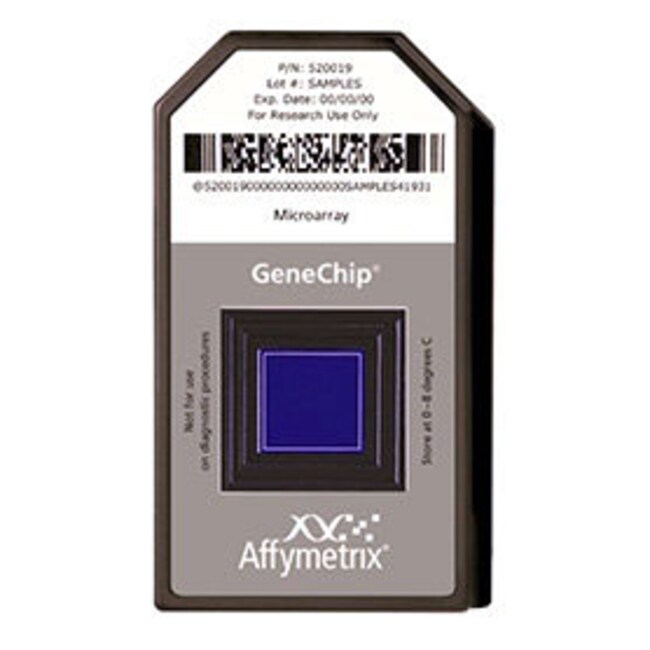
GeneChip™ Mouse Exon 1.0 ST Array
GeneChip ™ Mouse Exon 1.0 ST Array offers new insight and powerful key information for researchers. With approximately four probesRead more
Have Questions?
Change view

| Catalog Number | Number of Arrays |
|---|---|
| 900819 | 30 arrays |
| 900817 | 2 arrays |
| 900818TS also known as 900818 | 6 arrays |
Catalog number 900819
Price (KRW)
-
Number of Arrays:
30 arrays
GeneChip ™ Mouse Exon 1.0 ST Array offers new insight and powerful key information for researchers.
With approximately four probes per exon and roughly 40 probes per gene, the GeneChip™ Mouse Exon 1.0 ST Array enables two complementary levels of analysis-gene expression and alternative splicing.
Multiple probes per exon enable “exon-level” analysis and allow you to distinguish between different isoforms of a gene. This exon-level analysis on a whole-genome scale opens the door to detecting specific alterations in exon usage that may play a central role in disease mechanism and etiology.
The second level is “gene-level” expression analysis, in which multiple probes on different exons are summarized into an expression value of all transcripts from the same gene.
Exon arrays provide the most comprehensive coverage of the genome, including empirically supported and predicted transcribed sequences, enabling the discovery of previously unidentified novel events.
Array Features
•Highest resolution expression analysis, interrogating over 1 million exon clusters within the known and predicted transcribed regions of the entire genome.
•Tailored GeneChip™ Whole Transcript (WT) Assay and Reagents utilizing a random priming method for generating sense targets along the entire length of the transcripts.
•Flexible data analysis solutions and comprehensive annotation, giving you the opportunity to explore and dissect the data in various user-defined workflows.
Probe Sets: 1.2 million
Exon Clusters: ∼1 million
Supported by Putative Full-Length mRNA: 266,220 probe sets
Supported by Ensembl Transcripts: 266,791 probe sets
Supported by EST: 554,003 probe sets
Supported by Human or Rat mRNA: 214,763 probe sets
Supported by Gene Prediction: 835,897 probe sets
Probe Selection Region: Along the entire length of the transcripts
Probes/Probe Selection Region: 41
Background Subtraction Strategy: Median intensity of up to 1,000 background probes with the same GC content
Total Features Per Array: >4,500,000
Interrogated Strand: Sense2
1About 10 percent of the exon probe sets have fewer than four probes due to the probe selection region length and sequence constraints. 2 The probes tiled on the array are designed in the anti-sense orientation, requiring sense-strand labeled targets to be hybridized to the array. By convention, the array is called ST array representing the necessity of using sense targets (the labeled samples to be hybridized to the array).
Starter Pack
To ensure optimal results with the GeneChip™ Exon Array system, it is highly recommended that new users begin with the Starter Pack.
Each Starter Pack contains:
•GeneChip™ Mouse Exon 1.0 ST Array, 30 arrays
•GeneChip™ WT Sense Target Labeling and Control Reagents, 30 reactions
•On-site training including the following arrays and reagents for the training:
•GeneChip™ Mouse Exon 1.0 ST Array, 10 arrays
•GeneChip™ WT cDNA Synthesis and Amplification Kit, 10 reactions
•GeneChip™ WT Terminal Labeling Kit, 10 reactions
•GeneChip™ Sample Cleanup Module, 30 reactions
•GeneChip™ Eukaryotic Poly-A RNA Control Kit, 100 reactions
•GeneChip™ Hybridization Control Kit, 30 reactions
New XRAY demos for exon expression analysis
•View a two-minute demo on a typical workflow using Biotique’s XRAY for the analysis of GeneChip™ Exon Arrays
Windows Media Player | Quicktime
•View a two-minute demo on the interpretation of GeneChip™ Exon Array data from Biotique’s XRAY
Windows Media Player | Quicktime
With approximately four probes per exon and roughly 40 probes per gene, the GeneChip™ Mouse Exon 1.0 ST Array enables two complementary levels of analysis-gene expression and alternative splicing.
Multiple probes per exon enable “exon-level” analysis and allow you to distinguish between different isoforms of a gene. This exon-level analysis on a whole-genome scale opens the door to detecting specific alterations in exon usage that may play a central role in disease mechanism and etiology.
The second level is “gene-level” expression analysis, in which multiple probes on different exons are summarized into an expression value of all transcripts from the same gene.
Exon arrays provide the most comprehensive coverage of the genome, including empirically supported and predicted transcribed sequences, enabling the discovery of previously unidentified novel events.
Array Features
•Highest resolution expression analysis, interrogating over 1 million exon clusters within the known and predicted transcribed regions of the entire genome.
•Tailored GeneChip™ Whole Transcript (WT) Assay and Reagents utilizing a random priming method for generating sense targets along the entire length of the transcripts.
•Flexible data analysis solutions and comprehensive annotation, giving you the opportunity to explore and dissect the data in various user-defined workflows.
Probe Sets: 1.2 million
Exon Clusters: ∼1 million
Supported by Putative Full-Length mRNA: 266,220 probe sets
Supported by Ensembl Transcripts: 266,791 probe sets
Supported by EST: 554,003 probe sets
Supported by Human or Rat mRNA: 214,763 probe sets
Supported by Gene Prediction: 835,897 probe sets
Probe Selection Region: Along the entire length of the transcripts
Probes/Probe Selection Region: 41
Background Subtraction Strategy: Median intensity of up to 1,000 background probes with the same GC content
Total Features Per Array: >4,500,000
Interrogated Strand: Sense2
1About 10 percent of the exon probe sets have fewer than four probes due to the probe selection region length and sequence constraints. 2 The probes tiled on the array are designed in the anti-sense orientation, requiring sense-strand labeled targets to be hybridized to the array. By convention, the array is called ST array representing the necessity of using sense targets (the labeled samples to be hybridized to the array).
Starter Pack
To ensure optimal results with the GeneChip™ Exon Array system, it is highly recommended that new users begin with the Starter Pack.
Each Starter Pack contains:
•GeneChip™ Mouse Exon 1.0 ST Array, 30 arrays
•GeneChip™ WT Sense Target Labeling and Control Reagents, 30 reactions
•On-site training including the following arrays and reagents for the training:
•GeneChip™ Mouse Exon 1.0 ST Array, 10 arrays
•GeneChip™ WT cDNA Synthesis and Amplification Kit, 10 reactions
•GeneChip™ WT Terminal Labeling Kit, 10 reactions
•GeneChip™ Sample Cleanup Module, 30 reactions
•GeneChip™ Eukaryotic Poly-A RNA Control Kit, 100 reactions
•GeneChip™ Hybridization Control Kit, 30 reactions
New XRAY demos for exon expression analysis
•View a two-minute demo on a typical workflow using Biotique’s XRAY for the analysis of GeneChip™ Exon Arrays
Windows Media Player | Quicktime
•View a two-minute demo on the interpretation of GeneChip™ Exon Array data from Biotique’s XRAY
Windows Media Player | Quicktime
For Research Use Only. Not for use in diagnostic procedures.
Specifications
Quantity30 arrays
TypeMouse Exon 1.0 ST Array
ArrayTranscriptome Profiling
FormatArray Cartridge
Number of Arrays30 arrays
SpeciesMouse
Unit SizeEach