Search


Citations & References (24)
Invitrogen™
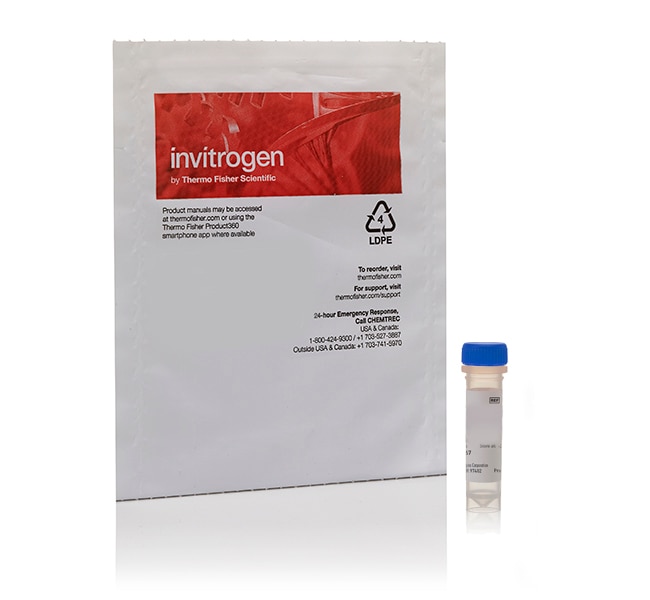
CellLight™ Golgi-GFP, BacMam 2.0
CellLight Golgi-GFP, BacMam 2.0, provides an easy way to label golgi with green fluorescent protein (GFP) in live cells. SimplyRead more
| Catalog Number | Quantity |
|---|---|
| C10592 | 1 mL |
Catalog number C10592
Price (KRW)
829,000
Online offer
Ends: 31-Dec-2026
947,000Save 118,000 (12%)
Each
Quantity:
1 mL
Price (KRW)
829,000
Online offer
Ends: 31-Dec-2026
947,000Save 118,000 (12%)
Each
CellLight Golgi-GFP, BacMam 2.0, provides an easy way to label golgi with green fluorescent protein (GFP) in live cells. Simply add the reagent to your cells, incubate overnight, and the cells are ready to image in the morning.
Want to label other cell structures? Learn more about CellLight fluorescent protein labeling tools
This ready-to-use construct is transfected into cells using BacMam 2.0 technology, where it expresses GFP fused to human golgi resident enzyme (N-acetylgalactosaminyltransferase). You can observe golgi-GFP behavior in live cells using fluorescent imaging and multiplex with other fluorescent proteins or organic dyes.
Cells expressing CellLight constructs can also be fixed with formaldehyde for multiplexed imaging using immunocytochemical techniques.
CellLight Technology is:
• Fast and convenient: simply add CellLight reagent to your cells, incubate overnight, and image—or store frozen, assay-ready cells for later use
• Highly efficient: up to 90% transduction of a wide range of mammalian cell lines, including primary cells, stem cells, and neurons
• Flexible: co-transduce more than one BacMam reagent for multiplex experiments or co-localization studies; tightly control expression levels by simply varying the dose
• Less toxic: CellLight reagents are non-replicating in mammalian cells and are suitable for biosafety level (BSL) 1 handling
BacMam Technology
CellLight Golgi-GFP, BacMam 2.0, is a fusion construct of human golgi resident enzyme (N-acetylgalactosaminyltransferase) and emGFP, providing accurate and specific targeting to cellular golgi-GFP. This fusion construct is packaged in the insect virus baculovirus, which does not replicate in human cells and is designated as safe to use with biosafety level (BSL) 1 in most laboratories. BacMam technology ensures that most mammalian cell types are transduced/transfected with high efficiency and minimal toxicity. This transient transfection can be detected after overnight incubation for up to five days—enough time to carry out most dynamic cellular analyses. Like any transfection/transduction technique, the BacMam method does not transfect/transduce all of the cells with equal efficiency, making it poorly suited to cellular population studies or automated imaging/counting. CellLight reagents are ideal for experiments where cellular or subcellular co-locatization is required, or for cellular function studies that need special resolution.
Visualize staining your cell without wasting your reagents, antibodies, or time with our new Stain-iT Cell Staining Simulator.
Want to label other cell structures? Learn more about CellLight fluorescent protein labeling tools
This ready-to-use construct is transfected into cells using BacMam 2.0 technology, where it expresses GFP fused to human golgi resident enzyme (N-acetylgalactosaminyltransferase). You can observe golgi-GFP behavior in live cells using fluorescent imaging and multiplex with other fluorescent proteins or organic dyes.
Cells expressing CellLight constructs can also be fixed with formaldehyde for multiplexed imaging using immunocytochemical techniques.
CellLight Technology is:
• Fast and convenient: simply add CellLight reagent to your cells, incubate overnight, and image—or store frozen, assay-ready cells for later use
• Highly efficient: up to 90% transduction of a wide range of mammalian cell lines, including primary cells, stem cells, and neurons
• Flexible: co-transduce more than one BacMam reagent for multiplex experiments or co-localization studies; tightly control expression levels by simply varying the dose
• Less toxic: CellLight reagents are non-replicating in mammalian cells and are suitable for biosafety level (BSL) 1 handling
BacMam Technology
CellLight Golgi-GFP, BacMam 2.0, is a fusion construct of human golgi resident enzyme (N-acetylgalactosaminyltransferase) and emGFP, providing accurate and specific targeting to cellular golgi-GFP. This fusion construct is packaged in the insect virus baculovirus, which does not replicate in human cells and is designated as safe to use with biosafety level (BSL) 1 in most laboratories. BacMam technology ensures that most mammalian cell types are transduced/transfected with high efficiency and minimal toxicity. This transient transfection can be detected after overnight incubation for up to five days—enough time to carry out most dynamic cellular analyses. Like any transfection/transduction technique, the BacMam method does not transfect/transduce all of the cells with equal efficiency, making it poorly suited to cellular population studies or automated imaging/counting. CellLight reagents are ideal for experiments where cellular or subcellular co-locatization is required, or for cellular function studies that need special resolution.
Visualize staining your cell without wasting your reagents, antibodies, or time with our new Stain-iT Cell Staining Simulator.
For Research Use Only. Not for use in diagnostic procedures.
Specifications
ColorGreen
Detection MethodFluorescence
Dye TypeGFP (EmGFP)
EmissionVisible
Excitation Wavelength Range488⁄510
For Use With (Equipment)Confocal Microscope, Fluorescence Microscope
FormLiquid
Product LineCellLight
Quantity1 mL
Shipping ConditionWet Ice
TechniqueFluorescence Intensity
Label TypeFluorescent Dye
Product TypeGolgi Label
Sub Cellular LocalizationGolgi
Unit SizeEach
Contents & Storage
Store at 2°C to 6°C, protected from light. Do Not Freeze.
Frequently asked questions (FAQs)
How can I increase the transduction efficiency with the BacMam 2.0 reagents such as the the CellLight and Premo products?
Is there any way to preserve the CellLights labeling beyond 5 days?
Are the CellLights products toxic to cells?
For how long will the CellLights products label my cells?
What cell types can the CellLights products be used with?
Citations & References (24)
Citations & References
Abstract
Substrate stiffness regulates cadherin-dependent collective migration through myosin-II contractility.
Journal:J Cell Biol
PubMed ID:23091067
'The mechanical microenvironment is known to influence single-cell migration; however, the extent to which mechanical cues affect collective migration of adherent cells is not well understood. We measured the effects of varying substrate compliance on individual cell migratory properties in an epithelial wound-healing assay. Increasing substrate stiffness increased collective cell
Dynamic colocalization microscopy to characterize intracellular trafficking of nanomedicines.
Journal:ACS Nano
PubMed ID:21923168
'To gain a better understanding of intracellular processing of nanomedicines, we employed quantitative live-cell fluorescence colocalization microscopy to study endosomal trafficking of polyplexes in retinal pigment epithelium cells. A new, dynamic colocalization algorithm was developed, based on particle tracking and trajectory correlation, allowing for spatiotemporal characterization of internalized polyplexes in
Intracellular trafficking mechanism, from intracellular uptake to extracellular efflux, for phospholipid/cholesterol liposomes.
Journal:Biomaterials
PubMed ID:22858002
'Liposomes are widely used as drug delivery vehicles to transfer chemotherapeutic agents, proteins, and nucleic acids into target cells. To improve therapeutic effects and reduce unexpected toxic side-effects, it is necessary to understand the mechanism of liposomal uptake into cells, and the intracellular fate of internalized liposomes. The intracellular fate
Glycophthalocyanines as photosensitizers for triggering mitotic catastrophe and apoptosis in cancer cells.
Journal:Chem Res Toxicol
PubMed ID:22394248
'Photodynamic therapy (PDT) is a treatment modality for different forms of cancer based on the combination of light, molecular oxygen, and a photosensitizer (PS) compound. When activated by light, the PS generates reactive oxygen species leading to tumor destruction. Phthalocyanines are compounds that have already shown to be efficient PSs
A Review of Reagents for Fluorescence Microscopy of Cellular Compartments and Structures, Part III: Reagents for Actin, Tubulin, Cellular Membranes, and Whole Cell and Cytoplasm.
Journal:
PubMed ID:24510770
'Non-antibody commercial fluorescent reagents for imaging of cytoskeletal structures have been limited primarily to tubulin and actin, with the main factor in choice based mainly on whether cells are live or fixed and permeabilized. A wider range of options exist for cell membrane dyes, and the choice of reagent primarily