Search


Citations & References (4)
Invitrogen™
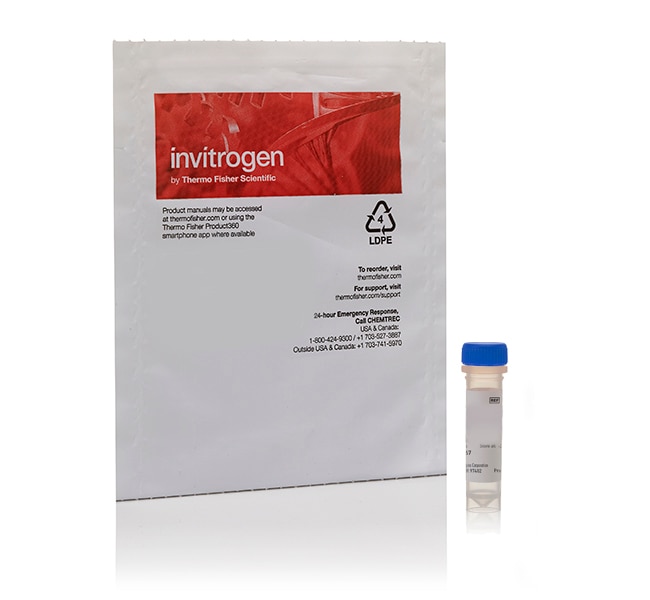
CellLight™ Null (control), BacMam 2.0
CellLight™ Null Control is intended as a negative transduction control for our CellLight™ fluorescent protein live cell staining reagents. TheRead more
| Catalog Number | Quantity |
|---|---|
| C10615 | 1 mL |
Catalog number C10615
Price (KRW)
912,000
Each
Quantity:
1 mL
Price (KRW)
912,000
Each
CellLight™ Null Control is intended as a negative transduction control for our CellLight™ fluorescent protein live cell staining reagents. The CellLight™ Null Control contains no mammalian promoter and no transgene. CellLight™ reagents combine the utility and selectivity of fluorescent proteins with the transduction efficiency of BacMam technology, enabling unambiguous staining of organelles, cellular structures, and processes in live mammalian cells. They are provided in a ready-to-use format—simply add, incubate, and image—with highly efficient expression in cell lines, primary cells, stem cells, and neurons.
CellLight™ Null Control is:
• Highly Efficient: >90% transduction of a wide range of mammalian cell lines, including primary cells, stem cells, and neurons
• Fast and Convenient: Simply add CellLight™ Null Control reagent to your cells, incubate overnight, and evaluate how well your cells tolerate BacMam transduction
• Safe: CellLight™ reagents are non-replicating in mammalian cells, lack of observable cytopathic effect, and are suitable for biosafety level (BSL) 1 handling
CellLight™ Reagents Principle
Other CellLight™ reagents are fusion constructs of signal peptides or cell structure proteins with premiere emGFP, TagRFP or CFP for accurate and specific targeting to sub-cellular compartments and structures. A variety of targets, including cytoskeleton, mitochondria, and secretory compartments, are available for convenient multiplexing, co-localization studies, and imaging of dynamic cellular processes where high spatial and temporal resolution is required. The CellLight™ reagents tolerate fixation with formaldehyde and are therefore compatible with fixed-cell analysis.
BacMam Technology
The BacMam technology is based on an insect virus (baculovirus) for efficient transduction and transient expression in mammalian cells. The baculovirus has been modified to include an expression cassette containing the CellLight™ fusion construct.
BacMam 2.0 incorporates elements that help greatly enhance transduction efficiency and expression levels: a pseudotyped capsid protein for more efficient cell entry, an enhanced CMV promoter, and the Woodchuck hepatitis post-transcriptional regulatory element (WPRE).
Baculoviruses do not replicate in mammalian cells and thus have an excellent safety profile and lack cytopathic effects on cells.
Work Flow Convenience
Unlike expression vectors, BacMam reagents enable titratable and reproducible transient protein expression. There is no need for harsh transfection methods or tedious cloning. To achieve highly efficient expression even in sensitive cells, such as stem cells, neurons, and primary cells, just add CellLight™ reagents to cells in complete medium, incubate, and image the next day. Alternatively, mix CellLight™ reagent and cells at the time of plating.
Co-transduction efficiencies are high allowing multiple CellLight™ reagents to be readily used in the same experiment when multiple structures or pathways need to be labeled. CellLight™ reagents also tolerate fixation with formaldehyde and are thus compatible with antibody-based fixed-cell analysis.
Typically, transiently transduced cells express fusion protein for about five days, though in slowly dividing cells, such as some primary cell types, expression has been demonstrated for up to two weeks; in terminally differentiated neurons we have recorded images more than three weeks after transduction.
CellLight™ Null Control is:
• Highly Efficient: >90% transduction of a wide range of mammalian cell lines, including primary cells, stem cells, and neurons
• Fast and Convenient: Simply add CellLight™ Null Control reagent to your cells, incubate overnight, and evaluate how well your cells tolerate BacMam transduction
• Safe: CellLight™ reagents are non-replicating in mammalian cells, lack of observable cytopathic effect, and are suitable for biosafety level (BSL) 1 handling
CellLight™ Reagents Principle
Other CellLight™ reagents are fusion constructs of signal peptides or cell structure proteins with premiere emGFP, TagRFP or CFP for accurate and specific targeting to sub-cellular compartments and structures. A variety of targets, including cytoskeleton, mitochondria, and secretory compartments, are available for convenient multiplexing, co-localization studies, and imaging of dynamic cellular processes where high spatial and temporal resolution is required. The CellLight™ reagents tolerate fixation with formaldehyde and are therefore compatible with fixed-cell analysis.
BacMam Technology
The BacMam technology is based on an insect virus (baculovirus) for efficient transduction and transient expression in mammalian cells. The baculovirus has been modified to include an expression cassette containing the CellLight™ fusion construct.
BacMam 2.0 incorporates elements that help greatly enhance transduction efficiency and expression levels: a pseudotyped capsid protein for more efficient cell entry, an enhanced CMV promoter, and the Woodchuck hepatitis post-transcriptional regulatory element (WPRE).
Baculoviruses do not replicate in mammalian cells and thus have an excellent safety profile and lack cytopathic effects on cells.
Work Flow Convenience
Unlike expression vectors, BacMam reagents enable titratable and reproducible transient protein expression. There is no need for harsh transfection methods or tedious cloning. To achieve highly efficient expression even in sensitive cells, such as stem cells, neurons, and primary cells, just add CellLight™ reagents to cells in complete medium, incubate, and image the next day. Alternatively, mix CellLight™ reagent and cells at the time of plating.
Co-transduction efficiencies are high allowing multiple CellLight™ reagents to be readily used in the same experiment when multiple structures or pathways need to be labeled. CellLight™ reagents also tolerate fixation with formaldehyde and are thus compatible with antibody-based fixed-cell analysis.
Typically, transiently transduced cells express fusion protein for about five days, though in slowly dividing cells, such as some primary cell types, expression has been demonstrated for up to two weeks; in terminally differentiated neurons we have recorded images more than three weeks after transduction.
For Research Use Only. Not for use in diagnostic procedures.
Specifications
ColorColorless
Detection MethodFluorescence
Dye TypeUnconjugated
EmissionVisible
For Use With (Equipment)Confocal Microscope, Fluorescence Microscope
FormLiquid
Product LineCellLight
Quantity1 mL
Shipping ConditionWet Ice
Label TypeUnlabeled
Product TypeNull Control
Unit SizeEach
Contents & Storage
Store at 2°C to 6°C, protected from light. Do Not Freeze.
Frequently asked questions (FAQs)
How can I increase the transduction efficiency with the BacMam 2.0 reagents such as the the CellLight and Premo products?
Is there any way to preserve the CellLights labeling beyond 5 days?
Are the CellLights products toxic to cells?
For how long will the CellLights products label my cells?
What cell types can the CellLights products be used with?
Citations & References (4)
Citations & References
Abstract
Carbon nanotube rope with electrical stimulation promotes the differentiation and maturity of neural stem cells.
Journal:Small
PubMed ID:22753249
'In recent years, the utilization of nanomaterials such as carbon nanotubes (CNTs) in the field of neuroscience has forever changed the approach to nerve-related research. The array of novel properties CNTs possess allows them to interact with neurons at the nanodimensional scale. In this study, a CNT rope substrate is
Immunobiotic lactic acid bacteria beneficially regulate immune response triggered by poly(I:C) in porcine intestinal epithelial cells.
Journal:Vet Res
PubMed ID:22046952
ABSTRACT: This study analyzed the functional expression of TLR3 in various gastrointestinal tissues from adult swine and shows that TLR3 is expressed preferentially in intestinal epithelial cells (IEC), CD172a+CD11R1high and CD4+ cells from ileal Peyer's patches. We characterized the inflammatory immune response triggered by TLR3 activation in a clonal porcine
BacMam technology and its application to drug discovery.
Journal:Expert Opin Drug Discov
PubMed ID:23488908
The recombinant baculovirus/insect cell system was firmly established as a leading method for recombinant protein production when a new potential use for these viruses was revealed in 1995. It was reported that engineered recombinant baculoviruses could deliver functional expression cassettes to mammalian cell types; a system which has come to
Baculovirus-mediated gene transfer into mammalian cells.
Journal:Proc Natl Acad Sci U S A
PubMed ID:8637876
This paper describes the use of the baculovirus Autographa californica multiple nuclear polyhedrosis virus (AcMNPV) as a vector for gene delivery into mammalian cells. A modified AcMNPV virus was prepared that carried the Escherichia coli lacZ reporter gene under control of the Rous sarcoma virus promoter and mammalian RNA processing