Search


인용 및 참조 문헌 (4)
Invitrogen™
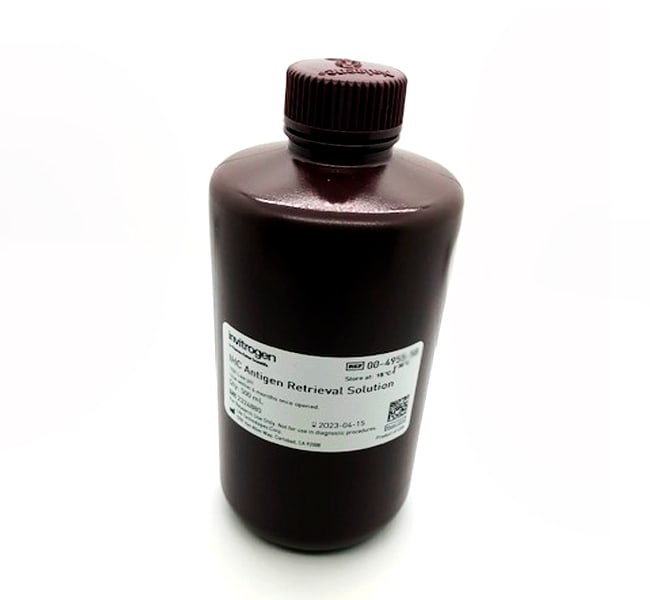
eBioscience™ IHC Antigen Retrieval Solution - High pH (10X)
The IHC Antigen Retrieval Solution- High pH (10X) is designed for use during the heat induced epitope retrieval (HIER) step자세히 알아보기
| 카탈로그 번호 | 수량 |
|---|---|
| 00-4956-58 | 500 mL |
카탈로그 번호 00-4956-58
제품 가격(KRW)
304,000
Online offer
Ends: 30-Sep-2026
347,000할인액 43,000 (12%)
Each
수량:
500 mL
제품 가격(KRW)
304,000
Online offer
Ends: 30-Sep-2026
347,000할인액 43,000 (12%)
Each
The IHC Antigen Retrieval Solution- High pH (10X) is designed for use during the heat induced epitope retrieval (HIER) step prior to immunohistochemistry on formalin-fixed paraffin embedded tissue sections. The use of this buffer in combination with heat (often by microwave, water bath, or pressure cooker) has been shown to restore the antigenicity of proteins modified during the formalin fixation of tissue. This buffer is supplied as a 10X stock solution. Dilution of this buffer to 1X using reagent grade water results in a 10 mM Tris, 1 mM EDTA solution, pH 9.0.
Reported Application
Immunohistochemical Staining of Formalin-Fixed Paraffin Embedded Tissue Sections
Reported Application
Immunohistochemical Staining of Formalin-Fixed Paraffin Embedded Tissue Sections
For Research Use Only. Not for use in diagnostic procedures.
사양
형태Liquid
제품 유형IHC Antigen Retrieval Solution
용도(애플리케이션)Immunohistochemistry (IHC)
제품라인eBioscience
수량500 mL
Unit SizeEach
인용 및 참조 문헌 (4)
인용 및 참조 문헌
Abstract
ROCK1 inhibitor stabilizes E-cadherin and improves barrier function in experimental necrotizing enterocolitis.
Journal:Am J Physiol Gastrointest Liver Physiol
PubMed ID:32090605
'Necrotizing enterocolitis (NEC) is a devastating gastrointestinal disease of newborns. Although incompletely understood, NEC is associated with intestinal barrier dysfunction. E-cadherin, an adherens junction, is a protein complex integral in maintaining normal barrier homeostasis. Rho-associated protein kinase-1 (ROCK1) is a kinase that regulates the E-cadherin complex, and p120-catenin is a
Targeting glioma-initiating cells via the tyrosine metabolic pathway.
Journal:J Neurosurg
PubMed ID:32059178
'Despite an aggressive multimodal therapeutic regimen, glioblastoma (GBM) continues to portend a grave prognosis, which is driven in part by tumor heterogeneity at both the molecular and cellular levels. Accordingly, herein the authors sought to identify metabolic differences between GBM tumor core cells and edge cells and, in so doing,
Grim-19 expressed by recombinant adenovirus for esophageal neoplasm target therapy.
Journal:Mol Med Rep
PubMed ID:29488605
Esophageal squamous cell carcinoma (ESCC) and esophageal adenocarcinoma (EA) are the two most common types of esophageal cancer, which is the sixth highest cause of cancer-associated mortality and the eighth most common cancer worldwide. Gene associated with retinoid-interferon (IFN)-induced mortality-19 (Grim-19) is reported to be a cell death activator that
Environmentally relevant exposure to dibutyl phthalate disrupts DNA damage repair gene expression in the mouse ovary†.
Journal:Biol Reprod
PubMed ID:31318015
Phthalates have a history of reproductive toxicity in animal models and associations with adverse reproductive outcomes in women. Human exposure to dibutyl phthalate (DBP) occurs via consumer products (7-10 µg/kg/day) and medications (1-233 µg/kg/day). Most DBP toxicity studies have focused on high supraphysiological exposure levels; thus, very little is known about exposures