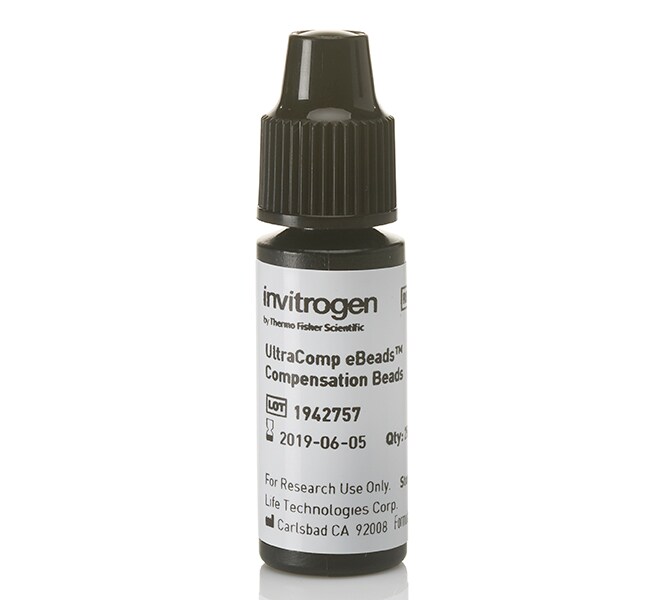
UltraComp eBeads™ Compensation Beads
Discover the next level of precision with UltraComp eBeads Spectral Unmixing Beads! Experience the 3rd generation of UltraComp eBeads, now with enhanced spectral unmixing and conventional compensation. Try them today and elevate your experiments!
UltraComp eBeads™ Compensation Beads
Invitrogen™

UltraComp eBeads™ Compensation Beads

UltraComp eBead™는 생쥐, 쥐, 햄스터 유래 항체와 반응하며 면역글로불린 경쇄와 독립적입니다. 이 비드는 자외선(355nm) 자색(405nm), 청색(488nm), 녹색(532nm), 황록색(561nm) 및 적색(633-640nm)자세히 알아보기
Have Questions?
보기 방식 변경buttonViewtableView
카탈로그 번호수량
01-2222-42100 tests
01-2222-4125 tests
카탈로그 번호 01-2222-42
제품 가격(KRW)
391,000
Online offer
Ends: 31-Dec-2025
460,000
할인액 69,000 (15%)
Each
카트에 추가하기
수량:
100 tests
제품 가격(KRW)
391,000
Online offer
Ends: 31-Dec-2025
460,000
할인액 69,000 (15%)
Each
카트에 추가하기
UltraComp eBead™는 생쥐, 쥐, 햄스터 유래 항체와 반응하며 면역글로불린 경쇄와 독립적입니다. 이 비드는 자외선(355nm) 자색(405nm), 청색(488nm), 녹색(532nm), 황록색(561nm) 및 적색(633-640nm) 레이저로 자극되는 모든 형광색소를 이용한 보상에 사용하도록 설계되었습니다. 이 비드는 개별 형광색소 결합 항체로 염색할 수 있는 구형 입자로서 단색 보상 대조군으로 사용됩니다.

비드 한 방울에는 생쥐, 쥐 또는 햄스터의 항체를 포착하는 양성 입자군과 항체에 반응하지 않는 음성 입자군 등 두 가지 입자군이 들어 있습니다. 형광색소 결합 항체를 비드에 첨가하면 양성 및 음성 입자군이 형성됩니다. 이러한 쌍봉(bimodal) 분포는 다색 유세포분석 실험에서 단색 보상 대조군으로 사용할 수 있습니다.

UltraComp eBead는 자외선(355nm) 또는 자색(405nm) 레이저로 자극되는 모든 종류의 형광색소와 호환됩니다. 이 제품은 PBS 또는 HBSS, BSA 또는 FBS와 같은 단백질 및 아지드화나트륨이 들어 있는 표준 염색 완충액과 함께 사용해야 합니다. 다른 첨가제는 사용할 수 없습니다. 자세한 내용은 기술 지원 팀에 문의하십시오
For Research Use Only. Not for use in diagnostic procedures.
사양
용도(장비)Flow Cytometer
테스트 수100 Tests
수량100 tests
제품라인eBeads
제품 유형Compensation Beads
Unit SizeEach

자주 묻는 질문(FAQ)

How long are UltraComp eBeads Compensation Beads (Cat. No. 01-2222-41, 01-2222-42) stable after staining?

After staining, UltraComp eBeads Compensation Beads (Cat. No. 01-2222-41, 01-2222-42) are stable for up to 3 days if the samples are stored in a fixative. If the samples are stored in FACS buffer, they are stable for 1 week.

Find additional tips, troubleshooting help, and resources within our Flow Cytometry Support Center.

I am performing flow cytometry. My compensation matrix has values over 100. That's not possible is it?

It is possible. But if you have a lot of values over 100, you probably need to look at the voltages that you are using for your data collection.

Find additional tips, troubleshooting help, and resources within our Cell Analysis Support Center.

I’ve been told that I need to compensate my data for flow cytometry analysis. What does that mean?

By running single-color controls, it is possible to remove signal of one fluorophore that spills over into the collection channel for another fluorophore.

Find additional tips, troubleshooting help, and resources within our Cell Analysis Support Center.

What kind of controls do I need for flow cytometry?

For compensation, you need to prepare a singly stained sample (or compensation beads) for each color parameter that you are using. In addition, we recommend that you use FMO (flow minus one) controls. These are controls in which you label cells or beads with every color in your panel, omitting one. Make one FMO control for each color. These controls are important for helping you properly set gates on your data.

Find additional tips, troubleshooting help, and resources within our Cell Analysis Support Center.

Why should I worry about compensation in flow cytometry analysis?

In a perfect world, the fluorescence emission profile for each individual fluorophore would be a very intense, narrow peak, well separated from all other emission peaks. In reality, organic dyes and fluorescent proteins have broad emission peaks, and compensation must be employed (during or after data acquisition) to correctly assign fluorescence signal to each fluorophore. Compensation is important because it removes fluorescent signal from overlapping spectra so you know that the signal you see is only the signal from the fluorophore of interest.

Find additional tips, troubleshooting help, and resources within our Cell Analysis Support Center.