Search


인용 및 참조 문헌 (9)
Gibco™
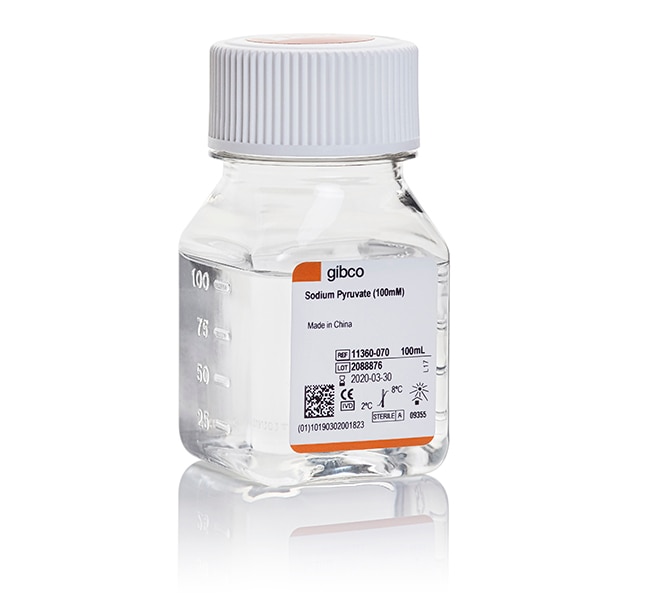
Sodium Pyruvate (100 mM)
글루코스와 더불어 피루브산 나트륨(sodium pyruvate)이 탄소 공급원으로 세포 배양 배지에 흔히 첨가됩니다. 세포는 당분해(glycolysis) 과정에서 중간 대사물로 피루브산 나트륨을 만들기자세히 알아보기
| 카탈로그 번호 | 수량 |
|---|---|
| 11360070 | 100 mL |
카탈로그 번호 11360070
제품 가격(KRW)
27,000
Online offer
Ends: 31-Dec-2026
29,000할인액 2,000 (7%)
Each
수량:
100 mL
제품 가격(KRW)
27,000
Online offer
Ends: 31-Dec-2026
29,000할인액 2,000 (7%)
Each
글루코스와 더불어 피루브산 나트륨(sodium pyruvate)이 탄소 공급원으로 세포 배양 배지에 흔히 첨가됩니다. 세포는 당분해(glycolysis) 과정에서 중간 대사물로 피루브산 나트륨을 만들기 때문에 모든 세포 배양에서 보충제로 요구되는 것은 아닙니다. 하지만 피루브산 나트륨이 보충된 배지에서 세포가 증식되고 경우 이 보충제가 없으면 세포 성장이 지연될 수 있으므로 이를 계속 사용할 것을 추천합니다. Gibco™ Sodium Pyruvate(100 mM)는 물 1리터당 11 g을 사용하여 조제됩니다. 대부분의 세포 배양 배지에서 사용되는 피루브산 나트륨의 최종 농도는 1 mM입니다.
두 군데의 cGMP 제조 시설 및 품질 시스템
Gibco™ Sodium Pyruvate Solution은 뉴욕주의 Grand Island에 위치한 cGMP 규정 준수 시설에서 제조됩니다. 이 시설은 의료기기 제조업체로 FDA에 등록되어 있으며 ISO 13485 스탠더드 인증을 받았습니다. 공급망 유지를 위해 당사는 또한 스코틀랜드 시설에서도 동일한 Gibco™ Sodium Pyruvate Solution 제품을 제조하여 공급합니다(11360-039). 이 시설은 의료기기 제조업체로 FDA에 등록되어 있으며 ISO 13485 스탠더드 인증을 받았습니다.
본 제품은 냉장/냉동제품으로 반송된 제품은 전량 폐기 처리 되오니 주문 전 상세 내용 다시 한번 확인 부탁드립니다.
두 군데의 cGMP 제조 시설 및 품질 시스템
Gibco™ Sodium Pyruvate Solution은 뉴욕주의 Grand Island에 위치한 cGMP 규정 준수 시설에서 제조됩니다. 이 시설은 의료기기 제조업체로 FDA에 등록되어 있으며 ISO 13485 스탠더드 인증을 받았습니다. 공급망 유지를 위해 당사는 또한 스코틀랜드 시설에서도 동일한 Gibco™ Sodium Pyruvate Solution 제품을 제조하여 공급합니다(11360-039). 이 시설은 의료기기 제조업체로 FDA에 등록되어 있으며 ISO 13485 스탠더드 인증을 받았습니다.
본 제품은 냉장/냉동제품으로 반송된 제품은 전량 폐기 처리 되오니 주문 전 상세 내용 다시 한번 확인 부탁드립니다.
For In Vitro Diagnostic Use.
사양
세포 유형Mammalian Cells
농도100 mM
수량100 mL
유통 기한12 Months
배송 조건Room Temperature
형태Liquid
제품 유형Sodium Pyruvate
멸균Sterile-filtered
Sterilization MethodSterile-filtered
Unit SizeEach
구성 및 보관
Storage conditions: 2°C to 8°C. Protect from light.
Shipping conditions: Room temperature
Shelf life: 12 months from date of manufacture
Shipping conditions: Room temperature
Shelf life: 12 months from date of manufacture
자주 묻는 질문(FAQ)
For how long is Sodium Pyruvate (100 mM) stable at 2-8 degrees C after opening the bottle?
How is your sodium pyruvate supplied?
What is the purpose of sodium pyruvate in media?
인용 및 참조 문헌 (9)
인용 및 참조 문헌
Abstract
A comparison between different human hepatocyte models reveals profound differences in net glucose production, lipid composition and metabolism in vitro.
Journal:Experimental cell research
PubMed ID:38499143
Effects of an indole derivative on cell proliferation, transfection, and alternative splicing in production of lentiviral vectors by transient co-transfection.
Journal:PloS one
PubMed ID:38833479
Lentiviral vectors derived from human immunodeficiency virus type I are widely used to deliver functional gene copies to mammalian cells for research and gene therapies. Post-transcriptional splicing of lentiviral vector transgene in transduced host and transfected producer cells presents barriers to widespread application of lentiviral vector-based therapies. The present study
Metabolism of 4 beta -hydroxycholesterol in humans.
Journal:J Biol Chem
PubMed ID:12077124
'One of the major oxysterols in the human circulation is 4 beta-hydroxycholesterol formed from cholesterol by the drug-metabolizing enzyme cytochrome P450 3A4. Deuterium-labeled 4 beta-hydroxycholesterol was injected into two healthy volunteers, and the apparent half-life was found to be 64 and 60 h, respectively. We have determined earlier the half-lives
Delivery of proteins into living cells by reversible membrane permeabilization with streptolysin-O.
Journal:Proc Natl Acad Sci U S A
PubMed ID:11248053
'The pore-forming toxin streptolysin O (SLO) can be used to reversibly permeabilize adherent and nonadherent cells, allowing delivery of molecules with up to 100 kDa mass to the cytosol. Using FITC-labeled albumin, 10(5)-10(6) molecules were estimated to be entrapped per cell. Repair of toxin lesions depended on Ca(2+)-calmodulin and on
Use of human tissue explants to study human infectious agents.
Journal:Nat Protoc
PubMed ID:19197269
The study of human cell-cell and cell-pathogen interactions that occur in the context of complex tissue cytoarchitecture is critical for deciphering the mechanisms of many normal and pathogenic processes. This protocol describes methods for culturing and infecting explants of human tissues to study the pathogenesis of human infectious agents and