Search


인용 및 참조 문헌 (90)
Invitrogen™
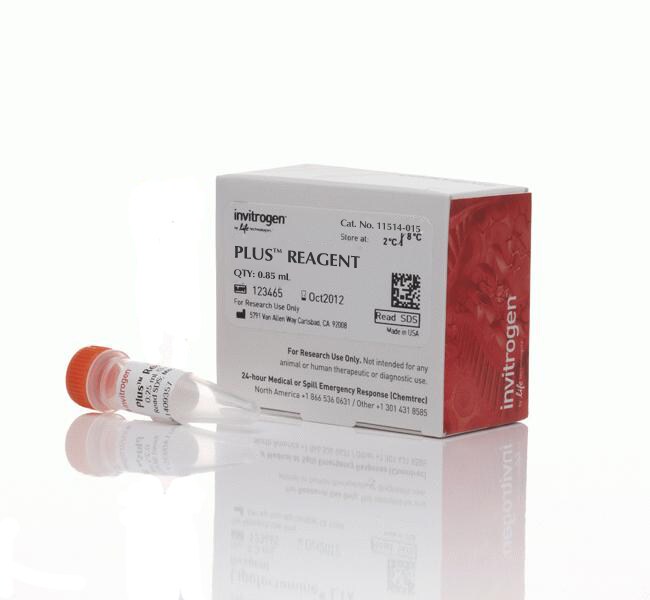
PLUS™ Reagent
PLUS™ Reagent은 Lipofectamine™ 같은 transfection agent와 함께 사용해 adherent cell line의 tranfection을 향상시킵니다. 어떤 고객은 높은 transfection 성능을 얻기 위해자세히 알아보기
| 카탈로그 번호 | 수량 |
|---|---|
| 11514015 | 0.85 mL |
카탈로그 번호 11514015
제품 가격(KRW)
406,000
Online offer
Ends: 31-Dec-2026
451,000할인액 45,000 (10%)
Each
수량:
0.85 mL
제품 가격(KRW)
406,000
Online offer
Ends: 31-Dec-2026
451,000할인액 45,000 (10%)
Each
PLUS™ Reagent은 Lipofectamine™ 같은 transfection agent와 함께 사용해 adherent cell line의 tranfection을 향상시킵니다. 어떤 고객은 높은 transfection 성능을 얻기 위해 DNA 농도 최적화가 덜한 Plus™ Reagent가 필요하다고 합니다. Plus™ Reagent를 추가하면 필요한 DNA와 lipid 양을 lipid 단독 경우보다 절반 정도로 줄일 수 있습니다. PLUS™ Reagent는 transfection이 가능한 세포 유형 array를 확장시키도록 특별히 고안되었습니다(1). Lipofectamine™ Reagent 와 PLUS™ Reagent를 함께 사용했을 때 BHK-21, NIH 3T3 등의 cell line transfection이 개선된다고 입증되었습니다(2).
For Research Use Only. Not for use in diagnostic procedures.
사양
용도(애플리케이션)Transfection
고처리량 호환성Not High-throughput Compatible (Manual)
제품라인PLUS
제품 유형Reagent
수량0.85 mL
혈청 호환 가능Yes
배송 조건Wet Ice
셀 유형Established Cell Lines, Stem Cells, Primary Cells, Hard-to-Transfect Cells
형식6-well Plate, 12-well Plate, 24-well Plate, 48-well Plate, 96-well Plate, Flasks
샘플 종류Plasmid DNA, RNAi Plasmids (shRNA, miR)
Transfection TechniqueLipid-based Transfection
Unit SizeEach
구성 및 보관
Contains one vial (0.85 ml) PLUS™ Reagent. Store at 4°C. Do not freeze.
자주 묻는 질문(FAQ)
I accidentally left my lipid reagent at room temperature. Can I still use it?
Do you offer a reagent for the transfection of endothelial cells?
Can I use the PLUS Reagent with Lipofectamine RNAiMAX?
Why do I have to dilute my DNA in medium before adding the PLUS Reagent? Can I just add them together?
What is the PLUS Reagent?
인용 및 참조 문헌 (90)
인용 및 참조 문헌
Abstract
c-Jun is a JNK-independent coactivator of the PU.1 transcription factor.
Journal:J Biol Chem
PubMed ID:9988737
The ETS domain transcription factor PU.1 is necessary for the development of monocytes and regulates, in particular, the expression of the monocyte-specific macrophage colony-stimulating factor (M-CSF) receptor, which is critical for monocytic cell survival, proliferation, and differentiation. The bZIP transcription factor c-Jun, which is part of the AP-1 transcription factor
A
Journal:J Biol Chem
PubMed ID:11973330
The large size (six membrane-spanning repeats in each of four domains) and asymmetric architecture of the voltage-dependent Na+ channel has hindered determination of its structure. With the goal of determining the minimum structure of the Na+ channel permeation pathway, we created two stable cell lines expressing the voltage-dependent rat skeletal
Vesicle-associated membrane protein-2/synaptobrevin binding to synaptotagmin I promotes O-glycosylation of synaptotagmin I.
Journal:J Biol Chem
PubMed ID:12048209
Synaptotagmin I (Syt I), an evolutionarily conserved integral membrane protein of synaptic vesicles, is now known to regulate Ca2+-dependent neurotransmitter release. Syt I protein should undergo several post-translational modifications before maturation and subsequent functioning on synaptic vesicles (e.g. N-glycosylation and fatty acylation in vertebrate Syt I), because the apparent molecular
Receptor-selective effects of endogenous RGS3 and RGS5 to regulate mitogen-activated protein kinase activation in rat vascular smooth muscle cells.
Journal:J Biol Chem
PubMed ID:12006602
Regulators of G protein signaling (RGS) proteins compose a highly diverse protein family best known for inhibition of G protein signaling by enhancing GTP hydrolysis by Galpha subunits. Little is known about the function of endogenous RGS proteins. In this study, we used synthetic ribozymes targeted to RGS2, RGS3, RGS5,
Extracellular Export of Sphingosine Kinase-1 Enzyme. SPHINGOSINE 1-PHOSPHATE GENERATION AND THE INDUCTION OF ANGIOGENIC VASCULAR MATURATION.
Journal:J Biol Chem
PubMed ID:11741921
The enzyme sphingosine kinase (SK) catalyzes the formation of sphingosine 1-phosphate (S1P), a bioactive lipid that acts extracellularly on G protein-coupled receptors of the S1P(1)/EDG-1 subfamily. Although S1P is formed in the cytosol of various cells, S1P release is not understood and is controversial because this lipid mediator is also