Search


인용 및 참조 문헌 (27)
Gibco™
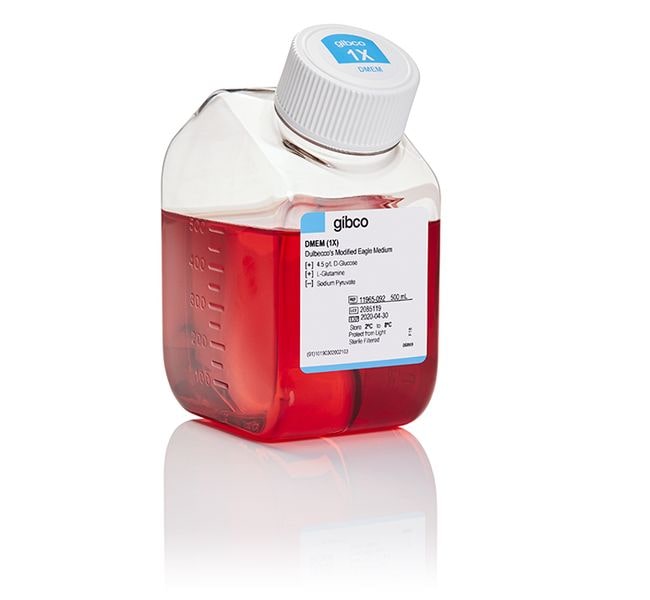
DMEM, high glucose
DMEM(Dulbecco Modified Eagle Medium)은 많은 다양한 포유류 세포의 성장을 지원하기 위해 널리 사용되는 기본 배지입니다. DMEM에서 성공적으로 배양되는 세포에는 일차자세히 알아보기
Have Questions?
보기 방식 변경

| 카탈로그 번호 | 수량 |
|---|---|
| 11965118 | 10 x 500 mL |
| 11965092 | 500 mL |
| 11965084 | 1000 mL |
| 11965126 | 6 x 1000 mL |
| 11965167 | 5 L |
| 11965175 | 10 L |
카탈로그 번호 11965118
제품 가격(KRW)
362,000
キャンペーン価格
Ends: 31-Dec-2026
402,000할인액 40,000 (10%)
Each
수량:
10 x 500 mL
제품 가격(KRW)
362,000
キャンペーン価格
Ends: 31-Dec-2026
402,000할인액 40,000 (10%)
Each
DMEM(Dulbecco Modified Eagle Medium)은 많은 다양한 포유류 세포의 성장을 지원하기 위해 널리 사용되는 기본 배지입니다. DMEM에서 성공적으로 배양되는 세포에는 일차 섬유아세포, 뉴런, 신경교세포, HUVECs, 평활근 세포 등을 비롯하여 HeLa, 293, Cos-7 및 PC-12 등의 세포주를 포함합니다. 라이프 테크놀로지스는 다양한 세포 배양 응용 분야에 맞는 다양한 조성의 DMEM 제품을 제공합니다. 배지 선택 도구를 사용하여 적절한 조성을 간편하게 찾을 수 있습니다.
이 DMEM은 다음과 같이 조성이 변경되었습니다.
- 포함
- 고농도 포도당
- L-글루타민
- 페놀 레드
- 제외 성분
- Sodium Pyruvate
- HEPES
모든 조성을 이용할 수 있습니다.
DMEM의 사용
DMEM은 기존 Eagle's Minimal Essential Medium에 비해 4배 더 높은 농도의 아미노산과 비타민을 함유하는 것을 특징으로 합니다. DMEM은 원래 저농도 glucose (1 g/L)와 sodium pyruvate로 제조되었으나, 종종 sodium pyruvate 포함 혹은 sodium pyruvate없이 고농도 glucose로도 제조됩니다. DMEM에는 단백질, 지질, 성장 인자가 들어있지 않습니다. 따라서 DMEM을 사용하려면 일반적으로 10% Fetal Bovine Serum(FBS)을 보충해야 합니다. DMEM은 중탄산나트륨(sodium bicarbonate) 버퍼 시스템(3.7 g/L)을 이용하며, 이로 인해 생리학적인 pH를 유지하기 위해 5–10% CO2 환경이 요구됩니다.
cGMP 제조 및 품질 시스템
DMEM은 뉴욕주의 Grand Island에 위치한 cGMP 준수 시설에서 제조됩니다. 이 시설은 의료기기 제조원으로 FDA에 등록되어 있으며 ISO 13485 표준 인증을 받은 기관입니다. 공급망 유지를 위해 라이프테크놀로지스는 본사 스코틀랜드 시설에서도 동일한 DMEM 제품을 제공합니다(41965-039). 이 시설은 의료기기 제조원으로 FDA에 등록되어 있으며 ISO 13485 표준 인증을 받은 기관입니다.
의료기기로 사용되는 경우 연방법상 의사의 지시에 따라서만 판매할 수 있습니다. 제조 공정에 Gibco DMEM을 사용하는 고객은 FDA 승인 신청 시 Life Technologies에 Type II 의약품 마스터 파일(DMF) 참조 인증서를 요청할 수 있습니다. 인간ex vivo조직 및 세포 배양 처리 응용.
사양
세포주HeLa, 293, Cos-7 및 PC-12
세포 유형일차 섬유아세포, 뉴런, 신경아교세포, HUVECs 및 평활근 세포
농도1X
배양 환경CO2
용도(애플리케이션)포유류 세포 배양
형식Bottles
Glucose 농도4500 mg/L
제조 품질cGMP-compliant under the ISO 13485 standard
제품라인Gibco
제품 유형DMEM(Dulbecco's Modified Eagle Medium)
수량10 x 500 mL
유통 기한제조일로부터 12개월
배송 조건실온
분류동물 원료 성분 비함유
Culture TypeMammalian Cell Culture
형태액체
Serum LevelStandard Serum Supplementation
멸균멸균 여과
Sterilization MethodSterile-filtered
첨가제 포함고농도 포도당, L-글루타민, 페놀 레드, Glutamine, Phenol Red
첨가제 없음HEPES, Sodium Pyruvate, No Sodium Pyruvate
Unit SizeEach
구성 및 보관
보관 조건: 2°C ∼ 8°C(차광 보관)
배송 조건: 상온
유통 기한: 제조일로부터 12개월
배송 조건: 상온
유통 기한: 제조일로부터 12개월
자주 묻는 질문(FAQ)
My cells will not grow in DMEM, what other type of culture media can be used with the Photoreactive Amino Acids?
What is the osmolality of DMEM, high glucose (Cat. No. 11965xxx)?
What is the manganese concentration in DMEM? Do you offer manganese-free DMEM?
How long can I keep my media after supplementing with serum?
My medium was shipped at room temperature but it is supposed to be stored refrigerated. Is it okay?
인용 및 참조 문헌 (27)
인용 및 참조 문헌
Abstract
Identification of a novel redox-sensitive gene, Id3, which mediates angiotensin II-induced cell growth.
Journal:Circulation
PubMed ID:12021231
BACKGROUND: Reactive oxygen species, such as superoxide (O(2)(-)), are involved in the abnormal growth of various cell types. Angiotensin II (Ang II) is one of the most potent inducers of oxidative stress in the vasculature. The molecular events involved in Ang II-induced proliferation of vascular smooth muscle cells (VSMCs) are
Human cytomegalovirus-encoded interleukin-10 homolog inhibits maturation of dendritic cells and alters their functionality.
Journal:J Virol
PubMed ID:15280480
Interleukin-10 (IL-10) suppresses the maturation and cytokine production of dendritic cells (DCs), key regulators of adaptive immunity, and prevents the activation and polarization of naïve T cells towards protective gamma interferon-producing effectors. We hypothesized that human cytomegalovirus (HCMV) utilizes its viral IL-10 homolog (cmvIL-10) to attenuate DC functionality, thereby subverting
Protocol to generate human liver spheroids to study liver fibrosis induced by metabolic stress.
Journal:STAR protocols
PubMed ID:38833372
Currently, there is no effective treatment for obesity and alcohol-associated liver diseases, partially due to the lack of translational human models. Here, we present a protocol to generate 3D human liver spheroids that contain all the liver cell types and mimic âlivers in a dish.â We describe strategies to induce
Shedding of the Interleukin-6 (IL-6) Receptor (gp80) Determines the Ability of IL-6 to Induce gp130 Phosphorylation in Human Osteoblasts.
Journal:J Biol Chem
PubMed ID:11884403
'Human osteoblasts produce interleukin-6 (IL-6) and respond to IL-6 in the presence of soluble IL-6 receptor (sIL-6R), but the cell surface expression of IL-6R and the mechanism of sIL-6R production are largely unknown. Three different human osteoblast-like cell lines (MG-63, HOS, and SaOS-2) and bone marrow-derived primary human osteoblasts expressed
Active nuclear import and export pathways regulate E2F-5 subcellular localization.
Journal:J Biol Chem
PubMed ID:12089160
'Epidermal keratinocyte differentiation is accompanied by differential regulation of E2F genes, including up-regulation of E2F-5 and its concomitant association with the retinoblastoma family protein p130. This complex appears to play a role in irreversible withdrawal from the cell cycle in differentiating keratinocytes. We now report that keratinocyte differentiation is also