Search


인용 및 참조 문헌 (3)
Gibco™
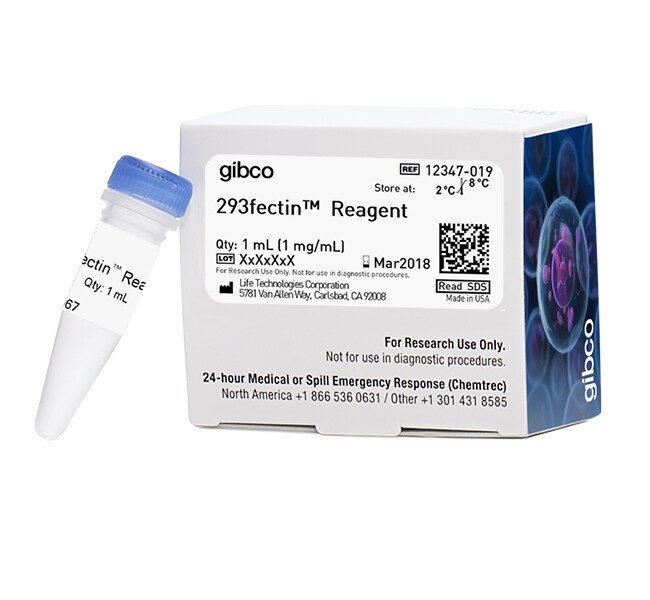
293fectin™ Transfection Reagent
293fectin™ Transfection Reagent is a proprietary, cationic lipid-based formulation for transfecting DNA into eukaryotic cells.
Have Questions?
보기 방식 변경

| 카탈로그 번호 | 수량 |
|---|---|
| 12347019 | 1 mL |
| 12347500 12347-500으로도 사용됨 | 15 mL |
| 12347750 12347-750으로도 사용됨 | 10 x 15 mL |
카탈로그 번호 12347019
제품 가격(KRW)
773,000
キャンペーン価格
Ends: 31-Dec-2026
858,000할인액 85,000 (10%)
Each
수량:
1 mL
제품 가격(KRW)
773,000
キャンペーン価格
Ends: 31-Dec-2026
858,000할인액 85,000 (10%)
Each
293fectin™ Transfection Reagent is a proprietary, cationic lipid-based formulation for transfecting DNA into eukaryotic cells. This reagent is optimized for transfecting suspension 293 human embryonic kidney cells (e.g., FreeStyle™ 293-F cells, Cat. No. R790-07) in defined, serum-free FreeStyle™ 293 Expression Medium (12338-018), and is intended for use with the FreeStyle™ 293 Expression System (K9000-01).
293fectin™ Transfection Reagent provides the following advantages:
- Demonstrates high transfection efficiency in suspension 293 cells and is also suitable for transfecting adherent 293 cells
- Suspension FreeStyle™ 293-F cells may be transfected in FreeStyle™ 293 Expression Medium; no medium change is required
- Add 293fectin™ reagent complexes directly to cells in culture medium
- No need to remove complexes or change or add medium following transfection
293fectin™ Transfection Reagent은 무혈청 GIBCO™ FreeStyle™ 293 Expression Medium에서 FreeStyle™ 293-F 부유세포의 이입 효율성을 최대화하도록 특별히 만들어진 양이온 지질 formulation입니다 . 이는 FreeStyle™ 293 Expression System의 일부나 별도로 구매가능합니다.
이 시스템에 대한 자세한 정보는 FreeStyle™ 293 Expression System Brochure에서 찾아볼 수 있습니다.
이 시스템에 대한 자세한 정보는 FreeStyle™ 293 Expression System Brochure에서 찾아볼 수 있습니다.
For Research Use Only. Not for use in diagnostic procedures.
사양
용도(애플리케이션)Transfection
고처리량 호환성Not High-throughput Compatible (Manual)
제품라인293fectin
제품 유형Transfection Reagent
수량1 mL
혈청 호환 가능Yes
셀 유형Established Cell Lines
샘플 종류Plasmid DNA
Transfection TechniqueLipid-based Transfection
Unit SizeEach
구성 및 보관
Each unit contains one vial of reagent. Store at 4°C.
293fectin™ is guaranteed stable for 6 months when stored properly.
293fectin™ is guaranteed stable for 6 months when stored properly.
자주 묻는 질문(FAQ)
What is the advantage of FreeStyle Max Reagent over 293fectin Transfection Reagent?
I accidentally left my lipid reagent at room temperature. Can I still use it?
What is the difference between reverse transfection and forward transfection? What should I use?
Is there a place where I can find references from other researchers who have used your transfection reagents?
Can I use antibiotics in the medium during transfection?
인용 및 참조 문헌 (3)
인용 및 참조 문헌
Abstract
Molecular dissection of the alpha-dystroglycan- and integrin-binding sites within the globular domain of human laminin-10.
Journal:J Biol Chem
PubMed ID:14701821
'The adhesive interactions of cells with laminins are mediated by integrins and non-integrin-type receptors such as alpha-dystroglycan and syndecans. Laminins bind to these receptors at the C-terminal globular domain of their alpha chains, but the regions recognized by these receptors have not been mapped precisely. In this study, we sought
Binding of anthrax toxin to its receptor is similar to alpha integrin-ligand interactions.
Journal:J Biol Chem
PubMed ID:14507921
The secreted protein toxin produced by Bacillus anthracis contributes to virulence of this pathogen and can cause many of the symptoms seen during an anthrax infection, including shock and sudden death. The cell-binding component of anthrax toxin, protective antigen, mediates entry of the toxin into cells by first binding directly
T cell immunoglobulin mucin-3 crystal structure reveals a galectin-9-independent ligand-binding surface.
Journal:Immunity
PubMed ID:17363302
The T cell immunoglobulin mucin (Tim) family of receptors regulates effector CD4(+) T cell functions and is implicated in autoimmune and allergic diseases. Tim-3 induces immunological tolerance, and engagement of the Tim-3 immunoglobulin variable (IgV) domain by galectin-9 is important for appropriate termination of T helper 1-immune responses. The 2