Search


인용 및 참조 문헌 (2)
Invitrogen™
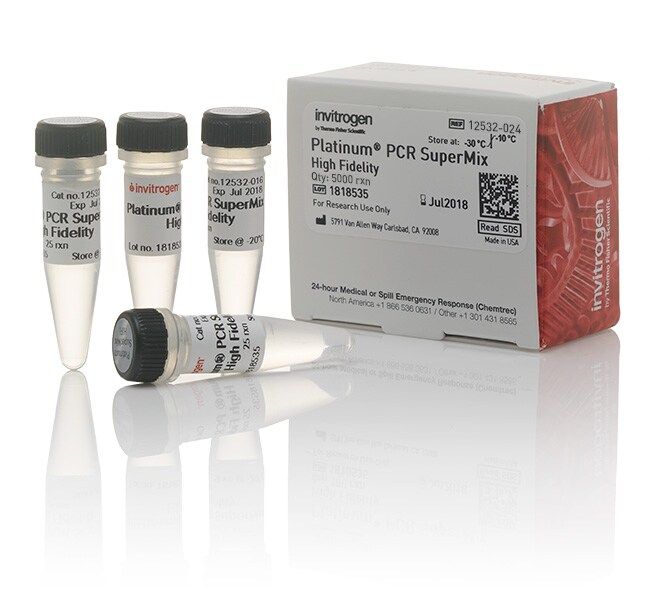
Platinum™ PCR SuperMix High Fidelity
Platinum PCR SuperMix, High Fidelity, is a ready-to-use mixture of DNA polymerase, salts, magnesium, and dNTPs for efficient PCR amplification.
Have Questions?
보기 방식 변경

| 카탈로그 번호 | 반응 수 |
|---|---|
| 12532024 | 5000 Reactions |
| 12532016 | 100 Reactions |
카탈로그 번호 12532024
제품 가격(KRW)
15,429,000
Online offer
Ends: 31-Dec-2026
18,151,000할인액 2,722,000 (15%)
Each
반응 수:
5000 Reactions
제품 가격(KRW)
15,429,000
Online offer
Ends: 31-Dec-2026
18,151,000할인액 2,722,000 (15%)
Each
Platinum PCR SuperMix, High Fidelity, is a ready-to-use mixture of DNA polymerase, salts, magnesium, and dNTPs for efficient PCR amplification. Designed for high-specificity, high-fidelity DNA amplification, Platinum PCR SuperMix reduces reaction set-up time and only requires the addition of template and primer.
High fidelity is provided by a mixture of Taq DNA polymerase and the proofreading Pyrococcus species GB-D polymerase. High specificity is achieved by anti-Taq antibodies, allowing for automatic hot-start PCR.
Benefits of Platinum PCR SuperMix, High Fidelity
- Six-times higher fidelity than Taq DNA polymerase
- Amplifies fragments up to 15 kb
- Minimizes PCR optimization
- Room-temperature reaction assembly
Applications
- High-fidelity PCR
- Cloning
- Mutagenesis
Notes
- Platinum PCR SuperMix, High Fidelity, produces products that are mixed blunt and 3-A' ends; however, the majority of ends will have a 3-A' overhangs.
- Hot-start capability increases specificity and yield and allows for room-temperature reaction assembly.
For Research Use Only. Not for use in diagnostic procedures.
사양
Fidelity (Taq 대비)6X
핫 스타트Built-In Hot Start
반응 수5000 Reactions
오버행Mixed
중합효소Platinum Taq DNA Polymerase High Fidelity
수량5,000 reactions
반응 형식SuperMix or Master Mix
배송 조건Wet or Dry Ice
크기(최종 제품)15 kb or less
농도1.1X
용도(애플리케이션)Hot-start PCR, High-fidelity PCR
GC-Rich PCR PerformanceLow
반응 속도Standard
Unit SizeEach
구성 및 보관
Platinum PCR SuperMix High Fidelity (4 x 56.25 mL)
Store at -20°C in a non-frost-free freezer.
Store at -20°C in a non-frost-free freezer.
자주 묻는 질문(FAQ)
What is the difference between Platinum technology and AccuPrime technology?
Can I use MgCl2 instead of MgSO4 with Platinum Taq High Fidelity enzyme?
If I do PCR using the Platinum PCR SuperMix High Fidelity, can I use DNA-RNA chimeric oligos such as 5'-AGGCTTggau (lower case letters for RNA bases)?
인용 및 참조 문헌 (2)
인용 및 참조 문헌
Abstract
Identifying genes of agronomic importance in maize by screening microsatellites for evidence of selection during domestication.
Journal:Proc Natl Acad Sci U S A
PubMed ID:12105270
'Crop species experienced strong selective pressure directed at genes controlling traits of agronomic importance during their domestication and subsequent episodes of selective breeding. Consequently, these genes are expected to exhibit the signature of selection. We screened 501 maize genes for the signature of selection using microsatellites or simple sequence repeats
Pattern of diversity in the genomic region near the maize domestication gene tb1.
Journal:Proc Natl Acad Sci U S A
PubMed ID:14701910
Domesticated maize and its wild ancestor (teosinte) differ strikingly in morphology and afford an opportunity to examine the connection between strong selection and diversity in a major crop species. The tb1 gene largely controls the increase in apical dominance in maize relative to teosinte, and a region of the tb1