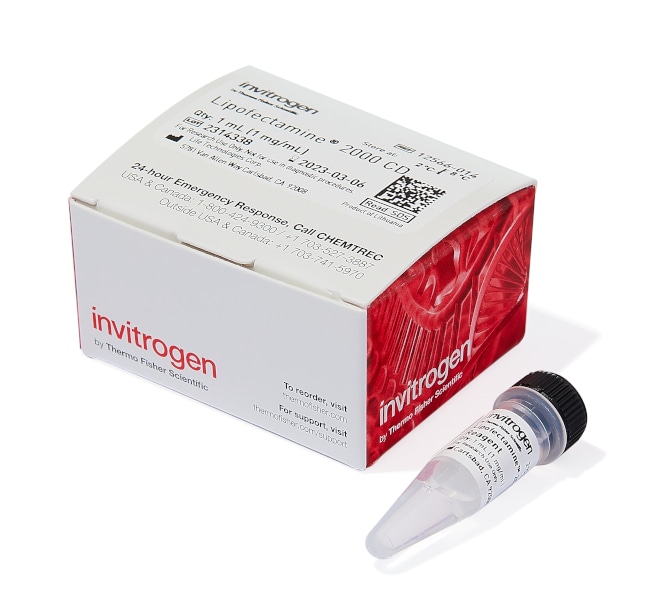
Lipofectamine™ 2000 CD Transfection Reagent
Invitrogen™

Lipofectamine™ 2000 CD Transfection Reagent

Lipofectamine™ 2000 CD (Chemically Defined) Transfection Reagent is a proprietary animal origin-free formulation for transfecting nucleic acids into eukaryotic cells.자세히 알아보기
Have Questions?
카탈로그 번호수량
125660141 mL
카탈로그 번호 12566014
제품 가격(KRW)
1,240,000
Each
카트에 추가하기
수량:
1 mL
제품 가격(KRW)
1,240,000
Each
카트에 추가하기
Lipofectamine™ 2000 CD (Chemically Defined) Transfection Reagent is a proprietary animal origin-free formulation for transfecting nucleic acids into eukaryotic cells. Using Lipofectamine™ 2000 CD reagent for transfection provides the following advantages:

• Highest transfection efficiency in many cell types and formats.
• The animal origin-free formulation ensures that mammalian cell culture and bioproduction processes are free of animal-derived materials.
• DNA-Lipofectamine™ 2000 CD complexes can be added directly to cells in culture medium.
• It is not necessary to remove complexes or change/add medium after transfection, but complexes may be removed after 4–6 hours.
For Research Use Only. Not for use in diagnostic procedures.
사양
분류Animal Origin-Free, Chemically Defined
용도(애플리케이션)Transfection
고처리량 호환성Not High-throughput Compatible (Manual)
제품라인Lipofectamine
제품 유형Transfection Reagent
수량1 mL
혈청 호환 가능Yes
배송 조건Wet Ice
셀 유형Established Cell Lines
샘플 종류Plasmid DNA
Transfection TechniqueLipid-based Transfection
Unit SizeEach
구성 및 보관
Each reagent should be stored at 2–8°C upon receipt.

자주 묻는 질문(FAQ)

I accidentally left my lipid reagent at room temperature. Can I still use it?

Yes, all of our lipid transfection reagents are stable at room temperature for months.

Find additional tips, troubleshooting help, and resources within our Lipid-Based Transfection Support Center.

What is the difference between Lipofectamine 2000 and Lipofectamine 2000 CD?

The CD designation for Lipofectamine 2000 CD was originally provided to ensure this reagent is animal origin-free. However, all of our premium Lipofectamine lipid-based transfection reagents are animal origin-free unless stated otherwise. Please contact Technical Support for information or questions regarding any of our reagents.

Find additional tips, troubleshooting help, and resources within our Transfection Support Center.

What is the difference between reverse transfection and forward transfection? What should I use?

In forward transfection, cells are seeded to appropriate confluence or cell density in wells or dishes, and the lipid-DNA complexes are added the next day. In reverse transfection, the transfection complexes are prepared inside the wells, after which cells and medium are added. Reverse transfection is faster to perform than forward transfection, and is the method of choice for high-throughput transfection. For non-high-throughput transfections, generally forward transfections have better efficiency for most cell types.

Find additional tips, troubleshooting help, and resources within our Transfection Support Center.

Is there a place where I can find references from other researchers who have used your transfection reagents?

Visit the product page for each reagent type and you will see a list of references at the bottom of the page. A table that lists specific cell line references is also accessible. We also recommend www.highwire.org as a search engine to find a large selection of up-to-date research articles using our transfection products. Simply include the name of the transfection reagent and your cell line/application of interest in your search criteria.

Find additional tips, troubleshooting help, and resources within our Transfection Support Center.

Can I use antibiotics in the medium during transfection?

Antibiotics can be used in the medium for culturing of cell lines. However, we do not recommend using antibiotics in the transfection medium unless previously tested in the cell type and payload being transfected. This is because presence of antibiotics during transfection may adversely affect transfection efficiency (i.e., positively charged antibiotics binding to the DNA being transfected) and overall health of cells being transfected.

For stable transfection, we recommend waiting wait 24-48 hrs after transfection before adding selected antibiotics.

Find additional tips, troubleshooting help, and resources within ourTransfection Basics Support Center.