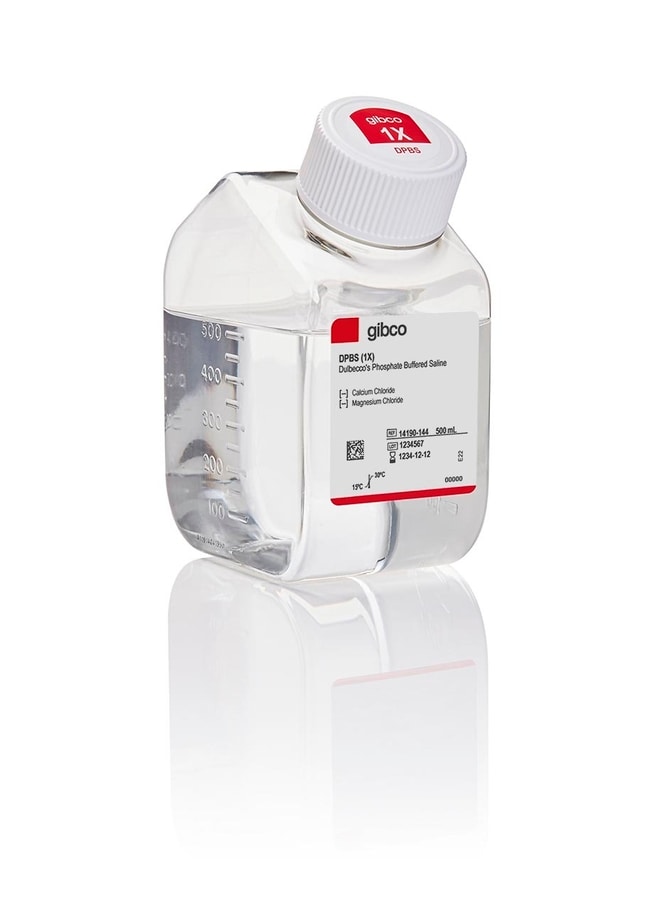
DPBS, no calcium, no magnesium
Gibco™

DPBS, no calcium, no magnesium

Dulbecco's phosphate-buffered saline(DPBS)은 해리 전 세포 세척, 세포 또는 조직 시료의 이동, 계수 전 세포 희석, 시약 조제 등 다양한자세히 알아보기
Have Questions?
보기 방식 변경buttonViewtableView
카탈로그 번호수량포장
14190144500 mLBottle
14190094
14190-094으로도 사용됨
500 mLBottle
1419025010 x 500 mLBottle
141901361000 mLBottle
141902356 x 1000 mLBottle
141903425 LBag
1419035910 LBag
1419036720 LBag
카탈로그 번호 14190144
제품 가격(KRW)
44,000
Online offer
Ends: 31-Mar-2026
48,000
할인액 4,000 (8%)
Each
카트에 추가하기
수량:
500 mL
포장:
Bottle
Customize this product
제품 가격(KRW)
44,000
Online offer
Ends: 31-Mar-2026
48,000
할인액 4,000 (8%)
Each
카트에 추가하기
Dulbecco's phosphate-buffered saline(DPBS)은 해리 전 세포 세척, 세포 또는 조직 시료의 이동, 계수 전 세포 희석, 시약 조제 등 다양한 세포 배양 응용 분야에 사용하는 평형 염액(balanced salt solution)입니다. 세포 해리 전 배양물로부터 킬레이터를 린스(rinse)하기 위해서 칼슘과 마그네슘이 포함되지 않은 조성이 필요합니다.

당사는 다양한 Gibco™ DPBS 조성으로 광범위한 세포 배양 응용 분야를 지원합니다.

이 DPBS는 다음과 같이 조성이 변경됩니다.

제외 성분
• 칼슘
• 마그네슘
• 페놀 레드(phenol red)

전체 조성 이용 가능.

cGMP 제조 및 품질 시스템
Gibco™ DPBS는 영국 스코틀랜드의 Paisley에 위치한 cGMP 규정 준수 시설에서 제조됩니다. 이 시설은 의료기기 제조업체로 FDA에 등록되어 있으며 ISO 13485 스탠더드 인증을 받았습니다. 공급망 유지를 위해 당사는 또한 Grand Island 시설에서 동일한 Gibco™ DPBS 제품을 제조하여 공급합니다(14190-144). 이 시설은 의료기기 제조업체로 FDA에 등록되어 있으며 ISO 13485 스탠더드 인증을 받았습니다.

This product is not used for in vitro diagnostic purpose in some countries.
For Research Use or Further Manufacturing. Not for diagnostic use or direct administration into humans or animals.
사양
화학물질 이름 또는 재질DPBS
색상Clear
포함No Sodium Pyruvate
제조 품질cGMP-compliant under the ISO 13485 standard
삼투압270 - 300 mOsm/kg
포장Bottle
권장 스토리지Storage conditions: 15°C to 30°C
Shipping conditions: Room temperature
Shelf life: 36 months from date of manufacture
멸균Sterile-filtered
농도1 X
용도(애플리케이션)Mammalian Cell Culture
물리적 형태Liquid
제품라인Gibco
수량500 mL
용액 유형Dulbecco's Phosphate Buffered Saline
pH7.0 to 7.3
Unit SizeEach

자주 묻는 질문(FAQ)

What procedures are recommended for the preparation of beta amyloid-containing samples?

Following are procedures which researchers have followed for handling beta amyloid in tissue and cell samples:

Kienlen-Campard, P, S. Miolet, B. Tasiaux, and J.-N. Octave (2002) Intracellular amyloid beta 1-42, but not extracellular soluble amyloid beta peptides, induces neuronal apoptosis. J. Biol. Chem. 277(18):15666-15670. These authors performed formic acid extraction of whole cells. Neurons (approximately 107) were scraped in ice cold PBS. Cell pellets were solubilized in 300 microliters of 70% formic acid. Formic acid-solubilized cell pellets were cleared by centrifuging at 16,000 x g for 5 minutes at 4 degrees C, and the supernatants were centrifuged at 21,000 x g for 20 minutes at 4 degrees C. The supernatants were vacuum dried and the resulting pellet was resuspended in 1 mL of alkaline carbonate buffer (2% Na2CO3, 0.1 N NaOH) and centrifuged 16,000 x g for 3 minutes at 4 degrees C. Protein concentration was determined by the BCA assay. For immunoprecipitation, 800 microliters of the supernatant was neutralized with 800 microliters of 1 M Tris-HCl, pH 6.8, and diluted 1:3 in H2O containing 10% FCS, 0.5% Triton X-100, and 0.5% Nonident P-40 (final concentrations). Beta amyloid 1-40 and Beta amyloid 1-42 concentrations were determined by ELISA using 100 microliters of neutralized extract.

Fagan, A.M., M. Watson, M. Parsadanian, K.R. Bales, S.M. Paul, and D.M. Holtzman (2002) Human and murine ApoE markedly alters A beta metabolism before and after plaque formation in a mouse model of Alzheimer"s disease. Neurobiol. Dis. 9(3):305-318. This paper discusses analyzing beta amyloid by ELISA. This paper has an interesting variation on the measurement of beta amyloid: they looked at soluble beta amyloid and also insoluble beta amyloid. Here are the key points of their protocol: For analysis of total beta amyloid levels, half of the hippocampus from each animal was Dounce homogenized in 5 M guandine (50 nM Tris-HCl, pH 8.0) and beta amyloid ELISA was performed as described previously (Johnson-Wood, et al. 1997). For analysis of soluble beta amyloid, the other half of the hippocampus was homogenized on ice in 400 microliters TBS (25 mM Tris-HCl, 150 mM NaCl, 3 mM EDTA, pH 7.4) containing protease inhibitors (20 micrograms/mL aprotinin, and 10 micrograms/mL leupeptin). Homogenates were spun at 125,000xg in polyallomer tubes in a Sorvall RP100 AT4-406 rotor for 1 hour at 4 degrees C and levels of beta amyloid total in the resultant supernatant (defines as soluble Abeta total) were obtained by beta amyloid ELISA. Percentage of soluble Abeta total was defined as the soluble (TBS-extractable) value divided by the total tissue (guanidine-extractable) value.

For Brain Tissue Homogenization, Prepare the Following Solutions: 5 M guanidine HCl 50 mM TrisHCl, pH 8.0. Reaction Buffer BSAT-DPBS (Dulbecco’s phosphate buffered saline with 5% BSA and 0.03% Tween-20, see formulation below) supplemented with 1x Protease Inhibitor Cocktail from Calbiochem (catalog code 539131; contains AEBSF, aprotinin, E64, EDTA, and leupeptin). BSAT-DPBS Formulation 0.2 g/L KCl 0.2 g/L KH2PO4 8.0 g/L NaCl 1.150 g/L Na2HPO4 5% BSA 0.03% Tween-20 to 1 L ultrapure water and adjust the pH to 7.4. Protocol: Determine the wet mass of the mouse hemibrain (100 mg) or a human brain sample in an Eppendorf tube (Fisher K749520-0000). Add 8 x mass of cold 5 M guanidineHCl / 50 mM Tris-HCl (Solution "A", above) to the tube by 50 - 100 µL aliquots and grind thoroughly with a hand-held motor (Fisher K749540-0000) after each addition. (Optional: transfer the homogenate from above to 1 mL Dounce homogenizer and homogenize thoroughly.) Mix the homogenate at room temperature for 3 - 4 hours. The sample is stable and can be freeze-thawed many times at this stage. Dilute the sample with cold Reaction Buffer (Solution "B"). Centrifuge (microfuge or Sorvall) at 16,000 x g for 20 minutes at 4°C. Save the supernatant for the assay.

What is the shelf life of DPBS after it has been opened?

We cannot provide an official expiration date for open bottles as this depends on the customer's use. Once opened, Thermo Fisher Scientific can no longer guarantee the performance of any product. However, if the storage conditions are followed as recommended, the stated expiration date (36 months from the date of manufacture) should apply to opened bottles as DPBS is extremely stable.

Find additional tips, troubleshooting help, and resources within our Cell Culture Support Center.

What is the shelf life of DPBS (Cat. No. 14190136)?

DPBS has a shelf life of 36 months from the date of manufacture, when stored as recommended (15-30 degrees C).

Does Diploid Growth Serum-Reduced Medium (SRM) contain L-glutamine?

The basal Diploid Growth Serum-Reduced Medium already contains 6 mM L-glutamine.

Find additional tips, troubleshooting help, and resources within our Cell Culture Support Center.

Do I have to adjust my infection parameters when using Diploid Production Serum-Free Medium (SFM)?

We recommend evaluating performance with Diploid Production Serum-Free Medium using current conditions, however, multiplicity of infection, time of infection, and time of harvest may be different than with conventional media. Closely monitor cells for cytopathic effect and evaluate viral titers at multiple time points.

Find additional tips, troubleshooting help, and resources within our Cell Culture Support Center.

인용 및 참조 문헌 (5)

인용 및 참조 문헌
Abstract
A comparison between different human hepatocyte models reveals profound differences in net glucose production, lipid composition and metabolism in vitro.
Authors:Bonanini F,Singh M,Yang H,Kurek D,Harms AC,Mardinoglu A,Hankemeier T
Journal:Experimental cell research
PubMed ID:38499143
Effects of an indole derivative on cell proliferation, transfection, and alternative splicing in production of lentiviral vectors by transient co-transfection.
Authors:Mier NC,Roper DK
Journal:PloS one
PubMed ID:38833479
Lentiviral vectors derived from human immunodeficiency virus type I are widely used to deliver functional gene copies to mammalian cells for research and gene therapies. Post-transcriptional splicing of lentiviral vector transgene in transduced host and transfected producer cells presents barriers to widespread application of lentiviral vector-based therapies. The present study ... More
Macrophage foam cell formation with native low density lipoprotein.
Authors: Kruth Howard S; Huang Wei; Ishii Itsuko; Zhang Wei-Yang;
Journal:J Biol Chem
PubMed ID:12118008
'This investigation has elucidated a mechanism for development of macrophage foam cells when macrophages are incubated with native low density lipoprotein (LDL). LDL is believed to be the main source of cholesterol that accumulates in monocyte-derived macrophages within atherosclerotic plaques, but native LDL has not previously been shown to cause ... More
Microfluidic single-cell real-time PCR for comparative analysis of gene expression patterns.
Authors:Sanchez-Freire V, Ebert AD, Kalisky T, Quake SR, Wu JC,
Journal:Nat Protoc
PubMed ID:22481529
'Single-cell quantitative real-time PCR (qRT-PCR) combined with high-throughput arrays allows the analysis of gene expression profiles at a molecular level in approximately 11 h after cell sample collection. We present here a high-content microfluidic real-time platform as a powerful tool for comparatively investigating the regulation of developmental processes in single ... More
Efficient intracellular assembly of papillomaviral vectors.
Authors:Buck CB, Pastrana DV, Lowy DR, Schiller JT,
Journal:J Virol
PubMed ID:14694107
Although the papillomavirus structural proteins, L1 and L2, can spontaneously coassemble to form virus-like particles, currently available methods for production of L1/L2 particles capable of transducing reporter plasmids into mammalian cells are technically demanding and relatively low-yield. In this report, we describe a simple 293 cell transfection method for efficient ... More