Search


인용 및 참조 문헌 (23)
Gibco™
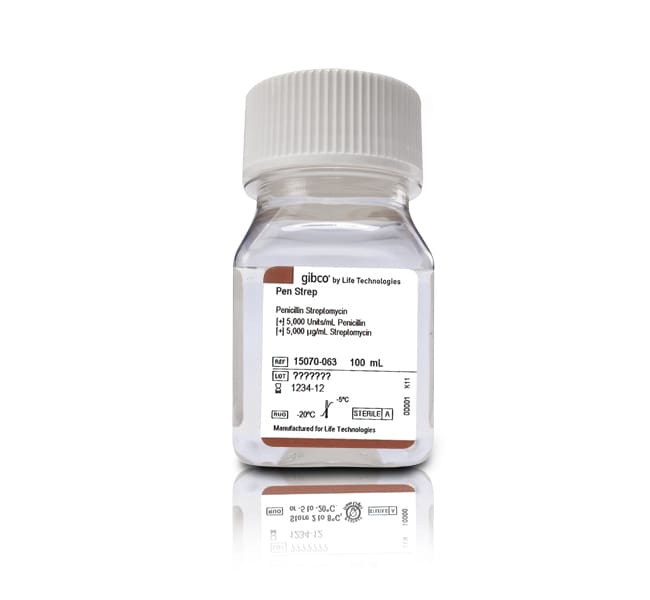
Penicillin-Streptomycin (5,000 U/mL)
본 제품은 그램 양성균과 그램 음성균에 효과적인 활성을 보이는 penicillin와 streptomycin 항생제가 복합되어 있어 세포 배양 시 세균 오염을 예방하기자세히 알아보기
| 카탈로그 번호 | 수량 |
|---|---|
| 15070063 | 100 mL |
카탈로그 번호 15070063
제품 가격(KRW)
43,000
온라인 행사
Ends: 31-Dec-2026
47,000할인액 4,000
Each
수량:
100 mL
제품 가격(KRW)
43,000
온라인 행사
Ends: 31-Dec-2026
47,000할인액 4,000
Each
본 제품은 그램 양성균과 그램 음성균에 효과적인 활성을 보이는 penicillin와 streptomycin 항생제가 복합되어 있어 세포 배양 시 세균 오염을 예방하기 위하여 사용할 수 있습니다. Penicillin은 원래 진균인 Penicillium에서 정제된 물질로 세균 세포벽 전환을 직접적으로 저해하고 세포벽을 변형시키는 효소 분비를 유도하는 간접 억제 작용을 합니다. Streptomycin는 원래 Streptomyces griseus에서 정제된 물질입니다. Streptomycin은 세균 리소좀 30S에 결합해 단백질 합성을 억제하고 감수성 높은 세균의 사멸을 유도합니다. 라이프 테크놀로지스는 세포 배양 어플리케이션에 사용하는 다양한 항생∙항진균제 를 제공합니다.
이 솔루션에는 penicillin 5000 단위와 streptomycin 5000 μg/ml가 함유되어 있습니다.
용도
이 제품은 연구용으로만 사용할 수 있습니다. 치료 또는 진단 목적으로 동물이나 인간에 사용할 수 없습니다.
이 솔루션에는 penicillin 5000 단위와 streptomycin 5000 μg/ml가 함유되어 있습니다.
용도
이 제품은 연구용으로만 사용할 수 있습니다. 치료 또는 진단 목적으로 동물이나 인간에 사용할 수 없습니다.
For Research Use Only. Not for use in diagnostic procedures.
사양
농도100 X
배양 유형Mammalian Cell Culture, Insect Cell Culture
용도(애플리케이션)Prevention of Cell Culture Contamination
수량100 mL
유통 기한12 Months
배송 조건Dry Ice
형태Liquid
제품 유형Antibiotic
멸균Sterile-filtered
Unit SizeEach
구성 및 보관
Storage conditions: -5°C to -20°C
Shipping conditions: Dry ice
Shelf life: 12 months from date of manufacture
Shipping conditions: Dry ice
Shelf life: 12 months from date of manufacture
자주 묻는 질문(FAQ)
My Penicillin-Streptomycin solution is not colorless. Is this normal?
How can I decontaminate my cultures?
What antibiotics do you offer to help control or eliminate cell culture contamination?
인용 및 참조 문헌 (23)
인용 및 참조 문헌
Abstract
Identification of a novel redox-sensitive gene, Id3, which mediates angiotensin II-induced cell growth.
Journal:Circulation
PubMed ID:12021231
BACKGROUND: Reactive oxygen species, such as superoxide (O(2)(-)), are involved in the abnormal growth of various cell types. Angiotensin II (Ang II) is one of the most potent inducers of oxidative stress in the vasculature. The molecular events involved in Ang II-induced proliferation of vascular smooth muscle cells (VSMCs) are
Directed differentiation of pancreatic δ cells from human pluripotent stem cells.
Journal:Nature communications
PubMed ID:39068220
Dysfunction of pancreatic δ cells contributes to the etiology of diabetes. Despite their important role, human δ cells are scarce, limiting physiological studies and drug discovery targeting δ cells. To date, no directed δ-cell differentiation method has been established. Here, we demonstrate that fibroblast growth factor (FGF) 7 promotes pancreatic
Involvement of c-Src Tyrosine Kinase Upstream of Class I Phosphatidylinositol (PI) 3-Kinases in Salmonella Enteritidis Rck Protein-mediated Invasion.
Journal:J Biol Chem
PubMed ID:22810232
'The Salmonella outer membrane protein Rck mediates a Zipper entry mechanism controlled by tyrosine phosphorylation and class I phosphatidylinositol 3-kinase (PI 3-kinase). However, the underlying mechanism leading to this signaling cascade remains unclear. The present study showed that using Rck-coated beads or Rck-overexpressing Escherichia coli, Rck-mediated actin polymerization and invasion
A differential role for the mitogen-activated protein kinases in lipopolysaccharide signaling: the MEK/ERK pathway is not essential for nitric oxide and interleukin 1beta production.
Journal:J Biol Chem
PubMed ID:11786532
'Endotoxin (lipopolysaccharide, LPS) is a component of the outer membrane of Gram-negative bacteria and promotes the activation of macrophages and microglia. Although these cells are highly LPS-responsive, they serve unique tissue-specific functions and exhibit different LPS sensitivities. Accordingly, it was of interest to evaluate whether these biological differences reside in
Electrophoretic profiling of both RNA and protein from a single 250-pL sample.
Journal:Anal Chem
PubMed ID:11985318
'A novel approach is described that uses capillary electrophoresis (CE) to electrophoretically sample and separate both protein and RNA from a single injected plug of cell lysate. A 250-pL sample of lysate from Chinese hamster ovary cells (9.6 x 10(7) cells/mL) was hydrodynamically injected into a capillary containing a Tris-based