Search



인용 및 참조 문헌 (3)
Gibco™
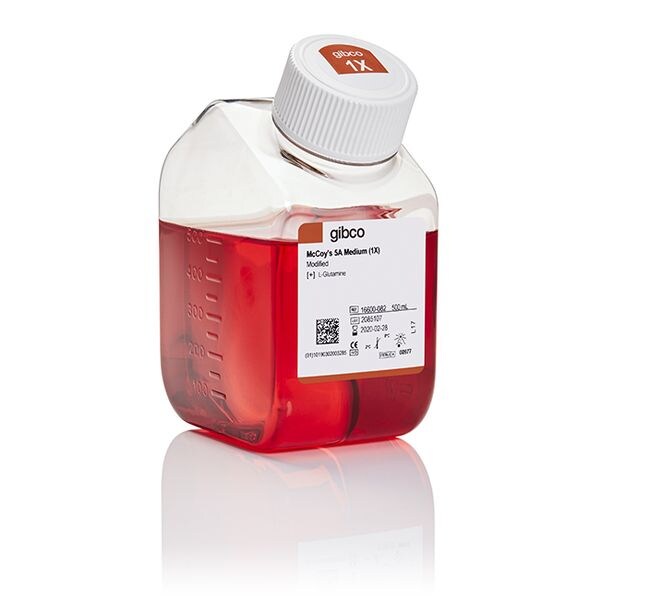
McCoy's 5A (Modified) Medium
McCoy's 5A (modified) Medium is a general purpose medium that supports the propagation of many types of primary cells, established자세히 알아보기
Have Questions?
보기 방식 변경

| 카탈로그 번호 | 수량 |
|---|---|
| 16600082 | 500 mL |
| 16600108 | 10 x 500 mL |
카탈로그 번호 16600082
제품 가격(KRW)
58,000
Online offer
Ends: 31-Dec-2026
64,000할인액 6,000
Each
수량:
500 mL
제품 가격(KRW)
58,000
Online offer
Ends: 31-Dec-2026
64,000할인액 6,000
Each
McCoy's 5A (modified) Medium is a general purpose medium that supports the propagation of many types of primary cells, established cell lines, and explants from biopsy tissues. This medium will support the growth of primary mammalian cells derived from normal bone marrow, skin, spleen, kidney, lung, rat embryos, and other tissues.
This McCoy's 5A is modified as follows:
The complete formulation is available.
Using McCoy's 5A (modified) Medium
Dr. Thomas McCoy originally formulated McCoy's 5A medium as a modification of Basal Medium 5A. Unlike other media, McCoy's 5A contains the reducing agent glutathione, bacto-peptone, and a high level of glucose. This product also includes Dr. Hsu's addition of Hanks' salts to enable use outside a CO2 incubator. McCoy's 5A (modified) Medium requires serum supplementation, commonly with 10% Fetal Bovine Serum (FBS). McCoy's 5A (modified) Medium uses a sodium bicarbonate buffer system (2.2 g/L), and therefore requires a 5–10% CO2 environment to maintain physiological pH.
cGMP manufacturing and quality system
McCoy's 5A (modified) Medium is manufactured at a cGMP-compliant facility located in Grand Island, New York. The facility is registered with the FDA as a medical device manufacturer and is certified to ISO 13485 standards. For supply chain continuity, we offer an identical McCoy's 5A (modified) Medium product made in our Scotland facility (26600-080). This facility is registered with the FDA as a medical device manufacturer and is certified to the ISO 13485 standard.
This product is not used for in vitro diagnostic purpose in some countries.
This McCoy's 5A is modified as follows:
| With | Without |
| • High Glucose | • Sodium Pyruvate |
| • L-glutamine | • HEPES |
| • Bacto-peptone | |
| • Phenol Red |
The complete formulation is available.
Using McCoy's 5A (modified) Medium
Dr. Thomas McCoy originally formulated McCoy's 5A medium as a modification of Basal Medium 5A. Unlike other media, McCoy's 5A contains the reducing agent glutathione, bacto-peptone, and a high level of glucose. This product also includes Dr. Hsu's addition of Hanks' salts to enable use outside a CO2 incubator. McCoy's 5A (modified) Medium requires serum supplementation, commonly with 10% Fetal Bovine Serum (FBS). McCoy's 5A (modified) Medium uses a sodium bicarbonate buffer system (2.2 g/L), and therefore requires a 5–10% CO2 environment to maintain physiological pH.
cGMP manufacturing and quality system
McCoy's 5A (modified) Medium is manufactured at a cGMP-compliant facility located in Grand Island, New York. The facility is registered with the FDA as a medical device manufacturer and is certified to ISO 13485 standards. For supply chain continuity, we offer an identical McCoy's 5A (modified) Medium product made in our Scotland facility (26600-080). This facility is registered with the FDA as a medical device manufacturer and is certified to the ISO 13485 standard.
This product is not used for in vitro diagnostic purpose in some countries.
사양
세포주Rat fibroblasts
세포 유형Biopsy Tissues
농도1 X
제조 품질cGMP-compliant under the ISO 13485 standard
제품라인Gibco
제품 유형McCoy's 5A Modified Medium
수량500 mL
유통 기한12 Months From Date of Manufacture
배송 조건Room Temperature
분류Animal Origin
형태Liquid
멸균Sterile-filtered
Sterilization MethodSterile-filtered
첨가제 포함High Glucose, Glutamine, Phenol Red, Sodium Bicarbonate
첨가제 없음No HEPES, No Sodium Pyruvate
Unit SizeEach
구성 및 보관
Storage conditions: 2-8° C. Protect from light
Shipping conditions: Ambient
Shelf life: 12 months from date of manufacture
Shipping conditions: Ambient
Shelf life: 12 months from date of manufacture
자주 묻는 질문(FAQ)
What is the shelf life of the DMEM, high glucose, pyruvate medium once the bottle is opened and the medium is supplemented?
Is it necessary to store DMEM, high glucose, pyruvate medium in the dark?
How long can I keep my media after supplementing with serum?
My medium was shipped at room temperature but it is supposed to be stored refrigerated. Is it okay?
How can I remove mycoplasma contamination from my cell culture medium?
인용 및 참조 문헌 (3)
인용 및 참조 문헌
Abstract
Novel kelch-like protein, KLEIP, is involved in actin assembly at cell-cell contact sites of Madin-Darby canine kidney cells.
Journal:Mol Biol Cell
PubMed ID:14668487
Dynamic rearrangements of cell-cell adhesion underlie a diverse range of physiological processes, but their precise molecular mechanisms are still obscure. Thus, identification of novel players that are involved in cell-cell adhesion would be important. We isolated a human kelch-related protein, Kelch-like ECT2 interacting protein (KLEIP), which contains the broad-complex, tramtrack,
DMH1, a novel BMP small molecule inhibitor, increases cardiomyocyte progenitors and promotes cardiac differentiation in mouse embryonic stem cells.
Journal:PLoS One
PubMed ID:22848549
The possibility of using cell-based therapeutics to treat cardiac failure has generated significant interest since the initial introduction of stem cell-based technologies. However, the methods to quickly and robustly direct stem cell differentiation towards cardiac cell types have been limited by a reliance on recombinant growth factors to provide necessary
A 2-D liquid separations/mass mapping method for interlysate comparison of ovarian cancers.
Journal:Anal Chem
PubMed ID:11985308
A two-dimensional liquid phase separation of proteins from whole cell lysates coupled on-line to an electrospray-ionization time-of-flight (ESI-TOF) mass spectrometer (MS) is used to map the protein content of ovarian surface epithelial cells (OSE) and an ovarian carcinoma-derived cell line (ES2). The two dimensions involve the use of liquid isoelectric