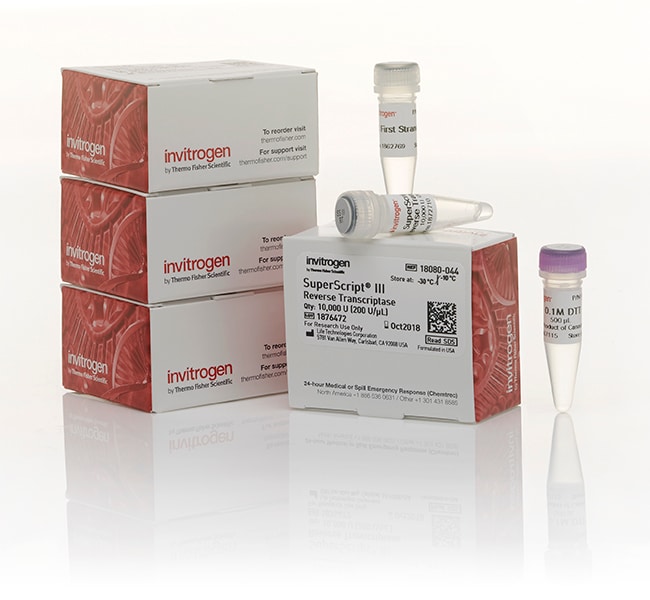
SuperScript™ III 역전사 효소
해당 제품을 구매한 고객들이 함께 검색한 제품을 추천해드립니다. 온라인 할인 진행 중!
SuperScript™ III 역전사 효소
Invitrogen™

SuperScript™ III 역전사 효소

Invitrogen SuperScript III Reverse Transcriptase는 RNase H 활성 감소, 반감기 증가 및 열 안정성 향상을 위해 여러 돌연변이를 도입하여 유전적으로자세히 알아보기
Have Questions?
보기 방식 변경buttonViewtableView
카탈로그 번호반응 수
18080085200 Reactions
1808009310 Reactions
1808004450 Reactions
카탈로그 번호 18080085
제품 가격(KRW)
1,840,000
キャンペーン価格
Ends: 31-Dec-2025
2,164,000
할인액 324,000 (15%)
Each
카트에 추가하기
반응 수:
200 Reactions
대량 주문 또는 맞춤형 요청
제품 가격(KRW)
1,840,000
キャンペーン価格
Ends: 31-Dec-2025
2,164,000
할인액 324,000 (15%)
Each
카트에 추가하기
Invitrogen SuperScript III Reverse Transcriptase는 RNase H 활성 감소, 반감기 증가 및 열 안정성 향상을 위해 여러 돌연변이를 도입하여 유전적으로 조작된 MMLV 역전사 효소(RT)입니다. SuperScript III RT는 야생형 MMLV 및 MMLV RNase H-minus 효소보다 더 높은 cDNA 수율, cDNA 길이 개선, GC-rich 표적 RNA에 대한 개선된 효율성 및 전반적으로 더 나은 성능을 제공합니다.

SuperScript RT는 현재까지 50,000 건이 넘는 인용, 리뷰 및 논문과 함께 가장 신뢰성이 높고 널리 사용되는 RT입니다.

참고: SuperScript RT 제품군의 최신 제품인 SuperScript IV Reverse Transcriptase는 최적의 순도 또는 무결성을 제공하며 RNA 샘플에 사용 시 향상된 열안정성, processivity, 수율 및 성능을 제공합니다.

연구용으로만 사용하십시오. 진단용으로는 사용할 수 없습니다.
사양
최종 제품 유형First-Strand cDNA
형식독립형 효소
반응 수200 Reactions
최적 반응 온도50° C
수량4 x 10,000 units
반응 형식Separate components
시약 유형Reverse Transcription
역전사 효소SuperScript™ III
리보뉴클레아제 H 활성감소
배송 조건Dry Ice
크기(최종 제품)Up to 12.3 kb
시작 물질RNA
기술Reverse Transcription
농도200 U/μL
GC-Rich PCR Performance높음
반응 속도표준
Unit SizeEach
구성 및 보관
SuperScript™ III 역전사 효소(총 4× 10,000 유닛, 200U/µL)에는 5X 제1가닥 버퍼[250mM Tris-HCl(pH 8.3), 375mM KCl, 15mM MgCl2] 바이알(4 × 1mL) 및 100mM DTT 바이알(4 × 500µL)이 제공됩니다. -20°C에서 보관하십시오.

자주 묻는 질문(FAQ)

Which components of the SuperScript III First Strand Synthesis System for RT-PCR are available for purchase separately?

The following components are available as stand-alone items:

- Superscript III Reverse Transcriptase (Cat. Nos. 18080093, 18080044, 18080085)
- Oligo (dT)20 Primer (Cat. No. 18418020)
- Random hexamers (Cat. No. 48190011)
- 10 mM dNTP Mix (Cat. Nos. 18427013, 18427088)
- RNAseOUT Recombinant Ribonuclease Inhibitor (Cat. No. 10777019)
- E. coli RNAse H (Cat. Nos. 18021014, 18021071)

I am interested in generating cDNA from total RNA. What is the difference between SuperScript III Reverse Transcriptase and SuperScript III First Strand Synthesis System for RT-PCR?

SuperScript III Reverse Transcriptase (Cat. Nos. 18080093, 18080044, 18080085) contains the stand-alone enzyme and a vial each of 5X first-strand buffer and 100 mM DTT.

SuperScript III First Strand Synthesis System for RT-PCR is a complete kit that provides the SuperScript III Reverse Transcriptase and all the other components required for synthesis of first-strand cDNA from total or poly(A)- RNA. It includes:
- Superscript III Reverse Transcriptase
- Oligo (dT)20 Primer
- Random hexamers
- 10X RT buffer
- 25 mM MgCl2
- 0.1 M DTT
- 10 mM dNTP Mix
- RNAseOUT Recombinant Ribonuclease Inhibitor
- E. coli RNAse H
- DEPC-treated water
- Total HeLa RNA control
- Sense control primer
- Anti-sense control primer
Note: The kit does not include the PCR amplification enzyme.

How can I remove genomic DNA contamination from my sample prior to performing RT-PCR?

We recommend using ezDNase (Cat. No. 11766051). ezDNase Enzyme's high specificity for double-stranded DNA enables efficient and fast genomic DNA removal without reduction in the quality or quantity of RNA. ezDNase Enzyme is heat-labile and so can be easily deactivated by heat treatment at moderate temperature (55 degrees C). These features make ezDNase Enzyme an excellent choice for genomic DNA removal prior to reverse transcription reactions.

How much RNA should be employed for first-strand cDNA synthesis?

The amount of RNA template for a cDNA synthesis is highly flexible and depends upon the amount of sample available and an individual's need. In general, 1 µg total RNA is used in a typical 20-µL RT reaction.

Find additional tips, troubleshooting help, and resources within ourReverse Transcription and RACE Support Center.

Should I treat the cDNA with RNase H prior to downstream processing?

RNase H treatment is not always necessary. Many PCR reactions work without it. However, for cDNA synthesized with RNase H-deficient reverse transcriptases (like SuperScript II, III, and IV), RNA/cDNA hybrids—especially GC-rich ones—may not denature well, reducing PCR sensitivity. RNase H treatment can help in such cases. Additionally, RNase H treatment is beneficial for cloning larger fragments.