Search


인용 및 참조 문헌 (33)
Gibco™
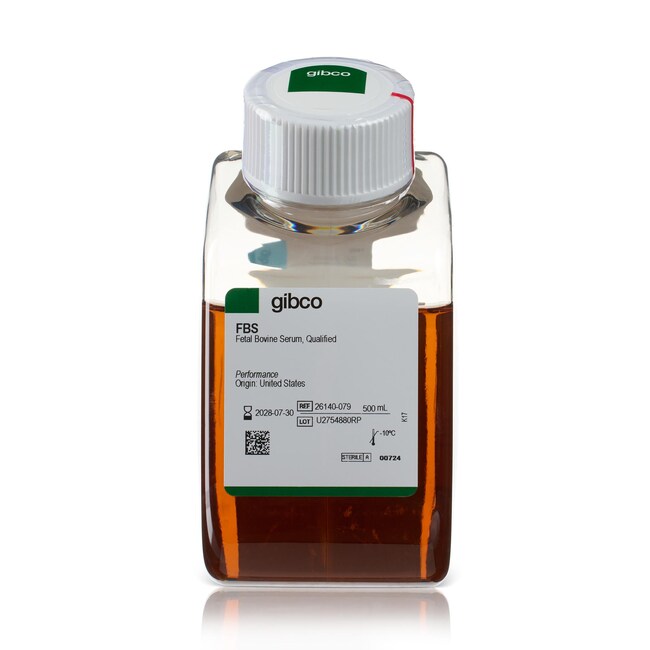
Fetal Bovine Serum, qualified, 미국
Gibco fetal bovine sera는 기본 세포 배양, 특수 연구 및 특정 분석에 뛰어난 가치를 제공하며, 연구자의 연구 요구 사항과 예산자세히 알아보기
| 카탈로그 번호 | 수량 | 형식 |
|---|---|---|
| 26140079 | 500 mL | 병 |
Premium Fetal Bovine Serum (FBS) 은 안정성 및 제조 공정은 그대로 유지되면서 품질이 더욱 강화되었습니다.
카탈로그 번호 26140079
제품 가격(KRW)
887,000
Each
Gibco fetal bovine sera는 기본 세포 배양, 특수 연구 및 특정 분석에 뛰어난 가치를 제공하며, 연구자의 연구 요구 사항과 예산 요구 사항을 충족할 수 있도록 일관된 품질 및 우수성을 널리 인정받은 지원을 통해 신뢰할 수 있는 결과를 제공합니다.
Gibco 혈청: 일관된 성능을 위한 믿을 수 있는 품질
Gibco 혈청 카테고리: Value Plus(Performance)
• 일반적인 세포주를 사용한 일반 세포 배양 용도
• 낮은 엔도톡신 및 헤모글로빈 함량
• 엔도톡신 함량: < 10 EU/mL
• 헤모글로빈 함량: < 25 mg/dL
• 원산지: 미국
Gibco 혈청이 제공하는 이점
• ISO 13485 인증, FDA 등록 시설에서 처리
• 체외 진단용 라벨(최고 수준의 USP 멸균 시험 준수)
• 0.1 μm에서 삼중 필터링됨
• Gibco 병은 후드 안에서도 사용이 간편하고 오염 위험을 줄이며 세포 배양을 보다 일관성 있게 수행할 수 있도록 도와줍니다.
• 떼어내기 쉬운 라벨 스티커는 실험실 노트북에 붙여서 로트 번호 및 유효기간 기록을 쉽게 참조할 수 있도록 해줍니다.
Gibco 혈청: 일관된 성능을 위한 믿을 수 있는 품질
Gibco 혈청 카테고리: Value Plus(Performance)
• 일반적인 세포주를 사용한 일반 세포 배양 용도
• 낮은 엔도톡신 및 헤모글로빈 함량
• 엔도톡신 함량: < 10 EU/mL
• 헤모글로빈 함량: < 25 mg/dL
• 원산지: 미국
Gibco 혈청이 제공하는 이점
• ISO 13485 인증, FDA 등록 시설에서 처리
• 체외 진단용 라벨(최고 수준의 USP 멸균 시험 준수)
• 0.1 μm에서 삼중 필터링됨
• Gibco 병은 후드 안에서도 사용이 간편하고 오염 위험을 줄이며 세포 배양을 보다 일관성 있게 수행할 수 있도록 도와줍니다.
• 떼어내기 쉬운 라벨 스티커는 실험실 노트북에 붙여서 로트 번호 및 유효기간 기록을 쉽게 참조할 수 있도록 해줍니다.
For research use or further manufacturing use only. Serum and blood proteins are not for direct administration into humans or animals.
사양
엔도톡신 농도≤ 10 EU/mL
헤모글로빈 농도≤ 25 mg⁄dl
순도 또는 품질 등급적합
배송 조건냉동 상태
종소
Age태아
원산지미국
형태액체
형식병
제품 유형소 태아 혈청(Fetal Bovine Serum)
수량500 mL
Serum TreatmentStandard (Sterile-Filtered)
멸균멸균
Sterilization MethodTriple-filtered, 0.1 μm
Unit SizeEach
구성 및 보관
보관 조건: ≤-10°C
배송 조건: 냉동 상태
배송 조건: 냉동 상태
자주 묻는 질문(FAQ)
What are the benefits and disadvantages of using heat-inactivated FBS in cell culture?
How long can I store Gibco Fetal Bovine Serum at 4 degrees C?
How should I thaw Gibco Fetal Bovine Serum?
How can I minimize lot-to-lot variability in serum?
Can I aliquot and refreeze serum?
인용 및 참조 문헌 (33)
인용 및 참조 문헌
Abstract
A functional role for the B56 alpha-subunit of protein phosphatase 2A in ceramide-mediated regulation of Bcl2 phosphorylation status and function.
Journal:J Biol Chem
PubMed ID:11929874
'Recently it has been shown that the potent apoptotic agent ceramide activates a mitochondrial protein phosphatase 2A (PP2A) and promotes dephosphorylation of the anti-apoptotic molecule Bcl2 (Ruvolo, P. P., Deng, X., Ito, T., Carr, B. K., and May, W. S. (1999) J. Biol. Chem. 274, 20296-20300). In cells expressing Bcl2,
Metabolism of 4 beta -hydroxycholesterol in humans.
Journal:J Biol Chem
PubMed ID:12077124
'One of the major oxysterols in the human circulation is 4 beta-hydroxycholesterol formed from cholesterol by the drug-metabolizing enzyme cytochrome P450 3A4. Deuterium-labeled 4 beta-hydroxycholesterol was injected into two healthy volunteers, and the apparent half-life was found to be 64 and 60 h, respectively. We have determined earlier the half-lives
Activation of retinoic acid receptor-dependent transcription by all-trans-retinoic acid metabolites and isomers.
Journal:J Biol Chem
PubMed ID:12070176
'We have shown that four metabolites of all-trans-retinoic acid (ATRA) (4-oxo-, 4-OH-, 18-OH-, and 5,6-epoxy-RA) can induce maturation of NB4 promyelocytic leukemia cells (Idres, N., Benoit, G., Flexor, M. A., Lanotte, M., and Chabot, G. G. (2001) Cancer Res. 61, 700-705). To better understand the mechanism of action of ATRA
Interaction of human breast fibroblasts with collagen I increases secretion of procathepsin B.
Journal:J Biol Chem
PubMed ID:12072442
'Interactions of stromal and tumor cells with the extracellular matrix may regulate expression of proteases including the lysosomal proteases cathepsins B and D. In the present study, we determined whether the expression of these two proteases in human breast fibroblasts was modulated by interactions with the extracellular matrix component, collagen
A ligand-inducible epidermal growth factor receptor/anaplastic lymphoma kinase chimera promotes mitogenesis and transforming properties in 3T3 cells.
Journal:J Biol Chem
PubMed ID:11919185
'Oncogenic rearrangements of the anaplastic lymphoma kinase (ALK) gene, encoding a receptor type tyrosine kinase, are frequently associated with anaplastic large cell lymphomas. Such rearrangements juxtapose the intracellular domain of ALK to 5''-end sequences belonging to different genes and create transforming fusion proteins. To understand how the oncogenic versions of