Search

Gibco™
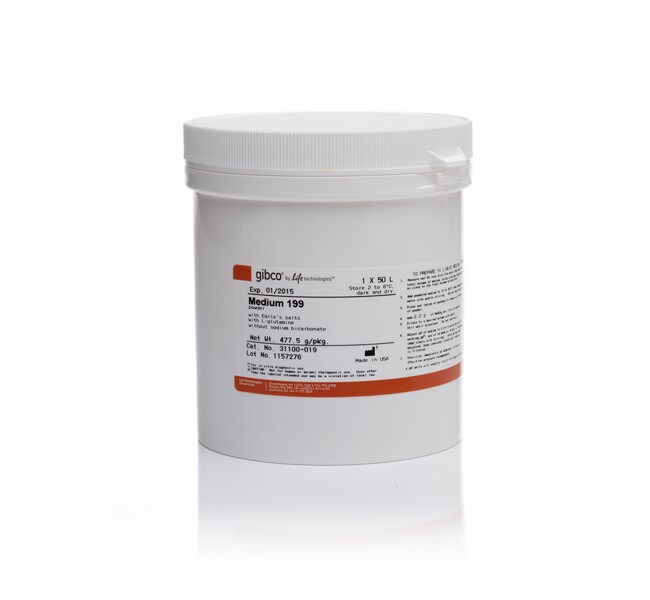
Medium 199, Earle's Salts, powder
Medium 199 was originally developed for nutritional studies of chick embryo fibroblasts. It has broad species applicability, particularly for cultivation자세히 알아보기
Have Questions?
보기 방식 변경

| 카탈로그 번호 | 수량 |
|---|---|
| 31100019 | 50 L |
| 31100035 | 10 x 1 L |
카탈로그 번호 31100019
제품 가격(KRW)
260,000
Each
수량:
50 L
제품 가격(KRW)
260,000
Each
Medium 199 was originally developed for nutritional studies of chick embryo fibroblasts. It has broad species applicability, particularly for cultivation of non-transformed cells. Medium 199 is widely used in virology, vaccine production, and in vitro cultivation of primary explants of mouse pancreatic epithelium, and rat lens tissues. We offer a variety of Gibco™ Medium 199 modifications for a range of cell culture applications. Find the right formulation using the media selector tool.
The complete formulation is available.
Compared to other basal media, Medium 199 contains unique components, including adenine, adenosine, hypoxanthine, thymine, and additional vitamins. Medium 199 is available with Earle's salts for use in a CO2 incubator, or with Hanks' salts for use without CO2.
In Vitro Diagnostic
Gibco™ Medium 199 is manufactured in compliance with the requirements of ISO 13485: 2003 for the design, development, manufacture, and distribution of liquid and powder tissue culture media, sera, and reagents for cell culture research, industrial bioprocessing, and related markets.
Dual-Site cGMP Manufacturing
Gibco™ Medium 199 is manufactured in a cGMP New York facility that is registered with the FDA as a medical device manufacturer and is certified to ISO 13485 . For supply chain continuity, we offer a comparable Gibco™ Medium 199 product made in the Scotland facility (31100-027). This second cGMP manufacturing location is also registered with the FDA as a medical device manufacturer and is certified to ISO 13485. Medium 199 contains no proteins, lipids, or growth factors. Medium 199 uses a sodium bicarbonate buffer system (2.2 g/L) and therefore requires a 5–10% CO2 environment to maintain physiological pH. Powder forms of Gibco™ cell culture medium require sodium bicarbonate supplementation, pH adjustment, and filtration at the time of preparation (see protocol for details).
This product is not used for in vitro diagnostic purpose in some countries.
This M199 is modified as follows:
| With | Without |
| • L-glutamine | • HEPES |
| • Phenol Red | • Sodium bicarbonate |
The complete formulation is available.
Compared to other basal media, Medium 199 contains unique components, including adenine, adenosine, hypoxanthine, thymine, and additional vitamins. Medium 199 is available with Earle's salts for use in a CO2 incubator, or with Hanks' salts for use without CO2.
In Vitro Diagnostic
Gibco™ Medium 199 is manufactured in compliance with the requirements of ISO 13485: 2003 for the design, development, manufacture, and distribution of liquid and powder tissue culture media, sera, and reagents for cell culture research, industrial bioprocessing, and related markets.
Dual-Site cGMP Manufacturing
Gibco™ Medium 199 is manufactured in a cGMP New York facility that is registered with the FDA as a medical device manufacturer and is certified to ISO 13485 . For supply chain continuity, we offer a comparable Gibco™ Medium 199 product made in the Scotland facility (31100-027). This second cGMP manufacturing location is also registered with the FDA as a medical device manufacturer and is certified to ISO 13485. Medium 199 contains no proteins, lipids, or growth factors. Medium 199 uses a sodium bicarbonate buffer system (2.2 g/L) and therefore requires a 5–10% CO2 environment to maintain physiological pH. Powder forms of Gibco™ cell culture medium require sodium bicarbonate supplementation, pH adjustment, and filtration at the time of preparation (see protocol for details).
This product is not used for in vitro diagnostic purpose in some countries.
사양
세포주Rat epithelial
세포 유형Chick Embryo Fibroblasts, Mouse Pancreatic Epithelium, Rat Lens Tissues
제조 품질cGMP-compliant under the ISO 13485 standard
제품라인Gibco
수량50 L
배송 조건Room Temperature
형태Powder
첨가제 포함Low Glucose, Phenol Red
첨가제 없음No HEPES, No Sodium Pyruvate
Unit SizeEach
구성 및 보관
Storage conditions: 2-8° C
Shipping conditions: Ambient
Shelf life: 36 months from date of manufacture
Shipping conditions: Ambient
Shelf life: 36 months from date of manufacture