Search

Thermo Scientific™
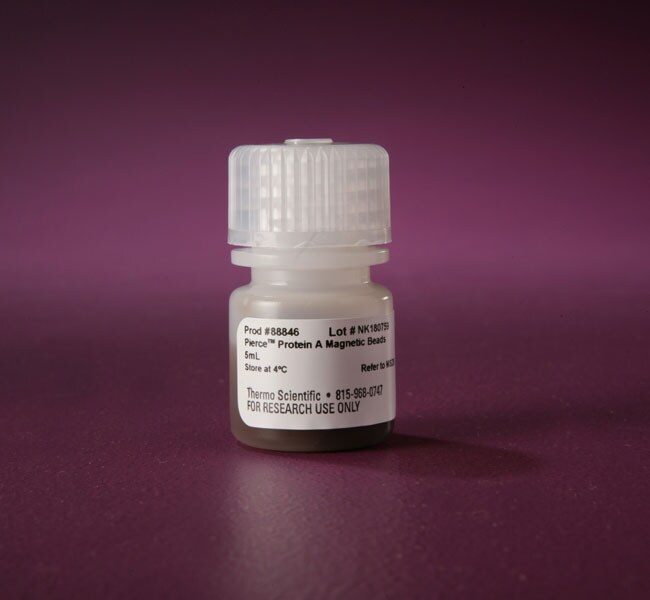
Pierce™ Protein A Magnetic Beads
Perform antibody purification and immunoprecipitation methods using manual or robotic magnetic separators with these high-capacity and high-throughput affinity particles.
Have Questions?
보기 방식 변경

| 카탈로그 번호 | 수량 |
|---|---|
| 88846 | 5 mL |
| 88845 | 1 mL |
카탈로그 번호 88846
제품 가격(KRW)
1,229,000
온라인 행사
Ends: 30-Sep-2026
1,365,000할인액 136,000 (10%)
Each
수량:
5 mL
제품 가격(KRW)
1,229,000
온라인 행사
Ends: 30-Sep-2026
1,365,000할인액 136,000 (10%)
Each
Thermo Scientific Pierce Protein A Magnetic Beads are high-capacity and high-throughput affinity particles for antibody purification and immunoprecipitation methods using manual or robotic magnetic separators.
Features of Protein A Magnetic Beads:
- High efficiency – equivalent or higher yield of IP target antigens than magnetic beads from other suppliers
- Low non-specific binding – stable, pre-blocked beads provide highly purified product (e.g., antigen eluted in IP with antibody is devoid of contaminating protein from complex cell lysate)
- Consistent – magnetic beads eliminate resin loss and provide for more efficient separation than traditional IP methods that use only centrifugation
- Versatile – beads are compatible with manual and automated workflows (e.g., Thermo Scientific KingFisher Instruments)
Recombinant protein A, covalently attached to a blocked magnetic bead surface, can bind to antibodies from many different species, enabling purification of antibodies from crude extracts. Immunoprecipitation assays performed with protein A coated beads result in high yield of target antigen with very low background. Using our crosslinker chemistry, you can immobilize an antibody onto the magnetic particle and prevent IgG contamination in IP or Co-IP experiments. The Pierce Protein A Magnetic Beads can be used manually with a magnetic stand, as well as with automated platforms, such as the Thermo Scientific KingFisher Instruments, for high-throughput workflows.
Applications:
- IP and Co-IP experiments
- Antibody purification
Thermo Scientific Pierce Protein A Magnetic Beads are used for purifying antibody from serum, cell culture supernatant or ascites, as well as for IP/Co-IP of antigens from cell or tissue extracts. Protein A can bind to antibodies from many different species, including mouse, human, rabbit, pig, dog, and cat. The protocol for the Pierce Protein A beads has been optimized to allow for high recovery and high purity of the isolated antibody or antigen. Antibody or antigen/antibody complex (IP) is first captured on the magnetic beads. The beads are washed and then the target is eluted with low pH elution buffer. IP performance is equivalent to or better than Protein A magnetic beads from other suppliers.
For Research Use Only. Not for use in diagnostic procedures.
Thermo Scientific™ Pierce Protein A Magnetic Beads are used for purifying antibody from serum, cell culture supernatant or ascites, as well as for IP/Co–IP of antigens from cell or tissue extracts. Protein A can bind to antibodies from many different species, including mouse, human, rabbit, pig, dog, and cat. The protocol for the Pierce Protein A beads has been optimized to allow for high recovery and high purity of the isolated antibody or antigen. Antibody or antigen/antibody complex (IP) is first captured on the magnetic beads. The beads are washed and then the target is eluted with low pH elution buffer. IP performance is equivalent to or better than Protein A magnetic beads from other suppliers.
사양
제제Slurry: 10 mg/mL, 1% solids
리간드 유형Protein A
수량5 mL
타겟Antibody
입자 크기1 μm
제품라인Pierce
유형Magnetic Affinity Bead
Unit SizeEach
구성 및 보관
Upon receipt store at 4°C. Product shipped with an ice pack.