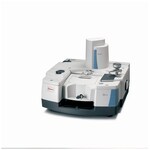
Nicolet™ iS™ 50 FTIR Spectrometer
Thermo Scientific™

Nicolet™ iS™ 50 FTIR Spectrometer

용도에 따른 액세서리 및 통합 소프트웨어를 특징으로 하며 분석 문제를 쉽게 해결해주는 Thermo Scientific™ Nicolet™ iS™50은 다기능 물질 분석 시스템입니다.

Have Questions?
카탈로그 번호성능 검증스펙트럼 범위
912A0760고객의 ISO/GLP 요건 만족을 위한 ASTM E1421,15 - 27,000cm¹
카탈로그 번호 912A0760
제품 가격(KRW)
-
견적 요청하기
성능 검증:
고객의 ISO/GLP 요건 만족을 위한 ASTM E1421,
스펙트럼 범위:
15 - 27,000cm¹

용도에 따른 액세서리 및 통합 소프트웨어를 특징으로 하며, 다기능 물질 분석 워크스테이션을 구성하는 Thermo Scientific™ Nicolet™ iS™ 50 FTIR Spectrometer를 사용하여 분석 작업의 문제를 쉽게 해결할 수 있습니다.

유연성이 높게 설계된 Nicolet iS 50 FTIR Spectrometer는 간단한 FT-IR 벤치를 원적외선부터 가시광선에 이르는 스펙트럼을 획득할 수 있는 완전 자동화된 멀티-스펙트럼 시스템으로 업그레이드할 수 있습니다. 버튼 하나를 눌러 새로운 ATR, Raman 및 NIR 모듈을 시작할 수 있으며 수동으로 시스템 구성 요소를 변경할 필요없이 이러한 기법에 액세스할 수 있습니다.

분석 실험실에서 빠르고 간편한 워크플로우가 중요한 경우 Nicolet iS 50 FT-IR Spectrometer가 가장 적합한 해답이 될 수 있습니다.

Nicolet iS50 FT-IR Spectrometer의 특징:

  • 듀얼 소스 사용 가능
  • Polaris™ long-life IR 소스
  • 텅스텐-할로겐 백색 광원
  • 메인 시료 컴파트먼트의 3개 검출기
  • 고-분해능 표준
  • 검증 휠(validation wheel) 표준
  • 전체가 금 소재로 된 광학부 표준(알루미늄 소재도 제공됨)
  • 기존 액세서리에 대한 완벽한 지원
  • 전동식 고-분해능 에너지 스크린(표준)
  • 퍼지 셔터(purge shutter) 옵션
  • 전동식 필터 옵션
  • 전동식 편광기 옵션
  • 조준 또는 집중 방출 포트

Smart Accessory와 같이 지금까지 설명된 것들은 다음의 옵션 모듈을 통해 더욱 보강될 수 있습니다.

  • 빌트인 중적외선 및 원적외선 기능 다이아몬드 ATR
  • Automated Beamsplitter Exchanger (ABX)
  • 샘플 컴파트먼트Raman 액세서리
  • 적분구(Integrating Sphere) 및 광섬유가 연결된 NIR 모듈
  • TGA-IR 액세서리
  • GC-IR 모듈

더 자세한 정보는 기술 라이브러리를 방문하여 사양표와 브로셔를 참조하십시오.

  • 풋프린트 - base only: 25 x 27 x 11 in. (62.6 x 69.8 x 27.6cm)
  • 중량 - base only: 132 lb.(60kg)
  • 풋프린트 - ABX 포함: 25 x 27 x 20in. (62.6 x 69.8 x 50.8cm)
  • 중량 - base only: ABX 포함: 141 lb.(64kg)
  • Raman 및 전용 ATR에 풋프린트가 추가되지 않음
  • Nicolet iS50 NIR 모듈과 함께 사용할 경우 11 in.(27.9cm)만 증가

권장 용도:

  • 고분자 및 고무
  • 법의학 분야
  • 제약
  • 안료/페인트/잉크
  • 식품/향미/오일
  • 일반 실험실

클라우드 기반 FTIR 분광법
모든 Nicolet FTIR 분광기는 이제 언제 어디서나 어떤 장치에서도 스펙트럼 데이터를 저장, 공유 및 해석할 수 있습니다. 연구자, 실험 담당자, 교육 담당자 및 학생 모두 Thermo Fisher Cloud 기반의 Thermo Fisher Connect 계정을 사용하여 OMNIC Anywhere 앱을 통해 데이터에 쉽게 액세스할 수 있습니다.

  • 데이터 내보내기, 보기 및 공유 – PC, Apple 컴퓨터, Android 또는 iOS 장치에서 OMNIC Anywhere 앱을 사용하여 Nicolet .spa 스펙트럼 파일 보기, 스펙트럼 피크 표시 및 스펙트럼 베이스라인 수정 가능
  • 더 많은 저장 공간 추가 – 처음에는 10 GB의 저장 공간이 무료로 제공되며 필요에 따라 적은 비용으로 저장 공간 확장 가능. 또한 Thermo Fisher Connect 계정에 OMNIC .spa 파일뿐만 아니라 다른 파일(보고서 문서, .xls 등)도 저장 가능
  • 데이터 보안 – Thermo Fisher Connect는 업계 최고의 보안 및 데이터 보호 클라우드 컴퓨팅 플랫폼인 Amazon Web Service™를 사용하여 데이터 유출 또는 도난 방지
사양
빔 스플리터Automated Beamsplitter Exchanger (ABX)
구성 요소소스; 검출기; 빔스플리터
깊이(영국식 단위)27 in.
깊이(미터법)69.8cm
설명용도에 따른 액세서리 및 통합 소프트웨어를 특징으로 하며 분석 작업 문제를 쉽게 해결할 수 있는 Nicolet iS50는 다기능 물질 분석 시스템입니다.
검출기 유형사용자가 선택 가능한 최대 9개의 검출기
전기 요구사항100-240V 50/60 Hz
용도(애플리케이션)고분자 및 고무; 법의학; 제약;
용도(장비)SMART Accessory, TGA-IR, Continuum 현미경, 광음향, 대부분의 표준 액세서리; 가스 셀; GC-IR; FT-Raman; ABX; NIR; 내장형 ATR
높이(영국식 단위)11 in.
높이(미터법)27.6cm
습도주변 습기 차단을 위해 긴밀하게 밀봉됨
인터페이스PC USB 2.0
레이저HeNe
제품 유형Nicolet iS50 Analytical FTIR Spectrometer 및 소프트웨어
소스 유형듀얼 소스 사용 가능: Polaris™ long-life IR 소스
스펙트럼 범위15 - 27,000cm¹
스펙트럼 분해능0.09cm¹보다 향상
중량(영국식 단위)132 lb.
중량(미터법)60kg
폭(영국식 단위)25 in.
폭(미터법)62.6cm
성능 검증고객의 ISO/GLP 요건 만족을 위한 ASTM E1421,
전압100/240 V
Unit SizeEach

자주 묻는 질문(FAQ)

What is Raman spectroscopy?

In Raman spectroscopy, an unknown sample of material is illuminated with monochromatic (single wavelength or single frequency) laser light, which can be absorbed, transmitted, reflected, or scattered by the sample. Light scattered from the sample is due to either elastic collisions of the light with the sample's molecules (Rayleigh scatter) or inelastic collisions (Raman scatter). Whereas Rayleigh scattered light has the same frequency (wavelength) of the incident laser light, Raman scattered light returns from the sample at different frequencies corresponding to the vibrational frequencies of the bonds of the molecules in the sample.

If you wish to learn more about Raman spectroscopy, visit our online Raman Spectroscopy Academy (https://www.thermofisher.com/us/en/home/industrial/spectroscopy-elemental-isotope-analysis/spectroscopy-elemental-isotope-analysis-learning-center/molecular-spectroscopy-information/raman-technology.html), where you will find basic Raman tutorials, advanced Raman webinars on sample applications, and a helpful instrument guide.

Using the Beer-Lambert law in FTIR ATR for quantitative analysis of a time-sensitive, migrating substance (e.g., erucamide) in a polymer is difficult. How can this be overcome?

The Beer-Lambert law is based on stable samples and reproducible conditions. In ATR, you have two concerns. First, the sample must make contact with the crystal in a consistent manner. If the material is rough or crystalline, you must ensure reproducibility. Grinding the material to a fine powder may be necessary. Second, ATR is a surface technique, examining the sample to a depth of around 1-4 microns. If the additive or target molecule is migrating further away, you will lose the signal. In this case, transmission, which illuminates the entire sample and entire thickness, may be a viable option (depending upon thickness). In some cases, the application of pressure can change the signal due to changes in the crystallinity or orientation of polymer strands in the sample. Any deeper insights would require an understanding of the specific sample involved.

What types of sampling cells and detectors are used for protein analysis using Fourier Transform Infrared Spectroscopy (FTIR)?

One key experimental step in protein analysis is the removal of the water bands (most proteins are in buffers). This requires highly controlled path-length transmission cells or ATR. Most historical work was done in 6-10 micron path length transmission cells using BaF2 or similar windows. The analytical region is roughly between 1400 and 1750cm-1 where these windows are transmissive. Recently, ATR devices using silicon, germanium, or diamond windows have become more prevalent. Reactions or binding of proteins to the crystal can occur with ZnSe devices (due to surface charges); sometimes this is desired but often it is not. Most of the literature is based on transmission cells. Protein analysis requires skill and consistency, so training is essential for most laboratories.

What is the advantage of DRIFTS compared to ATR technique in Fourier Transform Infrared Spectroscopy (FTIR)? What is the difference?

DRIFTS is used in both mid-IR and near-IR. In the mid-IR, DRIFTS requires the sample be blended with diluents like KBr, with 3-10% sample. This is typically undesirable as the sample is now mixed. However, DRIFTS is heavily used in catalysis research where powdered material is exposed to high temperature, elevated pressures, and mixtures of reactant gases. Several accessory suppliers make devices specific for this. In the near-IR, DRIFTS is used without dilution through direct measurement - many hand-held probes exist allowing analysis through a container wall (like plastic bags) meaning the sample can be analyzed without touching or contaminating it.

ATR involves making contact with the sample by forcing it into contact with a crystal. ATR generally does not require dilution and works well with solids like credit cards or car bumpers which would be tough in DRIFTS. ATR has, for the most part, displaced DRIFTS in the mid-IR except in special cases, while DRIFTS remains a method of choice in the near-IR world.

What are some subtleties and scenarios in inorganic applications for Fourier Transform Infrared Spectroscopy (FTIR)?

Fourier Transform Infrared Spectroscopy (FTIR) responds to a change in dipole moment, regardless of whether it is organic or inorganic. Metal oxides, carbonates, and carbonyls are good examples. The basic equation states that the wavenumber is proportional to the square root of the spring constant (bond strength) and one over the square root of the reduced mass. Simply put, as mass of the atoms involved in the bond goes up, the wavenumber goes down. Many inorganics have peaks below 400cm-1, such as ferrocene, acetylferrocene and cadmium oxide. This necessitates the use of “far-IR” optics. Many forensics users have found far-IR useful in identifying paint chips, due to their inorganic content. There are several ATR accessories that now permit far-IR ATR (mostly monolithic diamond devices). The Thermo Scientific Nicolet iS50 FTIR Spectrometer was designed to make far-IR performance trivial with a built-in ATR as well. Ultimately, if you have further interest in this area, you need to speak with an FTIR sales person to understand the capabilities and limitations.