Search


인용 및 참조 문헌 (3)
Invitrogen™
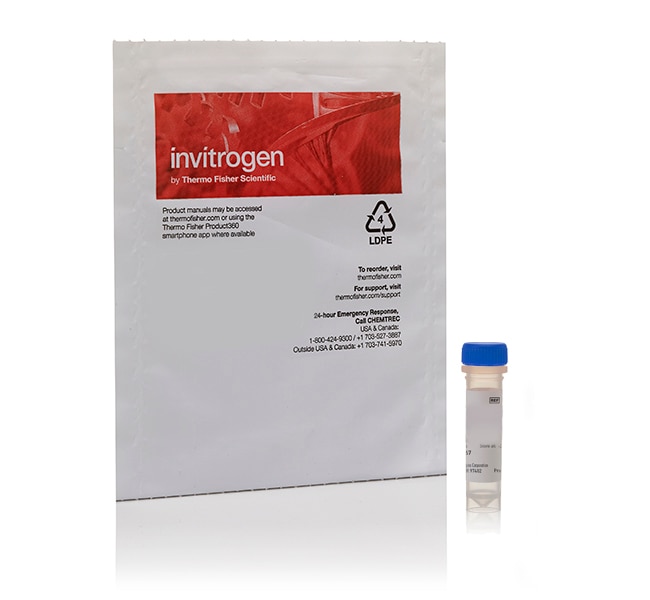
Avidin, NeutrAvidin™, Alexa Fluor™ 350 conjugate
Avidin, NeutrAvidin™, Alexa Fluor™ 350 conjugate
| 카탈로그 번호 | 수량 |
|---|---|
| A11236 | 1 mg |
카탈로그 번호 A11236
제품 가격(KRW)
-
수량:
1 mg
Our Alexa Fluor 350 conjugate of NeutrAvidin biotin-binding protein – a form of avidin that has been processed to remove carbohydrate and to lower its isoelectric point – can substantially decrease background due to nonspecific binding. The method used to deglycosylate the avidin retains its specific binding. This bright, blue-fluorescent reagent (absorption/emission maxima ∼346/442 nm) is ideal for detecting biotinylated targets in fluorescence microscopy and flow cytometry applications.
For Research Use Only. Not for use in diagnostic procedures.
사양
라벨 또는 염료Alexa Fluor Dyes
수량1 mg
배송 조건Room Temperature
콘주게이트Alexa Fluor 350
제품라인Alexa Fluor, NeutrAvidin
Unit SizeEach
구성 및 보관
Store in freezer (-5 to -30°C) and protect from light.
인용 및 참조 문헌 (3)
인용 및 참조 문헌
Abstract
A novel p21-activated kinase binds the actin and microtubule networks and induces microtubule stabilization.
Journal:J Cell Biol
PubMed ID:11733543
'Coordination of the different cytoskeleton networks in the cell is of central importance for morphogenesis, organelle transport, and motility. The Rho family proteins are well characterized for their effects on the actin cytoskeleton, but increasing evidence indicates that they may also control microtubule (MT) dynamics. Here, we demonstrate that a
Concentration and separation of proteins in microfluidic channels on the basis of transverse IEF.
Journal:Anal Chem
PubMed ID:11321320
'The use of microfluidic channels formed by two electrodes made of gold or palladium to perform transverse isoelectric focusing (IEF) is presented as a means for continuous concentration and fractionation of proteins. The microchannels were 40 mm long with an electrode gap of 1.27 mm and a depth of 0.354
iSLIM: a comprehensive approach to mapping and characterizing gene regulatory networks.
Journal:Nucleic Acids Res
PubMed ID:23258699
Mapping gene regulatory networks is a significant challenge in systems biology, yet only a few methods are currently capable of systems-level identification of transcription factors (TFs) that bind a specific regulatory element. We developed a microfluidic method for integrated systems-level interaction mapping of TF-DNA interactions, generating and interrogating an array