Search


인용 및 참조 문헌 (8)
Thermo Scientific™
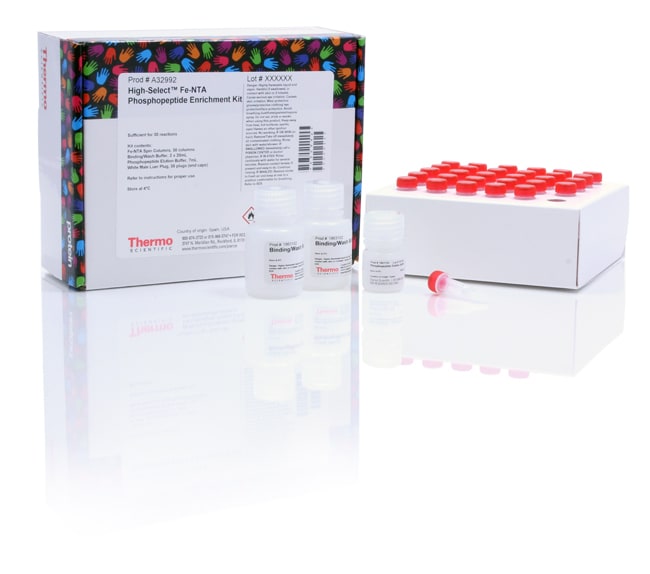
High Select™ Phosphopeptide Enrichment Kits & Reagents
The expanded High Select family of complete kits supports enrichment of phosphorylated peptides using Fe-NTA and TiO2 immobilized resins in spin column, tip, and magnetic bead formats designed for use with MS analysis.
Have Questions?
보기 방식 변경

| 카탈로그 번호 | 수량 | 제품 유형 |
|---|---|---|
| A32992 | 30 Reactions | Fe-NTA Phosphopeptide Enrichment Kit |
| A32993 | 24 Reactions | TiO2 Phosphopeptide Enrichment Kit |
| 88302 | 30 Columns | Graphite Spin Column |
| 88303 | 96 Tips | TiO2 Phosphopeptide Enrichment Spin Tips |
카탈로그 번호 A32992
제품 가격(KRW)
623,000
線上優惠
Ends: 31-Dec-2026
692,000할인액 69,000
Each
수량:
30 Reactions
제품 유형:
Fe-NTA Phosphopeptide Enrichment Kit
제품 가격(KRW)
623,000
線上優惠
Ends: 31-Dec-2026
692,000할인액 69,000
Each
Mass spectrometry (MS) is a key tool for identifying sites of protein phosphorylation and quantifying phosphorylation changes. However, MS analysis of protein phosphorylation is challenging due to the low stoichiometry, high hydrophilicity, poor ionization, and incomplete fragmentation of phosphopeptides. Given the low relative abundance of phosphorylation modifications in complex protein samples, enrichment is essential for successful MS analysis of phosphopeptides. High-Select Fe-NTA and TiO2 phosphopeptide enrichment kits complement our lysis, reduction, alkylation, and digestion reagents, along with our C18, graphite spin, and high-pH reversed-phase peptide fractionation columns to provide a complete workflow for phosphopeptide enrichment.
- Convenient—pre-formulated buffers for ease-of-use in spin-column (Fe-NTA and TiO2) or magnetic (Fe-NTA) formats to enable parallel processing of multiple samples
- High specificity—recovers phosphopeptides with > 90% selectivity
- Superior recovery—enriches more total and unique phosphopeptides than other commercially available resins
- High coverage—recovers peptides with single and multiple phosphorylation sites
- Scalable—compatible with automation, including the use of KingFisher magnetic particle processors
High-Select Fe-NTA Phosphopeptide Enrichment Kit enriches phosphopeptides from complex samples using iron-chelate resin in spin columns. Each column can enrich phosphopeptides from 0.5 to 5 mg of total protein digest as starting sample. Together with pre-formulated buffers, the improved and simplified procedure enriches up to 150 μg of phosphopeptides with greater than 90% selectivity in less than 45 minutes.
High-Select TiO2 Phosphopeptide Enrichment Kit includes 24 titanium dioxide (TiO2) spin tips with optimized buffers to facilitate preparation of enriched phosphopeptides. Each column can enrich phosphopeptides from 0.5 to 3 mg of total protein digest as starting sample. The optimized buffers and simplified procedure eliminate the need for pyrrolidine in the elution buffer and subsequent clean-up using graphite spin columns. Use of this kit results in enrichment of up to 150 μg of phosphopeptides with greater than 90% selectivity. TiO2 enriches a unique set of phosphopeptides that complements the High-Select Fe-NTA IMAC Phosphopeptide Enrichment Kit.
For high resolution analysis of the enriched phosphopeptides, the recommended LC column for Nanospray Flex source is Acclaim PepMap 100 C18 LC Column (Cat. No. 164942 or 164939). For EASY-Spray source, the recommended LC column is EASY-Spray C18 LC Column (Cat. No. ES902 or ES903). The stand-alone High Select Fe-NTA Magnetic Agarose beads provide flexibility for scale and throughput and may be used in both manual and automated platforms, including KingFisher 96 and KingFisher Flex magnetic particle processors.
For Research Use Only. Not for use in diagnostic procedures.
사양
최종 제품 유형Peptides
용도(장비)Microcentrifuge
라벨 또는 염료Unlabeled
수량30 Reactions
배송 조건Wet Ice
워크플로우 단계Peptide Enrichment
검출 방법Mass Spectrometry
형식Kit
제품라인High Select
제품 유형Fe-NTA Phosphopeptide Enrichment Kit
시작 물질Protease-digested Protein
Unit SizeEach
구성 및 보관
• Spin columns (30)
• White Luer plug (end cap) (30)
• Binding/Wash Buffer (2 x 20 mL)
• Phosphopeptide Elution Buffer (7 mL)
• White Luer plug (end cap) (30)
• Binding/Wash Buffer (2 x 20 mL)
• Phosphopeptide Elution Buffer (7 mL)
자주 묻는 질문(FAQ)
Should I desalt my peptide samples before enrichment using the High Select Phosphopeptide Enrichment Kits?
In the SMOAC protocol (https://www.thermofisher.com/blog/learning-at-the-bench/wp-content/uploads/sites/13/2024/10/High-SelectTM-SMOAC-Protocol.pdf), can I enrich with High-Select Fe-NTA kit first?
Why do you offer two phosphopeptide enrichment kits: the High-Select TiO2 kit (Cat. No. A32993) and the High-Select Fe-NTA kit (Cat. No. A32993)?
What are the differences between the old Fe-NTA kit (Cat. No. 88300) and the new High-Select Fe-NTA kit (Cat. No. A32992)?
What type of samples can I use with the High-Select Fe-NTA Phosphopeptide Enrichment Kit and High-Select Fe-NTA Magnetic Phosphopeptide Enrichment Kit?
인용 및 참조 문헌 (8)
인용 및 참조 문헌
Abstract
Phosphorylation of pyruvate dehydrogenase inversely associates with neuronal activity.
Journal:Neuron
PubMed ID:38266644
For decades, the expression of immediate early genes (IEGs) such as FOS has been the most widely used molecular marker representing neuronal activation. However, to date, there is no equivalent surrogate available for the decrease of neuronal activity. Here, we developed an optogenetic-based biochemical screen in which population neural activities
Phosphoproteomics Reveals Selective Regulation of Signaling Pathways by Lysophosphatidic Acid Species in Macrophages.
Journal:Cells
PubMed ID:38786034
Lysophosphatidic acid (LPA) species, prevalent in the tumor microenvironment (TME), adversely impact various cancers. In ovarian cancer, the 18:0 and 20:4 LPA species are selectively associated with shorter relapse-free survival, indicating distinct effects on cellular signaling networks. Macrophages represent a cell type of high relevance in the TME, but the
Increase of Phosphoprotein Expressions in Amotosalen/UVA-Treated Platelet Concentrates.
Journal:Transfusion medicine and hemotherapy : offizielles Organ der Deutschen Gesellschaft fur Transfusionsmedizin und Immunhamatologie
PubMed ID:38584699
BACKGROUND: Pathogen inactivation treatment (PIT) has been shown to alter platelet function, phenotype, morphology and to induce a faster aging of platelet concentrates (PCs). Key pieces of information are still missing to understand the impacts of PITs at the cellular level. OBJECTIVES: This study investigated the impact of amotosalen/UVA on
TMTpro-18plex: The Expanded and Complete Set of TMTpro Reagents for Sample Multiplexing.
Journal:Journal of proteome research
PubMed ID:33900084
The development of the TMTpro-16plex series expanded the breadth of commercial isobaric tagging reagents by nearly 50% over classic TMT-11plex. In addition to the described 16plex reagents, the proline-based TMTpro molecule can accommodate two additional combinations of heavy carbon and nitrogen isotopes. Here, we introduce the final two labeling reagents,
Phosphoproteomic Profiling Reveals mTOR Signaling in Sustaining Macrophage Phagocytosis of Cancer Cells.
Journal:Cancers
PubMed ID:39766137
Background: Macrophage-mediated cancer cell phagocytosis has demonstrated considerable therapeutic potential. While the initiation of phagocytosis, facilitated by interactions between cancer cell surface signals and macrophage receptors, has been characterized, the mechanisms underlying its sustentation and attenuation post-initiation remain poorly understood. Methods: Through comprehensive phosphoproteomic profiling, we interrogated the temporal evolution