Search


인용 및 참조 문헌 (2)
Invitrogen™
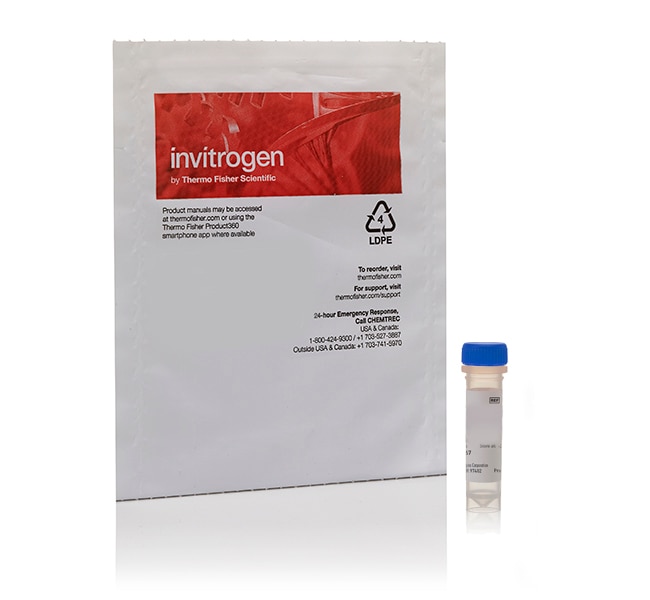
Click-IT™ Geranylgeranyl Alcohol, Azide, mixed isomers
Identify and characterize geranylated proteins with Click-iT® geranylgeranyl alcohol, azide using the powerful click chemistry, a simple and robust two-step자세히 알아보기
| 카탈로그 번호 | 수량 |
|---|---|
| C10249 | 1 mg |
카탈로그 번호 C10249
제품 가격(KRW)
1,097,000
Online offer
Ends: 31-Dec-2026
1,290,000할인액 193,000 (15%)
Each
수량:
1 mg
제품 가격(KRW)
1,097,000
Online offer
Ends: 31-Dec-2026
1,290,000할인액 193,000 (15%)
Each
Identify and characterize geranylated proteins with Click-iT® geranylgeranyl alcohol, azide using the powerful click chemistry, a simple and robust two-step labeling and detection technique. In step one, the azide-containing biomolecule is fed to cells or animals and actively incorporated into proteins. Unlike other labels such as biotin or a fluorescent dye, the azide-tag is small enough that the tagged molecule is an acceptable substrate for the enzymes that incorporate this building block into proteins. Detection utilizes the chemoselective ligation or “click" reaction between and azide and an alkyne where the modified protein is detected with the corresponding alkyne-containing dye or hapten using either the Click-iT® Cell Reaction Buffer Kit or the Click-iT® Protein Buffer Kit. With the Click-iT® Cell Reaction Buffer Kit, cells can be analyzed by fluorescence microscopy, flow cytometry or high-content imaging and analysis (HCS) together with other biomarkers of interest for content and context rich results. With the Click-iT® Protein Reaction Buffer Kit, achieve detection sensitivity in 1-D gels and western blots in the low femtomole range or perform LC-MS⁄MS and MALDI MS analysis.
For Research Use Only. Not for use in diagnostic procedures.
사양
형식Solid
라벨링 방법Metabolic Labeling
제품라인Click-iT, Molecular Probes
제품 유형Geranylgeranyl Alcohol Azide
수량1 mg
배송 조건Dry Ice
Labeling TargetProteins, Proteins
라벨 또는 염료Azide
Unit SizeEach
구성 및 보관
Store at ≤-20°C, desiccated and protected from light.
자주 묻는 질문(FAQ)
I am observing no signal or very low signal for my click-labeled samples. What can I do to improve the signal?
인용 및 참조 문헌 (2)
인용 및 참조 문헌
Abstract
A novel approach to tag and identify geranylgeranylated proteins.
Journal:Electrophoresis
PubMed ID:19784953
A recently developed proteomic strategy, the
Dynamic monitoring of newly synthesized proteomes: up-regulation of myristoylated protein kinase A during butyric acid induced apoptosis.
Journal:Angew Chem Int Ed Engl
PubMed ID:21678537
Doubly charged: A double metabolic incorporation approach capable of proteome-wide profiling of post-translational modification dynamics on newly synthesized proteins has been developed (see scheme; blue box: methionine surrogate, orange diamond: PTM probe). This strategy reveals for the first time that up-regulation of myristoylated PKA protein is necessary for the occurrence