Search



인용 및 참조 문헌 (8)
Invitrogen™
Click-iT™ Plus TUNEL Assay Kits for In Situ Apoptosis Detection
Detect apoptosis in cells and tissues samples with Click-iT Plus TUNEL Assay kits, which offer easy dye incorporation and can be multiplexed with GFP and RFP.
Have Questions?
보기 방식 변경

| 카탈로그 번호 | 색상 | 라벨 또는 염료 |
|---|---|---|
| C10619 | Far-Red | Alexa Fluor™ 647 |
| C10617 | Green | Alexa Fluor™ 488 |
| C10618 | Red | Alexa Fluor™ 594 |
카탈로그 번호 C10619
제품 가격(KRW)
-
색상:
Far-Red
라벨 또는 염료:
Alexa Fluor™ 647
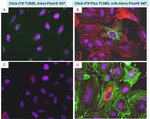
Detect more apoptotic cells in tissues and cultured cell samples with the Click-iT Plus TUNEL Assay for In Situ Apoptosis Detection, which offers Alexa Fluor 488, 594, and 647 fluorescent dye options. This in situ apoptosis detection kit is optimized for tissue or cell samples and the dyes can be multiplexed with other dyes or proteins, such as GFP and RFP, and incorporated more readily into complex molecules due to their smaller size (compared with antibodies). This TUNEL assay kit is also very flexible and can be used to test 1–50 samples in a single experiment.
The Click-iT Plus TUNEL Alexa Fluor 488, 594, and 647 assays for in situ apoptosis detection can detect apoptotic cells in tissue and cultured cell samples through the incorporation of a small, highly specific labeling moiety and a bright fluorescent dye. After incorporation of the labeling moiety into DNA fragments, detection is achieved through a catalyzed “click” reaction using conditions mild enough to preserve the emitted fluorescent signal from GFP or RFP.
Other advantages of the Click-iT Plus TUNEL Assay for In Situ Apoptosis Detection include:
• Optimized for the detection of apoptotic cells in either tissue or cell samples
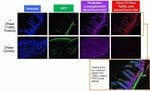
• Multiplex enabled—optimized to work with fluorescent dyes or proteins such as GFP and RFP
• Improved TUNEL assay—better label incorporation due to small reactive moiety
• Bright apoptotic signal—uses Alexa Fluor dyes, resulting in a stable, non-photobleaching fluorescent signal
• Flexibility—the assay can be configured to test 1–50 samples at a time
Fragmentation of cellular DNA is a hallmark of apoptosis. The TUNEL assay is the most widely used method to detect fragmented DNA in apoptotic cells or tissue samples. The TUNEL assay begins with incorporation of modified dUTP at the 3’-OH end of the fragmented DNA. The dUTP modification is often the addition of a fluorophore. Due to the size of the fluorophore, the modified dUTP can display lower than expected incorporation rates, which can affect the sensitivity of the TUNEL assay. Additionally, many fluorophores used in currently available TUNEL assay kits suffer from photobleaching and fluorescent spectral overlap issues, both of which reduce the sensitivity of and ability to multiplex the assay.
The Click-iT Plus TUNEL assay was developed to address these issues. The assay uses dUTP modified with an alkyne group (a small bio-orthogonal functional group), allowing the nucleotide to be more readily incorporated. After incorporation, a highly specific click reaction between the alkyne group and an Alexa Fluor picolyl azide fluorescent dye, and subsequent detection of that dye, results in a sensitive and specific assay for the detection of apoptotic cells or tissue samples. Because of its gentle reaction conditions, the Click-iT Plus TUNEL assay enables multiplexing with fluorescent proteins or dyes.
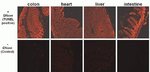
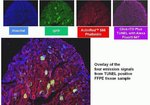
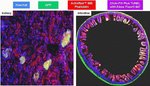
The Click-iT Plus TUNEL assay has been validated with several different formalin-fixed paraffin-embedded tissue types. In all cases, its ability to multiplex with fluorescent proteins and dyes was preserved. Additionally, the ability to stain actin using fluorescent-labeled phalloidin was also preserved.
The Click-iT Plus TUNEL assay contains all the reagents needed to detect apoptotic cells from either tissue or cell samples. The reagents supplied in this kit can be used to test 50 samples and can be configured to test 1–50 samples at a time.
Other advantages of the Click-iT Plus TUNEL Assay for In Situ Apoptosis Detection include:
• Optimized for the detection of apoptotic cells in either tissue or cell samples
• Multiplex enabled—optimized to work with fluorescent dyes or proteins such as GFP and RFP
• Improved TUNEL assay—better label incorporation due to small reactive moiety
• Bright apoptotic signal—uses Alexa Fluor dyes, resulting in a stable, non-photobleaching fluorescent signal
• Flexibility—the assay can be configured to test 1–50 samples at a time
Fragmentation of cellular DNA is a hallmark of apoptosis. The TUNEL assay is the most widely used method to detect fragmented DNA in apoptotic cells or tissue samples. The TUNEL assay begins with incorporation of modified dUTP at the 3’-OH end of the fragmented DNA. The dUTP modification is often the addition of a fluorophore. Due to the size of the fluorophore, the modified dUTP can display lower than expected incorporation rates, which can affect the sensitivity of the TUNEL assay. Additionally, many fluorophores used in currently available TUNEL assay kits suffer from photobleaching and fluorescent spectral overlap issues, both of which reduce the sensitivity of and ability to multiplex the assay.
The Click-iT Plus TUNEL assay was developed to address these issues. The assay uses dUTP modified with an alkyne group (a small bio-orthogonal functional group), allowing the nucleotide to be more readily incorporated. After incorporation, a highly specific click reaction between the alkyne group and an Alexa Fluor picolyl azide fluorescent dye, and subsequent detection of that dye, results in a sensitive and specific assay for the detection of apoptotic cells or tissue samples. Because of its gentle reaction conditions, the Click-iT Plus TUNEL assay enables multiplexing with fluorescent proteins or dyes.
The Click-iT Plus TUNEL assay has been validated with several different formalin-fixed paraffin-embedded tissue types. In all cases, its ability to multiplex with fluorescent proteins and dyes was preserved. Additionally, the ability to stain actin using fluorescent-labeled phalloidin was also preserved.
The Click-iT Plus TUNEL assay contains all the reagents needed to detect apoptotic cells from either tissue or cell samples. The reagents supplied in this kit can be used to test 50 samples and can be configured to test 1–50 samples at a time.
For Research Use Only. Not for use in diagnostic procedures.
사양
색상Far-Red
설명Click-iT Plus TUNEL Assay for In Situ Apoptosis Detection, Alexa Fluor™ 647 dye
여기/방출650/665
용도(장비)Fluorescence Microscope
라벨 유형Alexa Fluor™ Dyes
라벨 또는 염료Alexa Fluor™ 647
반응 수50 coverslips
제품라인Click-iT
제품 유형TUNEL Assay
수량1 kit
배송 조건Dry Ice
검출 방법Fluorescence
형식Coverslip
Unit SizeEach
구성 및 보관
Store at <20°C and protect from light.
자주 묻는 질문(FAQ)
What is the fluorescence excitation and emission maxima of Alexa Fluor 647 dye?
I will be performing a cell proliferation assay using Click-iT EdU kit. At what point can I stop overnight, or do I have to perform all the steps continuously?
I need to test cells for apoptosis after they have been formaldehyde-fixed and permeabilized. What dye or conjugate do you recommend? Will Annexin V conjugates work?
Can I use Click-iT Plus TUNEL Assay Kits for In Situ Apoptosis Detection (Cat. Nos. C10617, C10618, C10619) for whole mount immunofluorescence staining of zebrafish larvae?
I am observing no signal or very low specific signal for my click-labeled samples. What can I do to improve the signal?
인용 및 참조 문헌 (8)
인용 및 참조 문헌
Abstract
Spontaneous calcium waves in the developing enteric nervous system.
Journal:Dev Biol
PubMed ID:28528728
The enteric nervous system (ENS) is an extensive network of neurons in the gut wall that arises from neural crest-derived cells. Like other populations of neural crest cells, it is known that enteric neural crest-derived cells (ENCCs) influence the behaviour of each other and therefore must communicate. However, little is
Arundic Acid Prevents Developmental Upregulation of S100B Expression and Inhibits Enteric Glial Development.
Journal:Front Cell Neurosci
PubMed ID:28280459
S100B is expressed in various types of glial cells and is involved in regulating many aspects of their function. However, little is known about its role during nervous system development. In this study, we investigated the effect of inhibiting the onset of S100B synthesis in the development of the enteric
The impact of detergents on the tissue decellularization process: A ToF-SIMS study.
Journal:Acta Biomater
PubMed ID:27993639
Biologic scaffolds are derived from mammalian tissues, which must be decellularized to remove cellular antigens that would otherwise incite an adverse immune response. Although widely used clinically, the optimum balance between cell removal and the disruption of matrix architecture and surface ligand landscape remains a considerable challenge. Here we describe
Angiopoietin-1 deficiency increases renal capillary rarefaction and tubulointerstitial fibrosis in mice.
Journal:PLoS One
PubMed ID:29293543
Presence of tubulointerstitial fibrosis is predictive of progressive decline in kidney function, independent of its underlying cause. Injury to the renal microvasculature is a major factor in the progression of fibrosis and identification of factors that regulate endothelium in fibrosis is desirable as they might be candidate targets for treatment
Dual roles of hydrogen peroxide in promoting zebrafish renal repair and regeneration.
Journal:Biochem Biophys Res Commun
PubMed ID:31248596
Acute renal injury (AKI) is a serious disorder of renal failure or renal damage that occurs within hours or days. At present, there is no approved pharmaceutical treatment for AKI. Zebrafish is an excellent model for studying the repair of AKI because of its remarkable ability to repair kidney injury.