Search


인용 및 참조 문헌 (3)
Invitrogen™
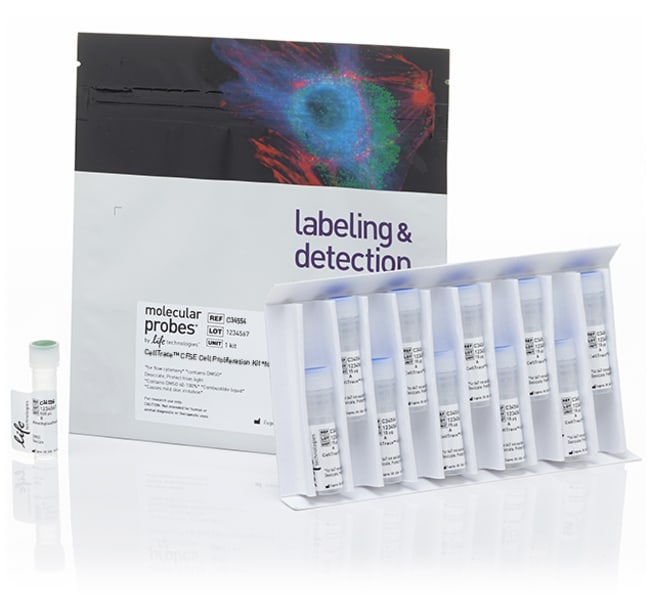
CellTrace™ CFSE Cell Proliferation Kit, for flow cytometry
CellTrace™ CFSE Cell Proliferation Kit은 편리한 일회용 vial에 다용도로 사용할 수 있고 유지력이 우수한 세포 추적 시약을 제공합니다. Carboxyfluorescein diacetate자세히 알아보기
Have Questions?
보기 방식 변경

| 카탈로그 번호 | 충분 |
|---|---|
| C34554 | 180 Reactions |
| C34570 | 20 Reactions |
카탈로그 번호 C34554
제품 가격(KRW)
345,000
キャンペーン価格
Ends: 31-Dec-2026
405,000할인액 60,000 (15%)
Each
충분:
180 Reactions
제품 가격(KRW)
345,000
キャンペーン価格
Ends: 31-Dec-2026
405,000할인액 60,000 (15%)
Each
CellTrace™ CFSE Cell Proliferation Kit은 편리한 일회용 vial에 다용도로 사용할 수 있고 유지력이 우수한 세포 추적 시약을 제공합니다. Carboxyfluorescein diacetate succinimidyl ester (CFSE)가 세포로 수동 확산됩니다. 이는 세포내 에스테르화로 acetate 군이 제거될 때 까지 무색, 무형광으로 강한 형광을 띠는 carboxyfluorescein succinimidyl ester를 회수합니다. succinimidyl ester군은 세포 내 아민과 반응해 유지력이 높고 aldehyde fixative로 고정할 수 있는 fluorescent conjugate를 형성합니다. 이 kit에는 CFSE 일회용 vial 10개가 들어있어 버리게 되는 CFSE 없이 소규모 실험을 실시할 수 있습니다. 우수한 품질의 DMSO (dimethylsulfoxide)와 자세한 프로토콜도 들어있습니다.
For Research Use Only. Not for use in diagnostic procedures.
사양
설명CellTrace™ Cell Proliferation Kit, 180 rxns, CFSE, Lyophilized, Fluorescent Detection Method, 492/517nm Excitation/Emission Wavelength, CellTrace™ CFSE Label/Dye, –5 to –30°C Storage, Use with Flow Cytometer
검출 방법Fluorescence
염료 유형Other Label(s) or Dye(s)
방출 파장488
형태Lyophilized
형식Tube(s)
수량180 reactions kit
시약 유형CFSE & Related Compounds
배송 조건Room Temperature
용해도DMSO (Dimethylsulfoxide)
충분180 Reactions
용도(애플리케이션)Proliferation Assay, Flow Cytometry
용도 (장비)Flow Cytometer
제품라인CellTrace
제품 유형Cell Proliferation Kit
Unit SizeEach
구성 및 보관
Contains 10 vials of CellTrace™ CFSE (lyophilized powder) and 1 vial of DMSO (500 μL). Store in freezer (-5°C to -30°C) and protect from light.
자주 묻는 질문(FAQ)
I'm trying to label my cells in suspension and track them over time by labeling with CFDA SE, but after labeling them they will no longer adhere to a surface (whereas unlabeled cells adhere well). I've tried to label at 10 and 20 µM. What is causing this?
I want to do a cell migration study for around 4 hours and need to fluorescently label the cells with a dye. What do you recommend?
I labeled my cells with Calcein, AM, but when I imaged the next day, there was no fluorescence from Calcein. Why?
What is the shelf life of CellTrace CFSE Cell Proliferation Kit (Cat. No. C34554, C34570)?
For staining with CellTrace CFSE Cell Proliferation Kit, for flow cytometry (Cat. No. C34554 or C34570), up to how many cells can I have in 1 mL volume?
인용 및 참조 문헌 (3)
인용 및 참조 문헌
Abstract
Optimized staining and proliferation modeling methods for cell division monitoring using cell tracking dyes.
Journal:J Vis Exp
PubMed ID:23271219
'Fluorescent cell tracking dyes, in combination with flow and image cytometry, are powerful tools with which to study the interactions and fates of different cell types in vitro and in vivo.(1-5) Although there are literally thousands of publications using such dyes, some of the most commonly encountered cell tracking applications
Appraising the suitability of succinimidyl and lipophilic fluorescent dyes to track proliferation in non-quiescent cells by dye dilution.
Journal:
PubMed ID:25802116
Successful completion of the cell cycle usually results in two identical daughter progeny. This process of generational doubling is termed proliferation and when it occurs in a regulated fashion the benefits range from driving embryonic development to mounting a successful immune response. However when it occurs in a dis-regulated fashion,
TLR4 signaling induced by lipopolysaccharide or paclitaxel regulates tumor survival and chemoresistance in ovarian cancer.
Journal:Oncogene
PubMed ID:19826413
Toll-like receptors (TLRs) expressed on immune cells trigger inflammatory responses. TLRs are also expressed on ovarian cancer (OvCa) cells, but the consequences of signaling by the TLR4/MyD88 pathway in these cells are unclear. Here, TLR4 and MyD88 expression in OvCa tissues (n=20) and cell lines (OVCAR3, SKOV3, AD10, A2780 and