Search


인용 및 참조 문헌 (22)
Invitrogen™
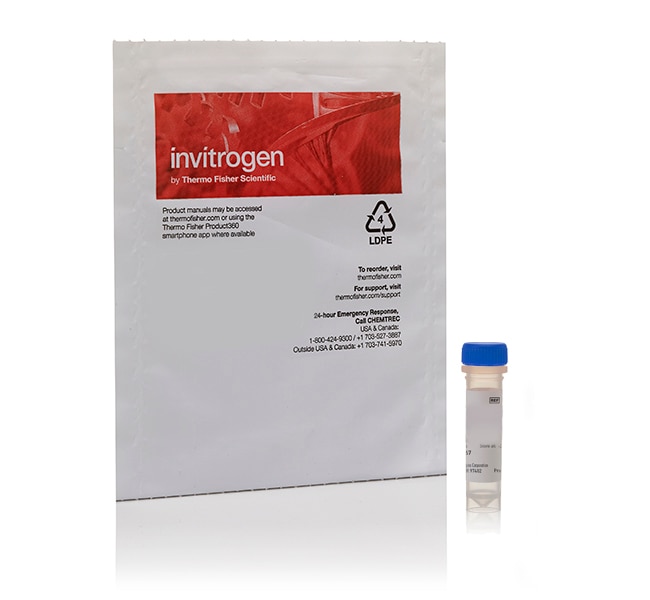
DQ™ Collagen, type I From Bovine Skin, Fluorescein Conjugate
The fluorogenic DQ™ collagen can be used to directly monitor collagenase activity.
| 카탈로그 번호 | 수량 |
|---|---|
| D12060 | 1 mg |
카탈로그 번호 D12060
제품 가격(KRW)
548,000
온라인 행사
Ends: 30-Sep-2026
626,000할인액 78,000 (12%)
Each
수량:
1 mg
제품 가격(KRW)
548,000
온라인 행사
Ends: 30-Sep-2026
626,000할인액 78,000 (12%)
Each
The fluorogenic DQ™ collagen can be used to directly monitor collagenase activity. DQ™ substrates are analogs of the natural substrate that have an excessive number of fluorescent dyes attached so that the fluorescence signal is almost non-existent. This quenching of the signal is caused by the close proximity of the dyes on the intact substrate. The enzyme-driven hydrolysis of the substrate results in separation of the dye results in separation of the dye molecules from one another and the fluorescence signal increases.
See User Manual for solubility instructions.
For Research Use Only. Not for use in diagnostic procedures.
사양
제품라인DQ
수량1 mg
배송 조건Room Temperature
기질Protease Substrate
검출 방법Fluorescence
형태Lyophilized
Substrate PropertiesProtein-Based Substrate
Target EnzymeMetalloproteinase
Unit SizeEach
구성 및 보관
Store in freezer (-5°C to -30°C) and protect from light.
인용 및 참조 문헌 (22)
인용 및 참조 문헌
Abstract
The roles of substrate thermal stability and P2 and P1' subsite identity on matrix metalloproteinase triple-helical peptidase activity and collagen specificity.
Journal:J Biol Chem
PubMed ID:17065155
'The hydrolysis of collagen (collagenolysis) is one of the committed steps in extracellular matrix turnover. Within the matrix metalloproteinase (MMP) family distinct preferences for collagen types are seen. The substrate determinants that may guide these specificities are unknown. In this study, we have utilized 12 triple-helical substrates in combination with
Type I collagen contains at least 14 cryptic fibronectin binding sites of similar affinity.
Journal:Arch Biochem Biophys
PubMed ID:12413494
'There is uncertainty in the literature regarding the number and location of fibronectin binding sites on denatured collagen. Although most attention has focused on a single site near the collagenase-sensitive region of each alpha chain, there is evidence for additional sites in other regions. We treated bovine type I collagen
TGF-beta1 + EGF-initiated invasive potential in transformed human keratinocytes is coupled to a plasmin/MMP-10/MMP-1-dependent collagen remodeling axis: role for PAI-1.
Journal:Cancer Res
PubMed ID:19383899
'The phenotypic switching called epithelial-to-mesenchymal transition is frequently associated with epithelial tumor cell progression from a comparatively benign to an aggressive, invasive malignancy. Coincident with the emergence of such cellular plasticity is an altered response to transforming growth factor-beta (TGF-beta) as well as epidermal growth factor (EGF) receptor amplification. TGF-beta
Vascular endothelial growth factor-C and C-C chemokine receptor 7 in tumor cell-lymphatic cross-talk promote invasive phenotype.
Journal:Cancer Res
PubMed ID:19118020
'Most carcinomas spread to distant sites through lymphatic vessels. Several preclinical and clinical studies have shown a positive correlation between the incidence of lymph node metastasis and secretion of the lymphatic growth factor vascular endothelial growth factor-C (VEGF-C) by tumor cells, suggesting tumor lymphangiogenesis as an escape mechanism. However, recent
Metabolic mapping of proteinase activity with emphasis on in situ zymography of gelatinases: review and protocols.
Journal:J Histochem Cytochem
PubMed ID:15150280
'Proteases are essential for protein catabolism, regulation of a wide range of biological processes, and in the pathogenesis of many diseases. Several techniques are available to localize activity of proteases in tissue sections or cell preparations. For localization of the activity of matrix metalloproteinases, in situ zymography was introduced some