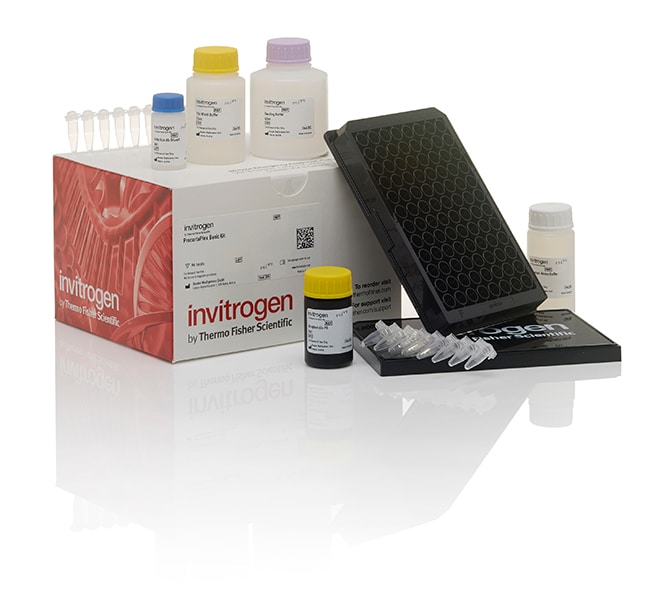
ProcartaPlex Porcine Basic Kit
Invitrogen™

ProcartaPlex Porcine Basic Kit

ProcartaPlex™ 면역분석은 단일 시료에서 여러 개의 단백질 생물표지자 평가를 위한 당사의 이상적인 솔루션입니다.당사의 ProcartaPlex 분석은 사이토카인, 케모카인, 성장 인자자세히 알아보기
Have Questions?
카탈로그 번호수량
EPX010-60460-90196 Tests
카탈로그 번호 EPX010-60460-901
제품 가격(KRW)
-
수량:
96 Tests
ProcartaPlex™ 면역분석은 단일 시료에서 여러 개의 단백질 생물표지자 평가를 위한 당사의 이상적인 솔루션입니다.
당사의 ProcartaPlex 분석은 사이토카인, 케모카인, 성장 인자 및 기타 단백질을 포함하는 분비 단백질에서 여러 분석물을 검출하기 위한 Luminex ™ xMAP 기술을 사용합니다.
ProcartaPlex™ 분석은 철저하게 검증된 당사의 백금 및 즉석 ELISA 키트와 마찬가지로 엄격하고 신뢰성 높은 개발 및 제조 과정을 거칩니다. 세포/조직 배양 상청액, 혈청 및 혈장에 포함된 다수의 표적을 정량화합니다.

당사의 광범위한 사전 구성 패널 및 결합 가능 단일 분석물질 포트폴리오를 확인해 보십시오.

심플렉스 키트만 결합하려면 추가적인 기본 키트가 필요합니다. 이 키트는 모든 비표적 특이적 시약 - 분석용 희석제, 세척완충액, SA-PE 및 플레이트를 포함합니다.

이 키트에는 멀티스크린 필터 플레이트가 들어 있지 않습니다.


보고된 애플리케이션
복합 면역분석

For Research Use Only. Not for use in diagnostic procedures.
사양
어세이 민감성See Certificate of Analysis
용도(장비)Luminex™ Instruments
제품라인ProcartaPlex
CombinabilityCombinable
제품 유형Basic and Setup Kits
수량96 Tests
Porcine
Unit SizeEach

자주 묻는 질문(FAQ)

What is the size of the Luminex beads you currently use?

The beads used in our Luminex instrument-compatible ProcartaPlex and QuantiGene Plex assays are 6.5 micron superparamagnetic beads.

Find additional tips, troubleshooting help, and resources within our Protein Assays and Analysis Support Center.

I am interested in performing Luminex assays using BioSource kits, and I have a Luminex xMAP system. Besides the kits and system, what other reagents and equipment will I need?

The following is a list of general lab supplies that are required for running BioSource immunoassays on the Luminex xMAP system:
1) Sonicating water bath
2) Orbital shaker
3) Vortexer
4) Repeating and/or multi-channel pipetter (not required, but recommended)
5) Calibrated adjustable precision pipettes, with disposable plastic tips
6) Glass/plastic tubes and racks for preparing reagents
7) Graduated cylinder and container for preparing wash solution
8) Aluminum foil
9) Deionized or distilled water.

Find additional tips, troubleshooting help, and resources within our Protein Assays and Analysis Support Center.

Do the Luminex beads require special care in handling?

The Luminex beads should be protected from light because they are susceptible to photobleaching. We recommend protecting the beads by keeping containers covered with aluminum foil during all incubation steps, and exercising care during handling. The beads should not be frozen, subjected to excessive heat, or exposed to organic solvents.

Find additional tips, troubleshooting help, and resources within our Protein Assays and Analysis Support Center.

Why would the Luminex acquisition software display "Sample Empty" messages during analysis?

(1) The user did not properly aliquot the diluted beads, such that no beads were actually added to the wells (make sure that the bead concentrates are sonicated and vortexed well, then check the pipet tip to ensure that air bubbles were not drawn up)
(2) The user missed loading diluted beads to some wells, which is likely since the small volume is clear and difficult to visualize in the clear plastic plate (we have now addressed this customer difficulty by coloring each of the Buffer Reagent Kit components)
(3) The user applied too much vacuum pressure at some point during the wash steps, or allowed the pressure to spike even once, such that the filter membrane tore in a few wells releasing the beads (make sure that the vacuum manifold pressure is kept below 5mm/in Hg, depending on their system -- a good rule of thumb is that it should take a full 3-second count to GENTLY empty the wells of 200uL)
(4) The user did not properly sonicate and vortex the beads prior to dilution, such that the percent of bead aggregation was high and the instrument was unable to find enough single beads to meet the events/bead value designated by the customer (make sure that the Bead Concentrate tube is put into the waterbath all the way to the cap, since the tube is hollow until the top third)
(5) The user lost beads by shaking the plate too aggressively or handling it improperly (make sure that the orbital shaker is set to a speed that allows for maximum vortex in the wells without spillage)
(6) The user exposed the beads to an excess of light during storage or running of the assay, such that some but not all of the beads were photobleached and therefore falling outside the acceptable range for each bead region (make sure that the plate is covered on the top/sides with foil throughout the assay, away from Windows and spotlights, and that the bead component of the kits is stored in the dark)*
(7) There was a clog in the sample needle, such that the instrument was unable to take up enough sample to meet the number of events requested per bead region (suggest that the user follow the manual instructions for dislodging a clog, which include several Back Flush steps and may require removal of the needle for sonication with probe alignment).

* Some of the older Antibody Bead Kits still have clear plastic tops instead of black ones. In cases where customers store kits in lit refrigerators, or keep them open on the lab bench, even a few hours of light exposure is enough to photobleach beads. It is important to note, in general, that higher number bead regions are more susceptible to photobleaching. In order to draw conclusions about the source of the difficulty, we would ask to see the data, specifically the Masterplex QT file, which would enable us to examine the pattern of "Sample Empty" occurrences in addition to the bead counts per well.

Find additional tips, troubleshooting help, and resources within our Protein Assays and Analysis Support Center.

What are the Luminex beads made of?

The beads are made of polystyrene.

Find additional tips, troubleshooting help, and resources within our Protein Assays and Analysis Support Center.

인용 및 참조 문헌 (1)

인용 및 참조 문헌
Abstract
Development of podophyllotoxin-loaded nanostructured lipid carriers for the treatment of condyloma acuminatum.
Authors:Gao Y, Han K, Wang Q, Hu Z, Liu Q, Liu L, Zeng K
Journal:Mol Med Rep
PubMed ID:29512736
'Condyloma acuminatum (CA) is a common sexually transmitted disease caused by human papillomavirus (HPV). Podophyllotoxin (POD), a cytotoxic compound, is able to effectively treat HPV; however, the severe irritation side effects of POD restrict its use as a treatment for CA. The aim of the present study was to construct ... More