Search


Invitrogen™
iBlot™ 3 Starter Kit, low-fluorescence PVDF
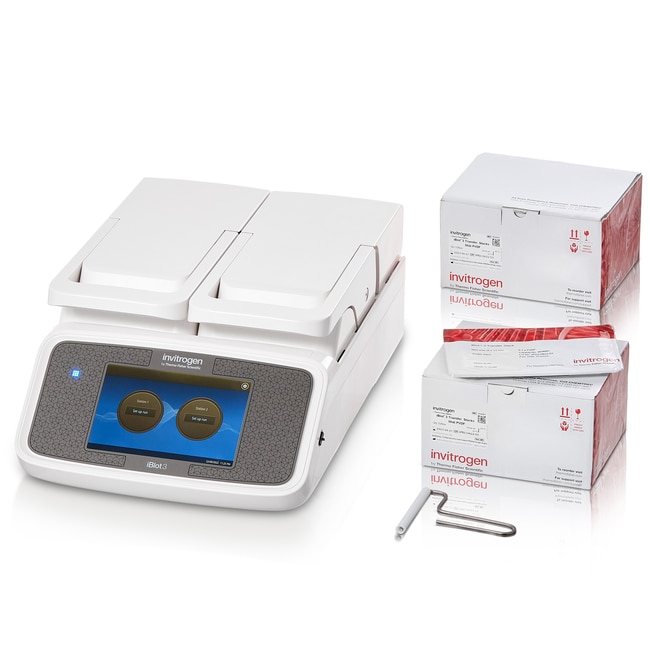
The iBlot 3 Starter Kit, Low Fluorescence PVDF, includes the iBlot 3 Western Blot Transfer Device and two boxes of iBlot 3 Transfer Stacks, Midi, Low Fluorescence PVDF—everything needed to perform a rapid dry-transfer in a fluorescent western blotting experiment.
| 카탈로그 번호 | 수량 |
|---|---|
| IB31003S | 1 Kit |
카탈로그 번호 IB31003S
제품 가격(KRW)
8,032,000
Each
수량:
1 Kit
제품 가격(KRW)
8,032,000
Each
The iBlot 3 Starter Kit, Low Fluorescence PVDF, includes the iBlot 3 Western Blot Transfer Device and two boxes of iBlot 3 Transfer Stacks, Midi, Low Fluorescence PVDF—everything needed to perform a rapid dry-transfer of proteins from a gel to a membrane in a fluorescent western blotting experiment.
iBlot 3 Western Blot Transfer Device
The iBlot 3 Western Blot Transfer Device is a dry transfer device that performs western blotting transfer efficiently and reliably in as few as three minutes and without the need for liquid buffers. The iBlot 3 system is compatible with both nitrocellulose, polyvinylidene difluoride (PVDF), and Low Fluorescence PVDF membranes and offers equivalent or better performance compared with traditional wet-transfer methods in a fraction of the time.
The iBlot 3 Western Blot Transfer Device is an integral part of the iBlot dry blotting system, which consists of the transfer device and pre-assembled transfer stacks that contain the required buffers and transfer membrane (nitrocellulose, PVDF, or Low Fluorescence PVDF).
iBlot 3 Western Blot Transfer Device features include:
- Complete protein transfer in as few as three minutes
- High detection sensitivity and even, consistent protein transfer
- Two independently controlled transfer stations capable of transferring up to two midi or four mini blots
- Built-in adjustable cooling to help ensure consistent transfer temperature
- Pre-programed transfer methods optimized for low, high, and broad molecular weight ranges
- Ability to create custom programs
- A simple, user-friendly interface
How the iBlot dry blotting system works
Buffer ion reservoirs are incorporated into the gel matrix of transfer stacks instead of buffer tanks or soaked filter papers. The high density of ions in the gel matrix enables rapid protein transfer. During blotting, the copper anode does not generate oxygen gas as a result of water electrolysis, reducing blot distortion. (Conventional protein transfer techniques, including wet, semi-wet, and semi-dry, use inert electrodes that generate oxygen.)
With the iBlot dry blotting system, transfer time is reduced by the shortened distance between electrodes, high field strength, and high current. Trapped air bubbles, often created during the manual preparation of the blotting sandwich layers, are easy to avoid due to our unique de-bubbling design that promotes even and complete transfer. With the iBlot 3 system, there is no need to prepare buffers or clean up after blotting. The total preparation and run time is normally less than ten minutes per blot.
For Research Use Only. Not for use in diagnostic procedures.
사양
검출 방법Fluorescence
치수(길이 x 폭 x 높이)44 x 30 x 18.25 cm
주파수50/60 Hz
멤브레인 호환성Nitrocellulose, PVDF
이송 모드Dry
수량1 Kit
처리량2 Midi or 4 Mini Gels
워런티Standard, 1-year warranty included
중량(미터법)8.3 kg
용량2 Midi-Gels, 4 Mini-Gels
용도(애플리케이션)Western Blot
용도 (장비)iBlot 3
Gel CompatibilityMini- or Midi-sized Bis-Tris Gels, Tricine Gels, Tris-Acetate Gels, Tris-Glycine Gels
젤 크기Midi
제품라인iBlot 3
Running Time∼3 to 8 min.
유형Dry Transfer System
Unit SizeEach
구성 및 보관
iBlot 3 Western Blot Transfer Device; Western Blot Roller; iBlot 3 Transfer Stacks, midi, Low Fluorescence PVDF (2 boxes, 20 stacks)