Search


인용 및 참조 문헌 (4)
Invitrogen™
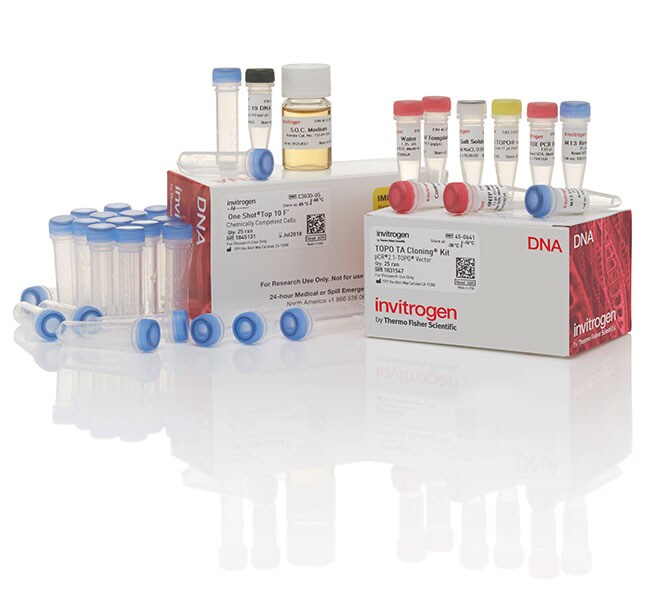
TOPO™ TA Cloning™ Kit for Subcloning, with TOP10F' E. coli
다양한 어플리케이션에서 빠르고 효과적으로 subcloning을 하려면 본사의 유명한 pCR™2.1 vector를 갖춘 Invitrogen's TOPO™ TA cloning Kit가 단연 유일한 선택입니다. 시간이자세히 알아보기
Have Questions?
보기 방식 변경

| 카탈로그 번호 | 수량 |
|---|---|
| K455001 | 25 Reactions |
| K455040 | 50 Reactions |
카탈로그 번호 K455001
제품 가격(KRW)
894,000
온라인 행사
Ends: 31-Dec-2026
1,051,000할인액 157,000
Each
수량:
25 Reactions
제품 가격(KRW)
894,000
온라인 행사
Ends: 31-Dec-2026
1,051,000할인액 157,000
Each
다양한 어플리케이션에서 빠르고 효과적으로 subcloning을 하려면 본사의 유명한 pCR™2.1 vector를 갖춘 Invitrogen's TOPO™ TA cloning Kit가 단연 유일한 선택입니다. 시간이 많이 걸리고 지루한 restriction site cloning 과정을 없앤 TOPO™ cloning은 믿을 수 있는 최고의 방법으로 3단계 프로토콜을 사용해 단 5분 만에 최고 95% recombinant를 수득할 수 있습니다.
pCR2.1™-TOPO™ TA vector를 갖춘 TOPO™ TA cloning Kit의 편리한 특징은 Taq-amplified PCR product의 direct ligation이 가능한 :3´-T overhangs입니다.
in vitro RNA transcription 및 sequencing을 위한 T7 promoter, M13 forward/reverse primer sites PCR product insertion site 옆에 있는 EcoR I site가 있어 간편하게 inserts excision 가능 해당 insert 옆에 편리하고 검증된 restriction site 15개가 있어 쉽고 확실하게 sub-cloning 가능 선택한 E. coli에 대한 Kanamycin 및 ampicillin resistance 선택한 recombinants에 대한 용이한 blue⁄white colony screening OneShot™ TOP10 F' Competent cells이 포함되어 있어 향상된 편의성과 최고의 cloning efficiency 보장함
pCR2.1™-TOPO™ TA vector를 갖춘 TOPO™ TA cloning Kit의 편리한 특징은 Taq-amplified PCR product의 direct ligation이 가능한 :3´-T overhangs입니다.
For Research Use Only. Not for use in diagnostic procedures.
사양
박테리아 또는 효모 균주TOP10F´
클로닝 방법TOPO™-TA
제품라인One Shot
제품 유형Cloning Kit
수량25 Reactions
벡터TOPO-TA Cloning Vectors
형식Kit
Unit SizeEach
구성 및 보관
Box 1:
• Topoisomerase I-activated pCR™2.1-TOPO™ vector
• PCR buffer
• Salt solution
• dNTPs
• Control template
• M13 forward and reverse primers
• Control PCR primers
• Sterile water
Store at -5 to -30°C.
All reagents are stable for 6 months when properly stored.
Box 2:
• One Shot™ Chemically Competent or Electrocomp™ E. coli
• S.O.C. medium
• Supercoiled pUC19 control plasmid
Store at -68 to -85°C.
• Topoisomerase I-activated pCR™2.1-TOPO™ vector
• PCR buffer
• Salt solution
• dNTPs
• Control template
• M13 forward and reverse primers
• Control PCR primers
• Sterile water
Store at -5 to -30°C.
All reagents are stable for 6 months when properly stored.
Box 2:
• One Shot™ Chemically Competent or Electrocomp™ E. coli
• S.O.C. medium
• Supercoiled pUC19 control plasmid
Store at -68 to -85°C.
자주 묻는 질문(FAQ)
Can I store my competent E. coli in liquid nitrogen?
How should I store my competent E. coli?
What is the difference between the pCR2.1-TOPO and pCR4-TOPO vectors?
What is the difference between the pCR2.1-TOPO and pCRII-TOPO vectors?
Your TOPO cloning kits contain a control template and control primers. Can I obtain the sequence of the control template?
인용 및 참조 문헌 (4)
인용 및 참조 문헌
Abstract
Genetic engineering of phytochrome biosynthesis in bacteria.
Journal:Proc Natl Acad Sci U S A
PubMed ID:11553807
The bilin prosthetic groups of the phytochrome photoreceptors and the light-harvesting phycobiliprotein antennae arise from the oxygen-dependent ring opening of heme. Two ferredoxin-dependent enzymes contribute to this conversion: a heme oxygenase and a bilin reductase with discrete double-bond specificity. Using a dual plasmid system, one expressing a truncated cyanobacterial apophytochrome
Cysteinyl-tRNA synthetase is not essential for viability of the archaeon Methanococcus maripaludis.
Journal:Proc Natl Acad Sci U S A
PubMed ID:11717392
The methanogenic archaea Methanocaldococcus jannaschii and Methanothermobacter thermautotrophicus contain a dual-specificity prolyl-tRNA synthetase (ProCysRS) that accurately forms both prolyl-tRNA (Pro-tRNA) and cysteinyl-tRNA (Cys-tRNA) suitable for in vivo translation. This intriguing enzyme may even perform its dual role in organisms that possess a canonical single-specificity cysteinyl-tRNA synthetase (CysRS), raising the question
Allurin, a 21-kDa sperm chemoattractant from Xenopus egg jelly, is related to mammalian sperm-binding proteins.
Journal:Proc Natl Acad Sci U S A
PubMed ID:11562501
Previously, we demonstrated that a protein from Xenopus egg jelly exhibits sperm chemoattractant activity when assayed by either video microscopy or by sperm passage across a porous filter. Here we describe the isolation and purification of allurin, the protein responsible for this activity. Freshly oviposited jellied eggs were soaked in
Functional cloning, heterologous expression, and purification of two different N-deoxyribosyltransferases from Lactobacillus helveticus.
Journal:J Biol Chem
PubMed ID:11836245
Lactobacillus helveticus contains two types of N-deoxyribosyltransferases: DRTase I catalyzes the transfer of 2'-deoxyribose between purine bases exclusively whereas DRTase II is able to transfer the 2'-deoxyribose between two pyrimidine or between pyrimidine and purine bases. An Escherichia coli strain, auxotrophic for guanine and unable to use deoxyguanosine as source