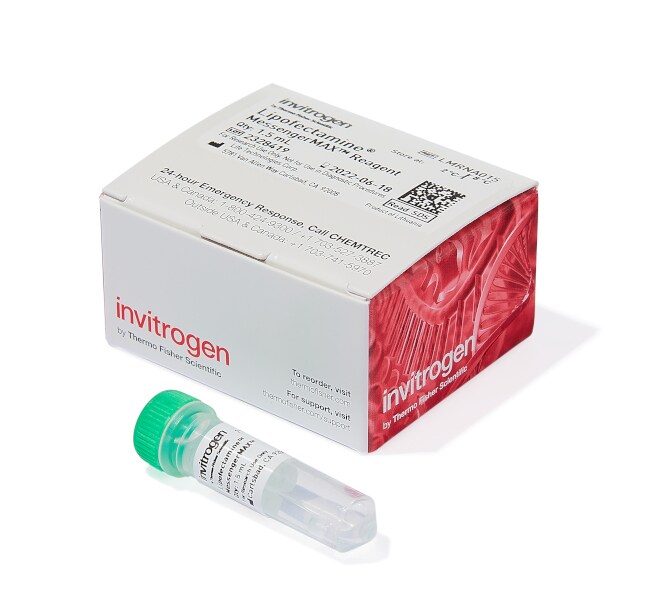
Lipofectamine™ MessengerMAX™ Transfection Reagent
Invitrogen™

Lipofectamine™ MessengerMAX™ Transfection Reagent

Green features
Lipofectamine™ MessengerMAX mRNA Transfection Reagent는 뉴런과 광범위한 주요 세포에서 놀라운 transfection효율을 나타내므로, 어플리케이션 결과가 향상되고 생물학적 관련성이 높은 연구에서도 사용자세히 알아보기
Have Questions?
보기 방식 변경buttonViewtableView
카탈로그 번호수량
LMRNA0151.5 mL
LMRNA0010.1 mL
LMRNA0030.3 mL
LMRNA0080.75 mL
LMRNA15015 mL
카탈로그 번호 LMRNA015
제품 가격(KRW)
1,282,000
線上優惠
Ends: 31-Mar-2026
1,424,000
할인액 142,000 (10%)
Each
카트에 추가하기
수량:
1.5 mL
제품 가격(KRW)
1,282,000
線上優惠
Ends: 31-Mar-2026
1,424,000
할인액 142,000 (10%)
Each
카트에 추가하기
Lipofectamine™ MessengerMAX mRNA Transfection Reagent는 뉴런과 광범위한 주요 세포에서 놀라운 transfection효율을 나타내므로, 어플리케이션 결과가 향상되고 생물학적 관련성이 높은 연구에서도 사용 가능합니다.이러한 성능이 가능한 이유는 라이프 테크놀로지스의 새로운 지질 나노입자 기술이 세포에 DNA전달 시 필요한 핵 진입 단계 없이도 최대한 많은 양의 mRNA를 전달하도록 최적화되어 있기 때문입니다.

다음 성능을 갖춘 시약을 사용해 보다 많은 예측 세포 모델을 성공적으로 transfection할 수 있습니다.
• 뉴런과 주요 세포 유형에서 놀라운 transfection 효율성
• Genomic integration위험이 없는 신속한 단백질 발현
• mRNA CRISPR를 사용해 cleavage 효율성 최대 10배 증가

새로운 게놈 편집 어플리케이션에서 높은 transfection 효율성 보장
Lipofectamine™ MessengerMAX™ 시약은 cleavage 가능성을 높여줄 뿐만 아니라, 매우 효율적인 transfection을 통해 GeneArt™ CRISPR Nuclease mRNA와의 재조합 가능성을 높여, 궁극적으로 유전자 변형 효율성을 극대화하고 다음 단계 공정을 간소화합니다.

Transfection어려운 세포를 효율적으로 진행
Lipofectamine™ MessengerMAX™ 시약은 고용량의 mRNA를 뉴런과 이입이 어려운 광범위한 주요 세포로 transfection해 줍니다. 또한, 이 시약은 전기영동이나 바이러스가 필요하지 않으면서도, 다른 지질 기반 효소에 비해 transfection 효율성을 2배 이상 향상시켜 줍니다.

mRNA transfection 이점 활용
mRNA transfection은 세포 핵내에 주입되지 않으며, 세포질에서 mRNA 번역이 일어나기 때문에 DNA transfection보다 단백질 발현이 빠릅니다.또한, mRNA는 genomic integration 위험이 없고 transfection 효율성이 세포 주기와 무관합니다.
For Research Use Only. Not for use in diagnostic procedures.
사양
용도(애플리케이션)Transfection
그린 기능Sustainable packaging
제품라인Lipofectamine
제품 유형Transfection Reagent
수량1.5 mL
혈청 호환 가능Yes
배송 조건Room Temperature
셀 유형Established Cell Lines, Neuronal Cells, Stem Cells, Primary Cells, Hard-to-Transfect Cells
형식6-well Plate, 12-well Plate, 24-well Plate, 48-well Plate, 96-well Plate, Flasks
샘플 종류mRNA
Transfection TechniqueLipid-based Transfection
Unit SizeEach
구성 및 보관
Store in refrigerator (2–8°C).

자주 묻는 질문(FAQ)

I am trying to troubleshoot our mRNA transfection process using Lipofectamine MessengerMAX Transfection Reagent. Could you tell me some reasons why we may not be seeing expression after transfection? We are using primary cells, so I am not sure if it is due to the difficulty in transfecting these cells or another cause.

There are reasons that can influence expression after transfection, but before troubleshooting all the possibilities, a transfection experiment with a positive GFP mRNA control (Tri-Link CleanCap EGFP mRNA, Cat. No. L-7201) and the Lipofectamine MessengerMAX mRNA Transfection Reagent could be the solution. If this does not yield good results, it might be best to try an alternative delivery solution or different cells. However, if this gives acceptable results, the next step would be to try the mRNA of interest with the MessengerMAX reagent. If there are expression level concerns at this point, it might be the mRNA that is being used, and troubleshooting from this perspective might be needed. For example, some questions to ask would be: Is there a 5' cap? Is there a poly(A) tail? Is the mRNA pure? Do I get a single band on a gel? Was the DNA template clean?

Find additional tips, troubleshooting help, and resources within our Transfection Support Center.

We have seen quite a bit of variation in our mRNA transfection efficiency with Lipofectamine MessengerMAX Transfection Reagent, based on the number of passages prior to transfection. Do you have advice on the best passage number?

It is normal to observe some transfection efficiency differences between cell passages.To minimized this variability, we recommend using cells between 5-20 passages. Including a positive GFP mRNA control (Tri-Link CleanCap EGFP mRNA, Cat. No. L-7201) with every transfection experiment is helpful to quantitatively determine and follow any changes in transfection efficiencies from week to week.

Find additional tips, troubleshooting help, and resources within our Transfection Support Center.

I have been getting some toxicity in my mRNA transfections using Lipofectamine MessengerMAX Transfection Reagent. What would you recommend for minimizing toxicity?

Consider including appropriate 5' UTR and 3' UTR sequences into the template design to promote mRNA stability and acceptance by the cell. Use high purity in vitro transcribed mRNA purified with the MegaClear Transcription Cleanup Kit. Ensure A260/280 ratios are between 1.8 and 2.1. Check for mRNA quality and size by agarose gel electrophoresis. In some cases, consider incorporating chemically modified nucleotides in the transcription reaction. Cell number, mRNA, and lipid quantities may need to be adjusted. Ideal viable cell density on the day of transfection is between 70 and 90% confluence. For transfection optimization tips, please visit: thermofisher.com/transfectionsupport.

Find additional tips, troubleshooting help, and resources within our Transfection Support Center.

I accidentally left my lipid reagent at room temperature. Can I still use it?

Yes, all of our lipid transfection reagents are stable at room temperature for months.

Find additional tips, troubleshooting help, and resources within our Lipid-Based Transfection Support Center.

When transfecting mRNA, does the packaging of the foreign RNA into vesicles reduce the accessibility of the mRNA for protein translation or is the mRNA all released in the cytoplasm? If packaged away, what percent is packaged vs. what percent is left to be available for translation? Is this observed with DNA plasmids?

We have not observed differences between how a cell packages an mRNA payload versus a DNA payload for the purpose of delivery. Transfection involves complex formation between a liposome and mRNA, which create lipoplexes that are taken up by the cell via endocytosis. The liposome protects the mRNA during this process and also assists in endosomal escape, which releases the mRNA into the cytoplasm of the cell. The mRNA is immediately available for translation with the ribosome. In vitro transcribed mRNA may be prepared using the mMESSAGE mMACHINE T7 Ultra Transcription Kit, which incorporates a 5' ARCA cap and a 3' poly(A) tail to mimic endogenously transcribed mRNA.

Find additional tips, troubleshooting help, and resources within our Transfection Support Center.