Search


인용 및 참조 문헌 (189)
Invitrogen™
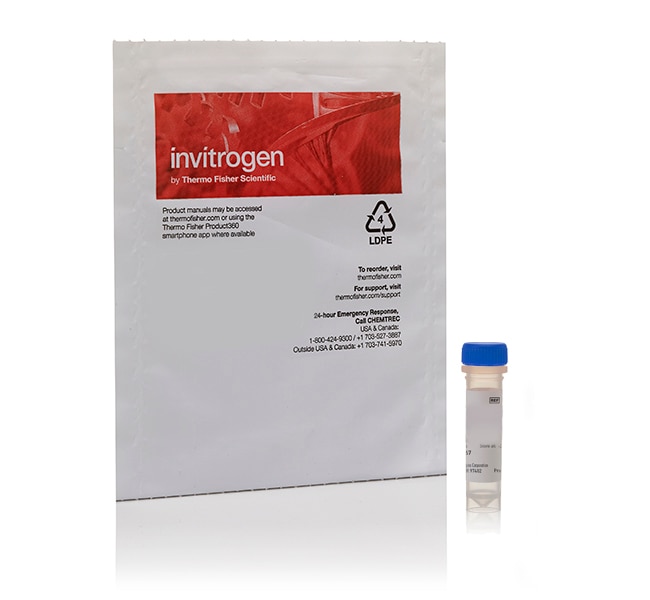
NBD C6-Ceramide Complexed to BSA
NBD C6-ceramide can be used to study sphingolipid transport and metabolism mechanisms. It is also used as a selective stain자세히 알아보기
| 카탈로그 번호 | 수량 |
|---|---|
| N22651 | 5 mg |
카탈로그 번호 N22651
제품 가격(KRW)
558,000
온라인 행사
Ends: 31-Dec-2026
637,000할인액 79,000 (12%)
Each
수량:
5 mg
제품 가격(KRW)
558,000
온라인 행사
Ends: 31-Dec-2026
637,000할인액 79,000 (12%)
Each
NBD C6-ceramide can be used to study sphingolipid transport and metabolism mechanisms. It is also used as a selective stain for the Golgi apparatus in live and fixed cells. Complexing fluorescent lipids with bovine serum albuin (BSA) facilitates cell labeling by eliminating the need for organic solvents to dissolve the lipophilic probe - the BSA-complexed probe can be directly dissolved in water. The environment sensitive NBD dye is weakly fluorescent in water but increases in aprotic solvents and other nonpolar environments with excitation/emission maxima ∼466/536 nm.
For Research Use Only. Not for use in diagnostic procedures.
사양
화학물질 이름 또는 재질Sphingolipids
권장 스토리지Store in freezer (-5 to -30°C) and protect from light.
물리적 형태Solid
제품라인Invitrogen
수량5 mg
Unit SizeEach
인용 및 참조 문헌 (189)
인용 및 참조 문헌
Abstract
Methods for studying glucosylceramide synthase.
Journal:Methods in enzymology
PubMed ID:10563310
Identification and characterization of Saccharomyces cerevisiae dihydrosphingosine-1-phosphate phosphatase.
Journal:J Biol Chem
PubMed ID:9353337
We have identified the yeast sphingosine resistance gene (YSR2) of Saccharomyces cerevisiae as encoding a protein that specifically dephosphorylates dihydrosphingosine 1-phosphate (DHS-1-P), and we refer to this protein as dihydrosphingosine-1-phosphate phosphatase. Overexpression of YSR2 conferred sphingosine resistance to the dihydrosphingosine-1-P lyase-defective mutant (JS16) of S. cerevisiae, which is hypersensitive to
Determination of the intracellular sites and topology of glucosylceramide synthesis in rat liver.
Journal:Biochem J
PubMed ID:1747103
We examined the intracellular site(s) and topology of glucosylceramide (GlcCer) synthesis in subcellular fractions from rat liver, using radioactive and fluorescent ceramide analogues as precursors, and compared these results with those obtained in our recent study of sphingomyelin (SM) synthesis in rat liver [Futerman, Stieger, Hubbard & Pagano (1990) J.
Insect NMDA receptors mediate juvenile hormone biosynthesis.
Journal:Proc Natl Acad Sci U S A
PubMed ID:11773617
'In vertebrates, the N-methyl-D-aspartate subtype of glutamate receptors (NMDAR) appears to play a role in neuronal development, synaptic plasticity, memory formation, and pituitary activity. However, functional NMDAR have not yet been characterized in insects. We have now demonstrated immunohistochemically glutamatergic nerve terminals in the corpora allata of an adult female
An endocytosed TGN38 chimeric protein is delivered to the TGN after trafficking through the endocytic recycling compartment in CHO cells.
Journal:J Cell Biol
PubMed ID:9722606
'To examine TGN38 trafficking from the cell surface to the TGN, CHO cells were stably transfected with a chimeric transmembrane protein, TacTGN38. We used fluorescent and 125I-labeled anti-Tac IgG and Fab fragments to follow TacTGN38''s postendocytic trafficking. At steady-state, anti-Tac was mainly in the TGN, but shortly after endocytosis it