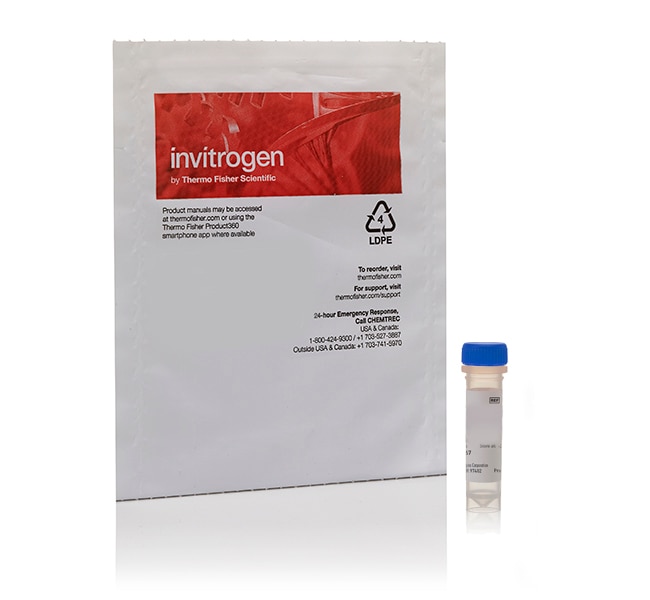
NeuroTrace™ CM-DiI Tissue-Labeling Paste
Invitrogen™

NeuroTrace™ CM-DiI Tissue-Labeling Paste

NeuroTrace™ CM-DiI tissue-labeling paste consists of CM-DiI (C7000, C7001) mixed into an inert, water-resistant gel. The paste is ready to자세히 알아보기
Have Questions?
카탈로그 번호수량
N22883100 mg
카탈로그 번호 N22883
제품 가격(KRW)
318,000
온라인 행사
Ends: 31-Dec-2025
374,000
할인액 56,000 (15%)
Each
카트에 추가하기
수량:
100 mg
제품 가격(KRW)
318,000
온라인 행사
Ends: 31-Dec-2025
374,000
할인액 56,000 (15%)
Each
카트에 추가하기
NeuroTrace™ CM-DiI tissue-labeling paste consists of CM-DiI (C7000, C7001) mixed into an inert, water-resistant gel. The paste is ready to use as supplied and can be applied directly to live or fixed tissue specimens using the tip of a needle. This method of application improves the penetration of the dye into bundled neurons, labeling axons both on and below the surface.
For Research Use Only. Not for use in diagnostic procedures.
사양
색상Yellow
검출 방법Fluorescence
용도(장비)Fluorescence Microscope
제품 유형Tissue Labeling Paste
수량100 mg
배송 조건Room Temperature
세포하위구조 국지화Cell Membranes & Lipids
제품라인NEUROTRACE
Unit SizeEach
구성 및 보관
Store in freezer (-5 to -30°C) and protect from light.

자주 묻는 질문(FAQ)

I am doing retrograde neuronal labeling using the NeuroTrace DiI Paste. I apply a small glob onto the neuron of interest, but it is not adhering very well. What can I do?

This paste, which has DiI C18 uniformly dispersed within a proprietary hydrophobic carrier, is commonly used to dab onto larger areas than smaller areas commonly used with crystals. Any moisture on the area the paste is applied may be the cause for lack of adherence. Apply the paste using a small flat-head spatula or toothpick and keep it in place a bit longer to ensure contact. The area may also be covered with parafilm to ensure contact as well.

Find additional tips, troubleshooting help, and resources within our Cell Analysis Support Center.

How long does it take for lipophlic tracers to transport along the membrane? How much faster are the FAST lipophilic dyes?

The transport is fairly slow, around 6 mm/day in live tissue and slower in fixed tissue, so diffusion of lipophilic carbocyanine tracers from the point of their application to the terminus of a neuron can take several days to weeks The FAST DiO and DiI analogs (which have unsaturated alkyl tails) can improve transport rate by around 50%.

Find additional tips, troubleshooting help, and resources within our Cell Analysis Support Center.

Which form of the lipophilic tracers (DiO, DiI, DiD, etc) should I use?

Select the dye that is compatible with your available excitation source(s) and emission filter set/channels. The solid, paste and crystal forms can be applied directly to neurons in tissues. For labeling cells in culture or microinjection, the lipophilic dyes in solution or solid form can be used.

Find additional tips, troubleshooting help, and resources within our Cell Analysis Support Center.

How do I know which tracer to choose for my experiment?

Factors to consider are size of tracer, method of delivery (injection, direct application to tissue, etc.), and if the tracer needs to be fixable. Here are some links to details about the various classes of neuronal tracers we offer and how to choose between them:

Neuronal Tracing (https://www.thermofisher.com/us/en/home/life-science/cell-analysis/cell-tracing-tracking-and-morphology/neuronal-tracing.html)
Choosing a Tracer (https://www.thermofisher.com/us/en/home/references/molecular-probes-the-handbook/fluorescent-tracers-of-cell-morphology-and-fluid-flow/choosing-a-tracer.html)
Imaging Analysis (http://assets.thermofisher.com/TFS-Assets/BID/Reference-Materials/bioprobes-50-journal.pdf)

Find additional tips, troubleshooting help, and resources within our Cell Analysis Support Center.

What products do you have for neuronal tracing?

Please check out this web page (https://www.thermofisher.com/us/en/home/life-science/cell-analysis/cell-tracing-tracking-and-morphology/neuronal-tracing.html) for details.

Find additional tips, troubleshooting help, and resources within our Cell Analysis Support Center.

인용 및 참조 문헌 (1)

인용 및 참조 문헌
Abstract
Nerve bundle formation during the promotion of peripheral nerve regeneration: collagen VI-neural cell adhesion molecule 1 interaction.
Authors:
Journal:Neural Regen Res
PubMed ID:34558529