Search


인용 및 참조 문헌 (13)
Invitrogen™
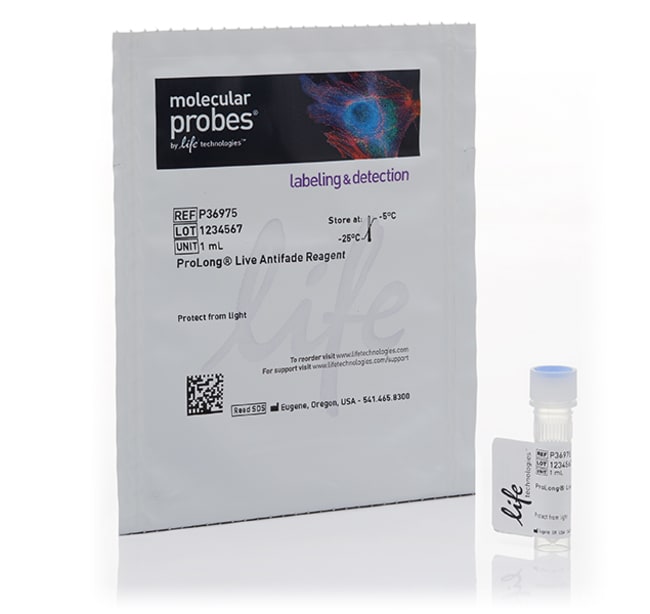
ProLong™ Live Antifade Reagent, for live cell imaging
Prolong Live Antifade Reagent helps prevent the loss of fluorescent signal (photobleaching) during live cell imaging.
Have Questions?
보기 방식 변경

| 카탈로그 번호 | 수량 |
|---|---|
| P36975 | 1 x 1 mL |
| P36974 | 5 x 1 mL |
카탈로그 번호 P36975
제품 가격(KRW)
94,000
Online offer
Ends: 30-Sep-2026
107,000할인액 13,000 (12%)
Each
수량:
1 x 1 mL
제품 가격(KRW)
94,000
Online offer
Ends: 30-Sep-2026
107,000할인액 13,000 (12%)
Each
ProLong Live Antifade Reagent helps prevent the loss of fluorescent signal due to photobleaching during live cell imaging through use of enzymes from the plasma membrane of E. coli. These enzymes metabolize the elements that can cause photobleaching. When dyes are illuminated, they can degrade which reduces the sample’s fluorescent intensity and leads to the creation of free radical singlet oxygen which degrades neighboring dye molecules. ProLong Live Antifade Reagent metabolizes this element, increasing the signal intensity and duration while keeping the background signal low. ProLong Live reagent has little-to-no effect on cellular viability, proliferation, or other cellular functions in experiments up to 48 hours. ProLong Live reagent provides photobleach protection in live cell experiments for fluorophores such as GFP, RFP, Hoechst 33342, MitoTracker™, LysoTracker™, and CellTracker™dyes. ProLong Live Antifade Reagent can be added to any cell culture media or buffer that is suitable for fluorescent imaging.
사양
수량1 x 1 mL
배송 조건Approved for shipment at Room Temperature or on Wet Ice
제품라인ProLong
제품 유형Live Antifade Reagent
시약 유형Cell Imaging Reagent
부피(미터법)1 mL
Unit SizeEach
구성 및 보관
When stored at -20°C product is stable for at least 6 months, with up to 4 freeze-thaw cycles. When stored at 2–8°C product should be used within 30 days (a precipitant may form at this temperature).
자주 묻는 질문(FAQ)
After using ProLong Live Antifade Reagent on live samples and then fixing and permeabilizing, may the samples be mounted in ProLong Gold or Diamond Anifade Mountant?
After using ProLong Live Antifade Reagent on my live sample, may I fix and permeabilize the sample?
May I use ProLong Live Antifade Reagent on a fixed/permeabilized sample?
I want to mount my dye-labeled cells in an antifade mounting medium to keep the dyes from photobleaching. Which mounting medium do you recommend?
My fluorescent dye signal is fading as I image it. What can I do to stop this?
인용 및 참조 문헌 (13)
인용 및 참조 문헌
Abstract
Targeting host mitochondria: A role for the Trypanosoma cruzi amastigote flagellum.
Journal:Cell Microbiol
PubMed ID:29119655
'Trypanosoma cruzi is the kinetoplastid protozoan parasite that causes human Chagas disease, a chronic disease with complex outcomes including severe cardiomyopathy and sudden death. In mammalian hosts, T. cruzi colonises a wide range of tissues and cell types where it replicates within the host cell cytoplasm. Like all intracellular pathogens, T. cruzi
Methamphetamine Augments Concurrent Astrocyte Mitochondrial Stress, Oxidative Burden, and Antioxidant Capacity: Tipping the Balance in HIV-Associated Neurodegeneration.
Journal:Neurotox Res
PubMed ID:28993979
'Methamphetamine (METH) use, with and without human immunodeficiency virus (HIV)-1 comorbidity, exacerbates neurocognitive decline. Oxidative stress is a probable neurotoxic mechanism during HIV-1 central nervous system infection and METH abuse, as viral proteins, antiretroviral therapy and METH have each been shown to induce mitochondrial dysfunction. However, the mechanisms regulating mitochondrial
Increased Fc?RIIB dominance contributes to the emergence of resistance to therapeutic antibodies in chronic lymphocytic leukaemia patients.
Journal:Oncogene
PubMed ID:27748757
Resistance to therapeutic antibodies in chronic lymphocytic leukaemia (CLL) is common. In this study, we show that therapeutic antibodies against CD62L (CD62L-Ab) or CD20 (obinutuzumab) were able to induce antibody-dependent cell-mediated cytotoxicity (ADCC) and phagocytosis (ADP) in primary cultures of CLL cells. CLL cells derived from patients with active disease
PI(3,5)P2 biosynthesis regulates oligodendrocyte differentiation by intrinsic and extrinsic mechanisms.
Journal:Elife
PubMed ID:27008179
Proper development of the CNS axon-glia unit requires bi-directional communication between axons and oligodendrocytes (OLs). We show that the signaling lipid phosphatidylinositol-3,5-bisphosphate [PI(3,5)P2] is required in neurons and in OLs for normal CNS myelination. In mice, mutations of Fig4, Pikfyve or Vac14, encoding key components of the PI(3,5)P2 biosynthetic complex,
Novel ecto-tagged integrins reveal their trafficking in live cells.
Journal:Nat Commun
PubMed ID:28924207
Integrins are abundant heterodimeric cell-surface adhesion receptors essential in multicellular organisms. Integrin function is dynamically modulated by endo-exocytic trafficking, however, major mysteries remain about where, when, and how this occurs in living cells. To address this, here we report the generation of functional recombinant ß1 integrins with traceable tags inserted