Search


인용 및 참조 문헌 (18)
Invitrogen™
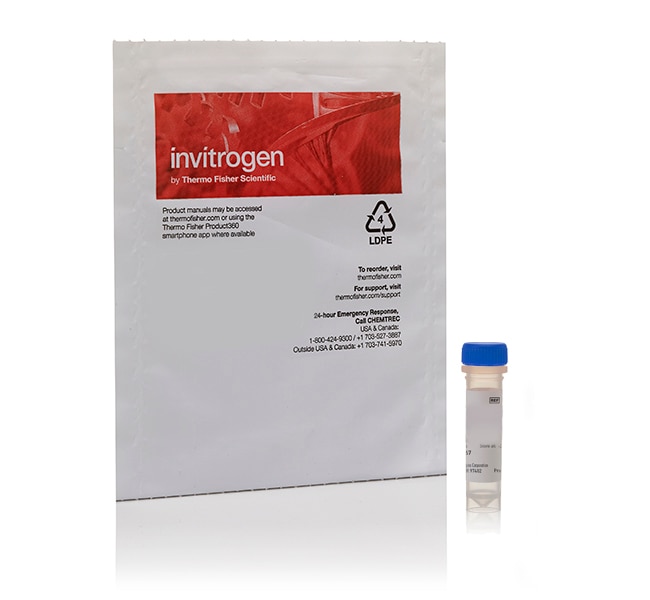
Qdot™ 655 ITK™ Carboxyl Quantum Dots
Qdot™ 655 ITK™ carboxyl quantum dot는 biomolecule 부하량이 높아야 하는 맞춤형 conjugate 조제에 이상적인 시작 물질입니다. 이들 물질은 carboxylate 기능을자세히 알아보기
| 카탈로그 번호 | 수량 |
|---|---|
| Q21321MP | 250 μL |
카탈로그 번호 Q21321MP
제품 가격(KRW)
785,000
キャンペーン価格
Ends: 30-Sep-2026
923,000할인액 138,000 (15%)
Each
수량:
250 μL
제품 가격(KRW)
785,000
キャンペーン価格
Ends: 30-Sep-2026
923,000할인액 138,000 (15%)
Each
Qdot™ 655 ITK™ carboxyl quantum dot는 biomolecule 부하량이 높아야 하는 맞춤형 conjugate 조제에 이상적인 시작 물질입니다. 이들 물질은 carboxylate 기능을 가지며 EDC-매개 응축을 사용해 단백질의 아민군과 변형 oligonucleotide에 결합할 수 있습니다. 이들 probe의 코팅은 본사 Qdot™ ITK™ amino quantum dot 보다 결합 부위가 많지만 비특이 상호작용을 방지하는 PEG linker가 부족합니다. 이들 물질을 X-PEG-amine bi-functional linker에 접합하여 반응을 맞춤화하고 특이성을 높일 수 있습니다. 본사의 Qdot™ ITK™ carboxyl quantum dot은 8 μM 용액으로 제공되며 9가지 Qdot™ probe 색상으로 구매가능합니다.
Qdot™ ITK™ Carboxyl Quantum Dot의 주요 특징:
• Qdot™ 655 ITK™ carboxyl quantum dot 최대 방출: 655 nm
• 높은 광안정성, 밝은 형광
• 단일 라인 여기원으로 효율적으로 방출
• 좁은 방출 및 넓은 스크로크 변화
• 여러가지 색상으로 구매 가능
• 다양한 라벨링 및 추적 어플리케이션에 이상적임
Qdot™ Nanocrystal의 특징
Qdot™ probe는 밝은 형광 신호 및/또는 실시간 추적이 필요한 어플리케이션에 이상적입니다. 형광 시약 중 유일하게 Qdot™ probe의 9가지 색상은 모두 단일 (UV --> 청색-녹색) 광원으로 동시에 여기할 수 있습니다. 이 특성은 사용자가 편리하게 사용할 수 있는 경제적인 multiplexing 어플리케이션에 매우 적합한 시약입니다. Qdot™ label은 반도체 나노기술에 기반하며 중간 크기의 단백질과 크기가 유사합니다.
Innovator’s Tool Kit Qdot™ ITK™ Reagent 설명
Qdot™ ITK™ probe는 해당 어플리케이션에 특이적인(non-stocked) conjugate을 준비하거나 맞춤화가 가능한 conjugation 기능이 필요한 연구자들에게 이상적입니다.
다른 유형의 Qdot™ Nanocrystal을 이용할 수 있습니다.
carboxyl-derivatized 유형 외에 본사는 amino와 aliphatic hydrocarbon이 변형된 Qdot™ ITK™ quantum dot도 제공합니다. 본사는 다양한 Qdot™ nanocrystals conjugate와 라벨링 키트도 개발하였습니다. 자세한 정보는 Qdot™ nanocrystals 속성을 조사하거나 Molecular Probes™ 지침서 6.6항—Qdot™ Nanocrystals을 참조하십시오.
본 제품은 연구용으로만 사용가능합니다. 치료 또는 진단 목적으로 동물이나 인간에 사용할 수 없습니다.
Qdot™ ITK™ Carboxyl Quantum Dot의 주요 특징:
• Qdot™ 655 ITK™ carboxyl quantum dot 최대 방출: 655 nm
• 높은 광안정성, 밝은 형광
• 단일 라인 여기원으로 효율적으로 방출
• 좁은 방출 및 넓은 스크로크 변화
• 여러가지 색상으로 구매 가능
• 다양한 라벨링 및 추적 어플리케이션에 이상적임
Qdot™ Nanocrystal의 특징
Qdot™ probe는 밝은 형광 신호 및/또는 실시간 추적이 필요한 어플리케이션에 이상적입니다. 형광 시약 중 유일하게 Qdot™ probe의 9가지 색상은 모두 단일 (UV --> 청색-녹색) 광원으로 동시에 여기할 수 있습니다. 이 특성은 사용자가 편리하게 사용할 수 있는 경제적인 multiplexing 어플리케이션에 매우 적합한 시약입니다. Qdot™ label은 반도체 나노기술에 기반하며 중간 크기의 단백질과 크기가 유사합니다.
Innovator’s Tool Kit Qdot™ ITK™ Reagent 설명
Qdot™ ITK™ probe는 해당 어플리케이션에 특이적인(non-stocked) conjugate을 준비하거나 맞춤화가 가능한 conjugation 기능이 필요한 연구자들에게 이상적입니다.
다른 유형의 Qdot™ Nanocrystal을 이용할 수 있습니다.
carboxyl-derivatized 유형 외에 본사는 amino와 aliphatic hydrocarbon이 변형된 Qdot™ ITK™ quantum dot도 제공합니다. 본사는 다양한 Qdot™ nanocrystals conjugate와 라벨링 키트도 개발하였습니다. 자세한 정보는 Qdot™ nanocrystals 속성을 조사하거나 Molecular Probes™ 지침서 6.6항—Qdot™ Nanocrystals을 참조하십시오.
본 제품은 연구용으로만 사용가능합니다. 치료 또는 진단 목적으로 동물이나 인간에 사용할 수 없습니다.
For Research Use Only. Not for use in diagnostic procedures.
사양
화학물질 반응성Amine
농도8 μM
방출655
라벨 또는 염료Qdot™ 655
제품 유형Quantum Dot
수량250 μL
반응성 부분Carboxylic Acid
배송 조건Room Temperature
라벨 유형Qdot Nanocrystals
제품라인ITK, Qdot
Unit SizeEach
구성 및 보관
Store in refrigerator (2–8°C).
자주 묻는 질문(FAQ)
How large are the Qdot nanocrystals?
What is the best way to remove white precipitate from my ITK Qdot nanocrystals?
I see a white precipitate in my ITK Qdot nanocrystals; should I be concerned?
Why do my Qdot nanocrystals appear to be blinking?
My Qdot nanocrystals were brightly fluorescent before I mounted my samples; now I'm seeing a loss of fluorescence. Why is this happening?
인용 및 참조 문헌 (18)
인용 및 참조 문헌
Abstract
Transgenic mice expressing a cameleon fluorescent Ca2+ indicator in astrocytes and Schwann cells allow study of glial cell Ca2+ signals in situ and in vivo.
Journal:J Neurosci Methods
PubMed ID:19454294
'Glial cell Ca2+ signals play a key role in glial-neuronal and glial-glial network communication. Numerous studies have thus far utilized cell-permeant and injected Ca2+ indicator dyes to investigate glial Ca2+ signals in vitro and in situ. Genetically encoded fluorescent Ca2+ indicators have emerged as novel probes for investigating cellular Ca2+
Optimizing a waveguide-based sandwich immunoassay for tumor biomarkers: evaluating fluorescent labels and functional surfaces.
Journal:Bioconjug Chem
PubMed ID:19173652
'The sensor team at the Los Alamos National Laboratory has developed a waveguide-based optical biosensor for the detection of biomarkers associated with disease. We have previously demonstrated the application of this technology to the sensitive detection of carcinoembryonic antigen in serum and nipple aspirate fluid from breast cancer patients. In
Targeted cellular delivery of quantum dots loaded on and in biotinylated liposomes.
Journal:Bioconjug Chem
PubMed ID:20715851
'We describe the preparation, biophysical characterization, and receptor-mediated cellular internalization of biotinylated lipid particles (BLPs) loaded on the surface and internally with two distinct (colors) of quantum dot (QD) probes. BLPs were formulated with 1.4 and 2.7 mol % PEG-lipids containing either a fusogenic or pH-sensitive lipid to promote bilayer
Quantum dot photon statistics measured by three-dimensional particle tracking.
Journal:Nano Lett
PubMed ID:17949048
'We present an instrument for performing correlation spectroscopy on single fluorescent particles while tracking their Brownian motion in three dimensions using real-time feedback. By tracking CdSe/ZnS quantum dots in water (diffusion coefficient approximately 20 mum2/s), we make the first measurements of photon antibunching (at approximately 10 ns) on single fluorophores
Bioconjugation of the estrogen receptor hER(a) to a quantum dot dye for a controlled immobilization on a SiO(2) surface.
Journal:J Colloid Interface Sci
PubMed ID:21216405
'We investigated the immobilization of the estrogen receptor hER(a) on silanized SiO(2) surfaces for biosensor applications. The conjugation of the estrogen receptor hER(a) to the quantum dot dye QD655 was achieved. In order to obtain an optimal immobilization of the estrogen receptor hER(a) on the functionalized SiO(2) surface, the bioconjugate