Search


인용 및 참조 문헌 (22)
Invitrogen™
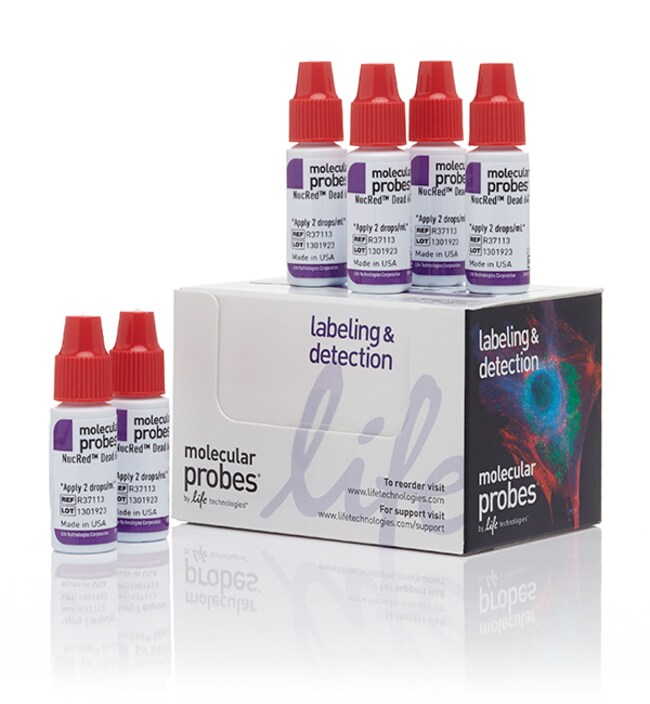
NucRed™ Dead 647 ReadyProbes™ Reagent (TO-PRO-3 iodide)
NucRed Dead 647 ReadyProbes Reagent is a cell impermeant stain that emits bright far-red fluorescence when bound to DNA. Since자세히 알아보기
| 카탈로그 번호 | 수량 |
|---|---|
| R37113 | 6 Bottles kit |
카탈로그 번호 R37113
제품 가격(KRW)
421,000
キャンペーン価格
Ends: 31-Dec-2026
481,000할인액 60,000
Each
수량:
6 Bottles kit
제품 가격(KRW)
421,000
キャンペーン価格
Ends: 31-Dec-2026
481,000할인액 60,000
Each
NucRed Dead 647 ReadyProbes Reagent is a cell impermeant stain that emits bright far-red fluorescence when bound to DNA. Since this reagent stains the cells without plasma membrane integrity it is extremely useful to measure viability and to measure cytotoxicity in kinetic live cell assays. NucRed Dead 647 reagent is also suitable for staining nuclei in fixed cell preparations and tissue sections.
Also available: TO-PRO-3 Iodide (1 μM solution in DMSO)
• Exceptionally bright far-red fluorescence upon binding to DNA
• Rapid staining of damaged, dead, or fixed cells without wash steps
• Ready-to-use liquid formulation in convenient dropper bottle
• Stability at room temperature—keep handy at your scope or cell culture area
See other ReadyProbes reagents for cell staining
See other nuclear stains for imaging
Cell imaging applications
The far-red fluorescence emission makes it ideal for use in combination with blue, green, and red fluorophores, such as Hoechst, GFP/FITC, and Texas Red.
Suggestions for use
• NucRed Dead 647 ReadyProbes Reagent may be added directly to cells in full media, or buffer solutions.
• In most cases, 2 drops/mL and an incubation of 15 to 30 minutes will give bright nuclear staining; however, more or fewer drops can be added for optimal staining intensity.
• In most cases, staining intensity increases with time if cells are not washed prior to imaging.
• It is detected through a far-red filter, such as a Cy5 filter, or a Cy5 Light Cube for EVOS imaging systems.
Visualize staining your cell without wasting your reagents, antibodies, or time with our new Stain-iT Cell Staining Simulator.
Also available: TO-PRO-3 Iodide (1 μM solution in DMSO)
• Exceptionally bright far-red fluorescence upon binding to DNA
• Rapid staining of damaged, dead, or fixed cells without wash steps
• Ready-to-use liquid formulation in convenient dropper bottle
• Stability at room temperature—keep handy at your scope or cell culture area
See other ReadyProbes reagents for cell staining
See other nuclear stains for imaging
Cell imaging applications
The far-red fluorescence emission makes it ideal for use in combination with blue, green, and red fluorophores, such as Hoechst, GFP/FITC, and Texas Red.
Suggestions for use
• NucRed Dead 647 ReadyProbes Reagent may be added directly to cells in full media, or buffer solutions.
• In most cases, 2 drops/mL and an incubation of 15 to 30 minutes will give bright nuclear staining; however, more or fewer drops can be added for optimal staining intensity.
• In most cases, staining intensity increases with time if cells are not washed prior to imaging.
• It is detected through a far-red filter, such as a Cy5 filter, or a Cy5 Light Cube for EVOS imaging systems.
Visualize staining your cell without wasting your reagents, antibodies, or time with our new Stain-iT Cell Staining Simulator.
For Research Use Only. Not for use in diagnostic procedures.
사양
검출 방법Fluorescence
방출 파장661
여기 파장642 nm
형태Liquid
수량6 Bottles kit
세포하위구조 국지화Nucleus
색상Far-red
용도(애플리케이션)Viability Assay
용도 (장비)Confocal Microscope, Fluorescence Microscope, Flow Cytometer
제품라인NucRed, ReadyProbes
제품 유형Nucleic Acid Stain
Unit SizeEach
구성 및 보관
6 x 2.5 mL dropper bottles
Store at ≤ 25°C
Store at ≤ 25°C
자주 묻는 질문(FAQ)
Can I use the ReadyProbes reagents for flow cytometry?
인용 및 참조 문헌 (22)
인용 및 참조 문헌
Abstract
Ammonia excretion in the Atlantic hagfish (Myxine glutinosa) and responses of an Rhc glycoprotein.
Journal:
PubMed ID:25715835
Hagfishes are the most ancient of the extant craniates, and demonstrate a high tolerance for a number of unfavorable environmental conditions including elevated ammonia. Proposed mechanisms of ammonia excretion in aquatic organisms include vesicular NH4+ transport and release by exocytosis in marine crabs, and passive NH3 diffusion, active NH4+ transport
ALS-associated FUS mutations result in compromised FUS alternative splicing and autoregulation.
Journal:
PubMed ID:24204307
The gene encoding a DNA/RNA binding protein FUS/TLS is frequently mutated in amyotrophic lateral sclerosis (ALS). Mutations commonly affect its carboxy-terminal nuclear localization signal, resulting in varying deficiencies of FUS nuclear localization and abnormal cytoplasmic accumulation. Increasing evidence suggests deficiencies in FUS nuclear function may contribute to neuron degeneration. Here
Hepatic DNA deposition drives drug-induced liver injury and inflammation in mice.
Journal:
PubMed ID:24824608
Drug-induced liver injury (DILI) is an important cause of acute liver failure, with limited therapeutic options. During DILI, oncotic necrosis with concomitant release and recognition of intracellular content amplifies liver inflammation and injury. Among these molecules, self-DNA has been widely shown to trigger inflammatory and autoimmune diseases; however, whether DNA
A map of gene expression in neutrophil-like cell lines.
Journal:BMC Genomics
PubMed ID:30068296
'Human neutrophils are central players in innate immunity, a major component of inflammatory responses, and a leading model for cell motility and chemotaxis. However, primary neutrophils are short-lived, limiting their experimental usefulness in the laboratory. Thus, human myeloid cell lines have been characterized for their ability to undergo neutrophil-like differentiation
Therapeutic Targeting of PTK7 is Cytotoxic in Atypical Teratoid Rhabdoid Tumors.
Journal:Mol Cancer Res
PubMed ID:28442586
'Novel discoveries involving the evaluation of potential therapeutics are based on newly identified molecular targets for atypical teratoid rhabdoid tumors (ATRT), which are the most common form of infantile brain tumors. Central nervous system ATRTs are rare, aggressive, and fast growing tumors of the brain and spinal cord and carry