Search


인용 및 참조 문헌 (13)
Invitrogen™
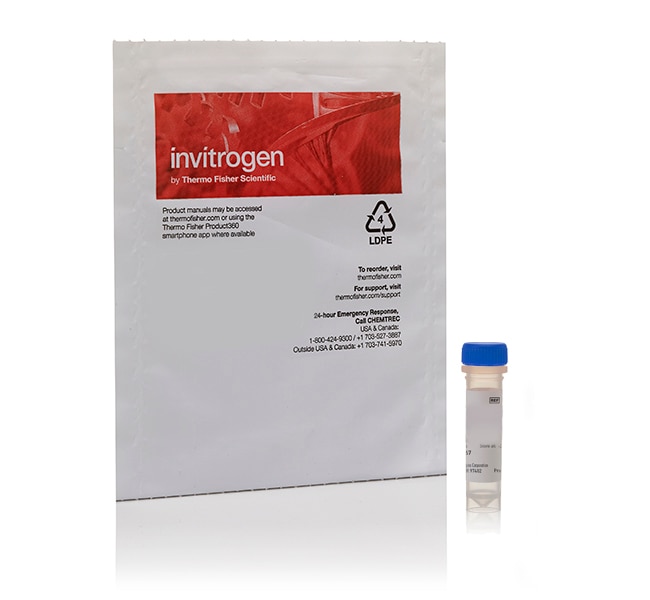
SYTO™ 83 Orange Fluorescent Nucleic Acid Stain - 5 mM Solution in DMSO
For use with fluorescence microscopy and flow cytometry
| 카탈로그 번호 | 수량 |
|---|---|
| S11364 | 250 μL |
카탈로그 번호 S11364
제품 가격(KRW)
445,000
Exklusiv online
Ends: 30-Sep-2026
523,000할인액 78,000 (15%)
Each
수량:
250 μL
제품 가격(KRW)
445,000
Exklusiv online
Ends: 30-Sep-2026
523,000할인액 78,000 (15%)
Each
The cell-permeant SYTO 83 orange fluorescent nucleic acid stain exhibits bright, orange fluorescence upon binding to nucleic acids. Because the staining pattern of the SYTO dyes in live cells may vary between cell types, we offer the SYTO Orange Fluorescent Nucleic Acid Stain Sampler Kit (Cat. No. S-11360) to enable researchers to find the most appropriate orange-fluorescent SYTO stain for their system.
Any physiological buffer between pH 7.0–8.0, including PBS, can be used to dilute the SYTO dyes for the staining solution.
For Research Use Only. Not for use in diagnostic procedures.
사양
색상Orange
설명SYTO™ 83 Orange Fluorescent Nucleic Acid Stain - 5 mM Solution in DMSO
검출 방법Fluorescence
염료 유형Cell-Permeant
방출559 nm
여기 파장 범위543 nm
용도(장비)Fluorescence Microscope
제품라인SYTO
수량250 μL
배송 조건Room Temperature
부피(미터법)250 μL
라벨 유형Fluorescent Dye
제품 유형Nucleic Acid Stain
Sub Cellular LocalizationNucleic Acids
Unit SizeEach
구성 및 보관
Store in freezer at -5°C to -30°C and protect from light.
자주 묻는 질문(FAQ)
How do SYTO dyes bind to DNA?
인용 및 참조 문헌 (13)
인용 및 참조 문헌
Abstract
Antibody to a conserved antigenic target is protective against diverse prokaryotic and eukaryotic pathogens.
Journal:
PubMed ID:23716675
'Microbial capsular antigens are effective vaccines but are chemically and immunologically diverse, resulting in a major barrier to their use against multiple pathogens. A ß-(1?6)-linked poly-N-acetyl-d-glucosamine (PNAG) surface capsule is synthesized by four proteins encoded in genetic loci designated intercellular adhesion in Staphylococcus aureus or polyglucosamine in selected Gram-negative bacterial
Antibodies to a novel leptospiral protein, LruC, in the eye fluids and sera of horses with Leptospira-associated uveitis.
Journal:Clin Vaccine Immunol
PubMed ID:22237897
Screening of an expression library of Leptospira interrogans with eye fluids from uveitic horses resulted in identification of a novel protein, LruC. LruC is located in the inner leaflet of the leptospiral outer membrane, and an lruC gene was detected in all tested pathogenic L. interrogans strains. LruC-specific antibody levels
Structural and functional characterizations of SsgB, a conserved activator of developmental cell division in morphologically complex actinomycetes.
Journal:J Biol Chem
PubMed ID:19567872
SsgA-like proteins (SALPs) are a family of homologous cell division-related proteins that occur exclusively in morphologically complex actinomycetes. We show that SsgB, a subfamily of SALPs, is the archetypal SALP that is functionally conserved in all sporulating actinomycetes. Sporulation-specific cell division of Streptomyces coelicolor ssgB mutants is restored by introduction
Perivascular cells with pericyte characteristics are involved in ATP- and PGE(2)-induced relaxation of porcine retinal arterioles in vitro.
Journal:Invest Ophthalmol Vis Sci
PubMed ID:23599323
Relaxation of porcine retinal arterioles in vitro has been shown to be preceded by calcium activity in a population of perivascular cells that cannot be classified as neurons, glial cells, or vascular smooth muscle cells. The purpose of the present investigation was to study calcium activity in these perivascular cells
The use of carbohydrate microarrays to study carbohydrate-cell interactions and to detect pathogens.
Journal:Chem Biol
PubMed ID:15610854
The use of carbohydrate microarrays to investigate the carbohydrate binding specificities of bacteria, to detect pathogens, and to screen antiadhesion therapeutics is reported. This system is ideal for whole-cell applications because microarrays present carbohydrate ligands in a manner that mimics interactions at cell-cell interfaces. Other advantages include assay miniaturization, since