Search


인용 및 참조 문헌 (2)
Invitrogen™
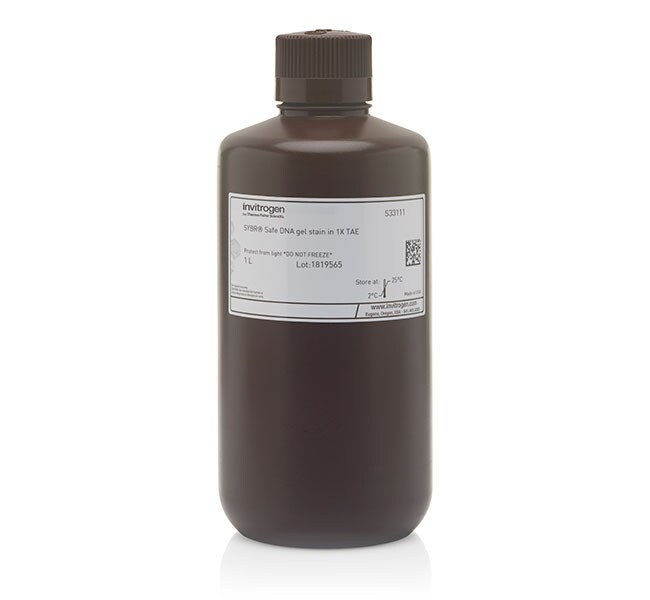
SYBR™ Safe DNA Gel Stain in 1X TAE
SYBR Safe™ DNA gel stain was developed specifically for reduced mutagenicity—to be safer than ethidium bromide for staining DNA in자세히 알아보기
Have Questions?
보기 방식 변경

| 카탈로그 번호 | 수량 |
|---|---|
| S33112 | 4 L |
| S33111 | 1 L |
카탈로그 번호 S33112
제품 가격(KRW)
464,000
온라인 행사
Ends: 30-Sep-2026
545,000할인액 81,000 (15%)
Each
수량:
4 L
제품 가격(KRW)
464,000
온라인 행사
Ends: 30-Sep-2026
545,000할인액 81,000 (15%)
Each
SYBR Safe™ DNA gel stain was developed specifically for reduced mutagenicity—to be safer than ethidium bromide for staining DNA in agarose or acrylamide gels. SYBR Safe™stain is not only less mutagenic than ethidium bromide, but SYBR Safe™ stain's detection sensitivity is better than that of ethidium bromide. SYBR Safe™ stain comes as a premixed solution that can be used just like an ethidium bromide solution, either in the gel during the electrophoresis run or as a post-run stain. Bound to nucleic acids, the green-fluorescent SYBR Safe™ stain has fluorescence excitation maxima at ∼280 and ∼502 nm, and an emission maximum at ∼530 nm.
For Research Use Only. Not for use in diagnostic procedures.
사양
검출 위치In-Gel Detection
검출 방법Fluorescence
수량4 L
유통 기한6 months from date of purchase
배송 조건Room Temperature
타겟 분자DNA
라벨 또는 염료SYBR Safe
제품 유형DNA Gel Stain
Unit SizeEach
구성 및 보관
• Supplied as a ready-to-use solution in 1X TAE
Store at room temperature in the original container.
Store at room temperature in the original container.
자주 묻는 질문(FAQ)
Why do I sometimes see speckles in my gel when using SYBR Safe DNA Gel Stain?
What is the pH range of SYBR dyes?
Which direction does the SYBR Safe dye run during electrophoresis?
Does ethanol precipitation remove the SYBR Safe dye?
Can I reuse SYBR Safe DNA Gel Stain for a second gel?
인용 및 참조 문헌 (2)
인용 및 참조 문헌
Abstract
Development of a SYBR safe technique for the sensitive detection of DNA in cesium chloride density gradients for stable isotope probing assays.
Journal:J Microbiol Methods
PubMed ID:18329741
SYBR safe, a fluorescent nucleic acid stain, was evaluated as a replacement for ethidium bromide (EtBr) in cesium chloride (CsCl) density gradients for DNA stable isotope probing (DNA-SIP) assays. The separation of 12C- and 13C-labelled DNA using SYBR safe gave similar results to those obtained using EtBr with pure cultures
Mechanisms of palatal epithelial seam disintegration by transforming growth factor (TGF) beta3.
Journal:Dev Biol
PubMed ID:17698055
TGFbeta3 signaling initiates and completes sequential phases of cellular differentiation that is required for complete disintegration of the palatal medial edge seam, that progresses between 14 and 17 embryonic days in the murine system, which is necessary in establishing confluence of the palatal stroma. Understanding the cellular mechanism of palatal