Search


Citations & References (4)
Invitrogen™
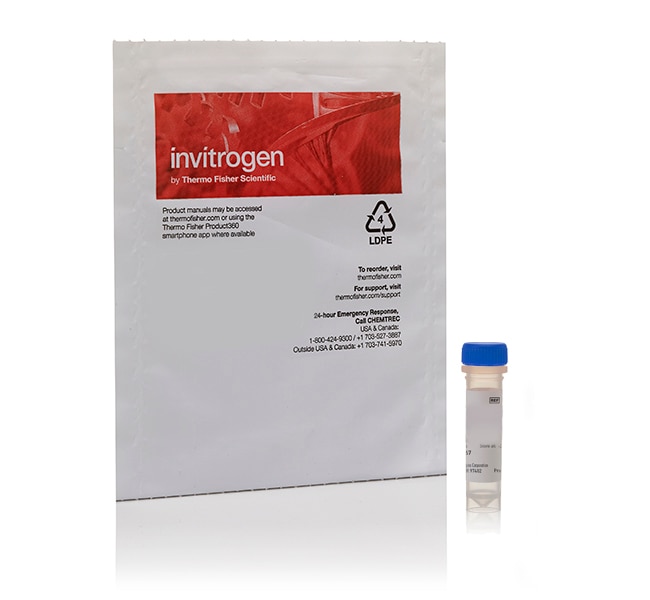
BODIPY™ TMR C5-Maleimide
BODIPY™ TMR C5-maleimide
| Catalog Number | Quantity |
|---|---|
| B30466 | 1 mg |
Catalog number B30466
Price (MXN)
-
Quantity:
1 mg
The thiol-reactive BODIPY™ TMR maleimide produces electronically neutral dye conjugates that are spectrally similar to the positively charged tetramethylrhodamine dye. This dye's lack of ionic charge results in minimal effects on the isoelectric points of standard proteins conjugated with this fluorophore. The small size and relatively long excited-state lifetime of BODIPY™ TMR dye has proven useful for studying ligand-receptor interaction by fluorescence polarization.
For Research Use Only. Not for use in diagnostic procedures.
Specifications
Chemical ReactivityThiol
Label or DyeBODIPY™ TMR
Product TypeMaleimide
Quantity1 mg
Reactive MoietyMaleimide
Shipping ConditionRoom Temperature
Label TypeBODIPY Dyes
Product LineBODIPY
Unit SizeEach
Contents & Storage
Store in freezer (-5 to -30°C) and protect from light.
Citations & References (4)
Citations & References
Abstract
Family of pH (low) insertion peptides for tumor targeting.
Journal:Proc Natl Acad Sci U S A
PubMed ID:23530249
'Cancer is a complex disease with a range of genetic and biochemical markers within and among tumors, but a general tumor characteristic is extracellular acidity, which is associated with tumor growth and development. Acidosis could be a universal marker for cancer imaging and the delivery of therapeutic molecules, but its
The crystal structure of the C-terminus of adseverin reveals the actin-binding interface.
Journal:Proc Natl Acad Sci U S A
PubMed ID:19666531
Adseverin is a member of the calcium-regulated gelsolin superfamily of actin severing and capping proteins. Adseverin comprises 6 homologous domains (A1-A6), which share 60% identity with the 6 domains from gelsolin (G1-G6). Adseverin is truncated in comparison to gelsolin, lacking the C-terminal extension that masks the F-actin binding site in
Ca2+ binding by domain 2 plays a critical role in the activation and stabilization of gelsolin.
Journal:Proc Natl Acad Sci U S A
PubMed ID:19666512
Gelsolin consists of six homologous domains (G1-G6), each containing a conserved Ca-binding site. Occupation of a subset of these sites enables gelsolin to sever and cap actin filaments in a Ca-dependent manner. Here, we present the structures of Ca-free human gelsolin and of Ca-bound human G1-G3 in a complex with
Detecting changes in the thiol redox state of proteins following a decrease in oxygen concentration using a dual labeling technique.
Journal:J Proteome Res
PubMed ID:19894774
Cells are routinely exposed to hyperoxic conditions when cultured in the presence of 95% air and 5% carbon dioxide. Hyperoxic conditions can increase the generation of reactive oxygen species and cause oxidative stress. Oxidative stress has been proposed to cause cells in culture to behave differently from cells in vivo.