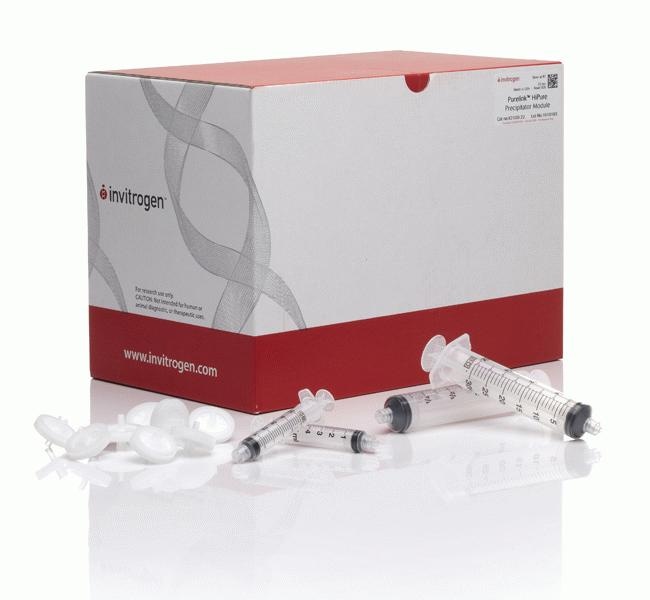
PureLink™ HiPure Precipitator Module
Invitrogen™

PureLink™ HiPure Precipitator Module

The PureLink™ HiPure Precipitator allows fast, simple, and efficient desalting and concentration of plasmid DNA isolated using anion-exchange chromatography. TheRead more
Have Questions?
Change viewbuttonViewtableView
Catalog NumberQuantity
K21002110 Preps
K21002225 Preps
Catalog number K210021
Price (MXN)
-
Quantity:
10 Preps

The PureLink™ HiPure Precipitator allows fast, simple, and efficient desalting and concentration of plasmid DNA isolated using anion-exchange chromatography. The traditional method for DNA precipitation of anion exchange isolated plasmid DNA involves isopropanol precipitation followed by centrifugation and drying of DNA,which is time consuming and labor intensive. The use of the PureLink™ HiPure Precipitator allows plasmid DNA concentration within 5 minutes, eliminates the need for centrifugation, and reduces the risk of losing the DNA pellet during supernatant removal. The recovery is >80% and resulting plasmid DNA is ready to use in the most challenging applications such as transfection.

For Research Use Only. Not for use in diagnostic procedures.
Specifications
Final Product TypePlasmid DNA
For Use With (Application)Next-Generation Sequencing, Transfection, Cloning, Sequencing, Transformation, Nucleic Acid Labeling, PCR, In Vitro Transcription
High-throughput CompatibilityNot High-throughput Compatible (Manual)
Prep Scale> 200 μg (Large-Scale) Plasmid DNA
Product LinePureLink
Product TypePrecipitator Module
Quantity10 Preps
Sample TypeBacterial Culture
Shipping ConditionRoom Temperature
TargetPlasmid DNA
Test Time5 min.
FormatSyringe
Isolation TechnologyAnion Exchange Resin
Unit SizeEach
Contents & Storage
The PureLink™ HiPure Precipitator Module includes HiPure Precipitators, and 5 mL and 30 mL syringes. Store all components at room temperature.

Frequently asked questions (FAQs)

My plasmid yield was lower than expected. What could be the cause?

There are several reasons lower yields can occur:

-Make sure the binding of the plasmid is being done at RT. Temperature affects the pH of the binding solution.

-Make sure all other solutions are also warmed to RT for optimal yield.

-Verify that the centrifugation immediately following the neutralization step was not done at 4 degrees C. If it was, the supernatant MUST be warmed to RT before loading onto the column.

-The 1:1:1 ratio of buffers (Resuspension/Lysis/Precipitation) has not been kept precisely. A surplus of solution E3 will exceed the optimal salt concentration for DNA binding, thus leading to decreased DNA yield.

-Low-copy number plasmids give lower yields.

-If all of the medium was not removed at the cell harvesting step, the pH of the subsequent step can be affected and reduce yield.

-The cell pellet was not thoroughly resuspended before lysis.

-The purified DNA pellet was overdried after isopropanol precipitation and ethanol wash making it difficult to resuspend the pellet. Air dry only.

-Pellets can be easily lost during the alcohol precipitation and wash steps. It is best to pipette off the alcohol solutions rather than pouring them off, as the pellets tend to be slippery.

-After lysis and neutralization, the lysate is not homogeneous. After addition of solutions (Resuspension/Lysis/Precipitation buffers), cells must be mixed thoroughly by inverting the tubes until a homogeneous phase is obtained. Otherwise, cells will not be lysed completely and the plasmid DNA will stick to bacterial debris. In the case of bigger bacterial cell pellets, more vigorous shaking may be required to achieve homogeneity. However, do NOT vortex, as vortexing will release chromosomal DNA.

I did not recover any DNA after using one of your PureLink HiPure plasmid purification kits. Why?

The DNA pellet from precipitation with isopropanol is easily dislodged when washing with 70% ethanol. It is best to remove the isopropanol supernatant and the ethanol wash by pipetting. Be careful not to shoot the washing buffer directly onto the pellet. Instead, allow the washing buffer to run over the pellet. Regardless of which manufacturer's miniprep kit you use, washing the pellet can be challenging because it is so small.

What is the binding capacity of the PureLink HiPure Precipitator?

The binding capacity of the PureLink HiPure Precipitator is 2 mg.

Can I use the PureLink HiPure Precipitator with other anion exchange kits?

For best results, we recommend the use of the PureLink HiPure Precipitators with our PureLink HiPure Plasmid Filter Maxiprep/Midiprep Kit or PureLink HiPure Plasmid Maxiprep/Midiprep kit. However, PureLink HiPure Precipitator can be used with an equivalent anion exchange plasmid purification kit. We do offer the PureLink HiPure Precipitator as a stand-alone product (Cat. Nos. K210021 and K210022).

Can the PureLink HiPure Precipitator be re-used?

It is not recommended. We cannot guarantee the yield or the quality of the DNA from a re-used Precipitator.