Search


Citations & References (7)
Invitrogen™
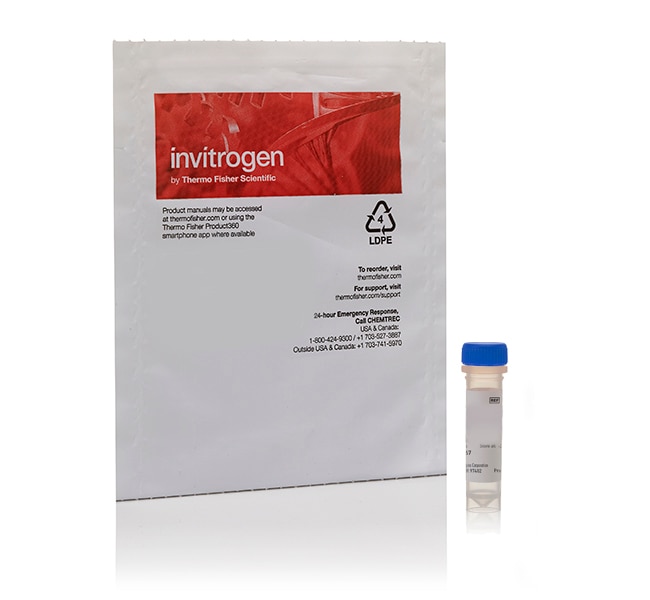
Qdot™ 565 ITK™ Carboxyl Quantum Dots
Qdot™ 565 ITK™ carboxyl quantum dots are the ideal starting material for preparing custom conjugates that require high loading of biomolecules.
| Catalog Number | Quantity |
|---|---|
| Q21331MP | 250 μL |
Catalog number Q21331MP
Price (MXN)
-
Quantity:
250 μL
Qdot™ 565 ITK™ carboxyl quantum dots are the ideal starting material for preparing custom conjugates that require high loading of biomolecules. These materials are carboxylate functionalized and can be coupled to amine groups of proteins and modified oligonucleotides using EDC (Cat. No. E2247)-mediated condensation. The coatings of these probes provides more binding sites than our Qdot™ ITK™ amino quantum dots, but lacks PEG linkers that help to prevent non-specific interactions. These materials can be conjugated to X-PEG-amine bi-functional linkers for custom reactivity and higher specificity. Our Qdot™ ITK™ carboxyl quantum dots are provided as 8 μM solutions and are available in all 9 Qdot™ probe colors.
Important Features of Qdot™ ITK™ Carboxyl Quantum Dots:
- Qdot™ 565 ITK™ carboxyl quantum dot has emission maxima of ∼565 nm
- Extremely photostable and bright fluorescence
- Efficiently excited with single-line excitation sources
- Narrow emission, large Stokes shift
- Available in multiple colors
- Ideal labeling and tracking applications
Properties of Qdot™ Nanocrystals
Qdot™ probes are ideal for imaging and labeling applications that require bright fluorescent signals and/or real-time tracking. Unique among fluorescent reagents, all nine available colors of Qdot™ probes can be simultaneously excited with a single (UV to blue-green) light source. This property makes these reagents excellent for economical and user-friendly multiplexing applications. Qdot™ labels are based on semiconductor nanotechnology and are similar in scale to moderately sized proteins.
About the Innovator's Tool Kit Qdot™ ITK™ Reagents
These Qdot™ ITK™ probes are ideal for researchers who wish to prepare specific (non-stocked) conjugates for their applications and need customizable conjugation functionality.
Other Forms of Qdot™ Nanocrystals are Available
In addition to the carboxyl-derivatized form, we offer Qdot™ ITK™ quantum dots with amino and aliphatic hydrocarbon modifications. We've also developed a wide range of Qdot™ nanocrystals conjugates and labeling kits. Investigate the properties of Qdot™ nanocrystals or read the Molecular Probes™ Handbook Section 6.6—Qdot™ Nanocrystals to find out more.
For Research Use Only. Not for use in diagnostic procedures.
Specifications
Chemical ReactivityAmine
Concentration8 μM
Emission565 nm
Label or DyeQdot™ 565
Product TypeQuantum Dot
Quantity250 μL
Reactive MoietyCarboxylic Acid
Shipping ConditionRoom Temperature
Label TypeQdot Nanocrystals
Product LineITK, Qdot
Unit SizeEach
Contents & Storage
Store in refrigerator (2°C to 8°C).
Frequently asked questions (FAQs)
How large are the Qdot nanocrystals?
What is the best way to remove white precipitate from my ITK Qdot nanocrystals?
I see a white precipitate in my ITK Qdot nanocrystals; should I be concerned?
Why do my Qdot nanocrystals appear to be blinking?
My Qdot nanocrystals were brightly fluorescent before I mounted my samples; now I'm seeing a loss of fluorescence. Why is this happening?
Citations & References (7)
Citations & References
Abstract
A quantum dot-aptamer beacon using a DNA intercalating dye as the FRET reporter: application to label-free thrombin detection.
Journal:Biosens Bioelectron
PubMed ID:21306887
'A new quantum dot (QD)-aptamer (apt) beacon that acts by folding-induced dissociation of a DNA intercalating dye, BOBO-3(B), is demonstrated with label-free thrombin detection. The beacon, denoted as QD-apt:B, is constructed by (1) coupling of a single-stranded thrombin aptamer to Qdot 565 via EDC/Sulfo-NHS chemistry and (2) staining the duplex
In vivo real-time, multicolor, quantum dot lymphatic imaging.
Journal:J Invest Dermatol
PubMed ID:19536144
'The lymphatic network is complex and difficult to visualize in real-time in vivo. Moreover, the direction of flow within lymphatic networks is often unpredictable especially in areas with well-developed '
Simultaneous multicolor imaging of five different lymphatic basins using quantum dots.
Journal:Nano Lett
PubMed ID:17530812
Quantum dots can be used to perform multicolor images with high fluorescent intensity and are of a nanosize suitable for lymphatic imaging via direct interstitial injection. Here simultaneous multicolor in vivo wavelength-resolved spectral fluorescence lymphangiography is shown using five quantum dots with similar physical sizes but different emission spectra. This
Variables influencing interactions of untargeted quantum dot nanoparticles with skin cells and identification of biochemical modulators.
Journal:Nano Lett
PubMed ID:17408303
Skin cells (NHEK) take up untargeted quantum dots (QD) with surface polyethylene glycol (PEG), amines, and carboxylic acids, but the mechanisms are unknown. Time courses of QD-NHEK interactions were determined and effects of QD surface coating, temperature, culture medium supplements and inhibitors of the cell cycle and endocytosis identified. The
In vivo skin penetration of quantum dot nanoparticles in the murine model: the effect of UVR.
Journal:Nano Lett
PubMed ID:18687009
Ultraviolet radiation (UVR) has widespread effects on the biology and integrity of the skin barrier. Research on the mechanisms that drive these changes, as well as their effect on skin barrier function, has been ongoing since the 1980s. However, no studies have examined the impact of UVR on nanoparticle skin