Search


Citas y referencias (17)
Invitrogen™
ADN polimerasa Platinum™ Taq
La ADN polimerasa Invitrogen Platinum Taq es una ADN polimerasa termoestable de inicio en caliente, fiable y práctica, para PCRMás información
Have Questions?
Cambiar vista

| Número de catálogo | N.º de reacciones |
|---|---|
| 10966018 | 120 reacciones |
| 10966026 | 300 reacciones |
| 10966034 | 600 reacciones |
| 10966083 | 5000 reacciones |
Número de catálogo 10966018
Precio (MXN)
3,908.33
Each
N.º de reacciones:
120 reacciones
Precio (MXN)
3,908.33
Each
La ADN polimerasa Invitrogen Platinum Taq es una ADN polimerasa termoestable de inicio en caliente, fiable y práctica, para PCR que proporciona una especificidad mejorada en comparación con la de la ADN polimerasa Taq. La propiedad de inicio en caliente de la enzima viene conferida por los anticuerpos monoclonales termolábilos que hacen inactiva la ADN polimerasa Taq hasta el paso inicial de desnaturalización de la PCR. De esta forma se evita la extensión de cebadores no específicamente recocidos y se mejora la producción.
Uso de ADN polimerasa Platinum Taq
La propiedad de inicio en caliente de la ADN polimerasa Platinum Taq permite un ensamblaje de reacción conveniente a temperatura ambiente. Al igual que con la ADN polimerasa Platinum Taq, la ADN polimerasa Platinum Taq tiene una actividad transferasa terminal que no depende de moldes y que añade una desoxiadenosina 3’ a los extremos del producto y tiene una actividad exonucleasa 5’→3’. Los productos de PCR generados con la ADN polimerasa Platinum Taq se pueden utilizar en las mismas aplicaciones posteriores sin modificar los protocolos. Utilice la ADN polimerasa Platinum Taq para la amplificación de ADN de moldes genómicos complejos, virales y plasmídicos, así como en la RT-PCR.
Nota: Para un rendimiento superior de PCR, recomendamos la enzima de próxima generación ADN polimerada Platinum II Taq Hot-Start. La ADN polimerasa Platinum II Taq Hot-Start está diseñada para el recocido universal de cebadores y una PCR rápida y sencilla con su combinación única de tampón innovador, ADN polimerasa Taq de alto rendimiento y tecnología superior de inicio en caliente.
Uso de ADN polimerasa Platinum Taq
La propiedad de inicio en caliente de la ADN polimerasa Platinum Taq permite un ensamblaje de reacción conveniente a temperatura ambiente. Al igual que con la ADN polimerasa Platinum Taq, la ADN polimerasa Platinum Taq tiene una actividad transferasa terminal que no depende de moldes y que añade una desoxiadenosina 3’ a los extremos del producto y tiene una actividad exonucleasa 5’→3’. Los productos de PCR generados con la ADN polimerasa Platinum Taq se pueden utilizar en las mismas aplicaciones posteriores sin modificar los protocolos. Utilice la ADN polimerasa Platinum Taq para la amplificación de ADN de moldes genómicos complejos, virales y plasmídicos, así como en la RT-PCR.
Nota: Para un rendimiento superior de PCR, recomendamos la enzima de próxima generación ADN polimerada Platinum II Taq Hot-Start. La ADN polimerasa Platinum II Taq Hot-Start está diseñada para el recocido universal de cebadores y una PCR rápida y sencilla con su combinación única de tampón innovador, ADN polimerasa Taq de alto rendimiento y tecnología superior de inicio en caliente.
Para uso exclusivo en investigación. No apto para uso en procedimientos diagnósticos.
Especificaciones
Actividad exonucleasa5' - 3'
Fidelidad (frente a Taq)1 X
FormatoTubo
Inicio en calienteInicio en caliente integrado
N.º de reacciones120 reacciones
Sobrante3'-A
PolimerasaADN polimerasa Taq Platinum
Tipo de productoADN polimerasa
Cantidad120 reacciones
Formato de reacciónComponentes separados
Condiciones de envíoAprobado para su envío en hielo húmedo o seco
Tamaño (producto final)5 kb o menos
Material de partidaADN
Para utilizar con (aplicación)Hot-start PCR
GC-Rich PCR PerformanceBajo
Velocidad de reacciónrápida o estándar
Unit SizeEach
Contenido y almacenamiento
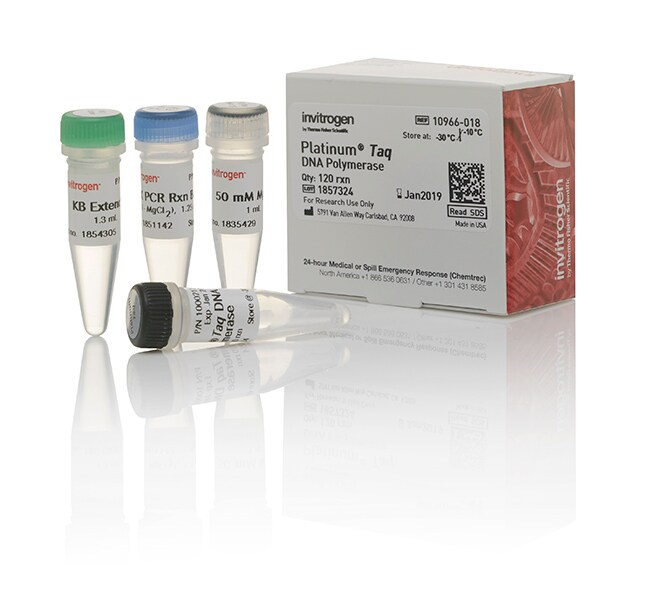
Cada caja contiene lo siguiente:
• 24 µl de ADN polimerasa Platinum™ Taq
• Tampón para PCR 10X de 1,25 ml (sin cloruro magnésico)
• 1 ml de cloruro magnésico de 50 mm
• 1,3 ml de KB Extender
Almacenar a una temperatura de entre -30 °C y -10 °C en un congelador que no forme escarcha.
• 24 µl de ADN polimerasa Platinum™ Taq
• Tampón para PCR 10X de 1,25 ml (sin cloruro magnésico)
• 1 ml de cloruro magnésico de 50 mm
• 1,3 ml de KB Extender
Almacenar a una temperatura de entre -30 °C y -10 °C en un congelador que no forme escarcha.
Preguntas frecuentes
Can I purchase just the 10X PCR buffer that comes with Platinum Taq?
My oligonucleotide does not appear to be the right length when I checked by gel electrophoresis. Why is this?
The primers I am using worked for PCR initially, but over time, have stopped working. What happened?
I don't see a pellet in my oligo tube order. Should I ask for a replacement?
There is a ball-shaped pellet at the bottom of my oligo tube. What is this and can I still use my oligo?
Citations & References (17)
Citations & References
Abstract
De novo ceramide regulates the alternative splicing of caspase 9 and Bcl-x in A549 lung adenocarcinoma cells. Dependence on protein phosphatase-1.
Journal:J Biol Chem
PubMed ID:11801602
'In a recent study, we showed that ceramide induces the dephosphorylation of SR proteins, a family of protein factors that regulate alternative splicing. In this study, the regulation of the alternative processing of pre-mRNA of both caspase 9 and Bcl-x(L) was examined in response to ceramide. Treatment of A549 lung
Quantitative Assessment of Gene Targeting in Vitro and in Vivo by the Pancreatic Transcription Factor, Pdx1. IMPORTANCE OF CHROMATIN STRUCTURE IN DIRECTING PROMOTER BINDING.
Journal:J Biol Chem
PubMed ID:11825903
'The transcription factor Pdx1 is expressed in the pancreatic beta-cell, where it is believed to regulate several beta-cell-specific genes. Whereas binding by Pdx1 to elements of beta-cell genes has been demonstrated in vitro, almost none of these genes has been demonstrated to be a direct binding target for Pdx1 within
Angiotensin II inhibits human trophoblast invasion through AT1 receptor activation.
Journal:J Biol Chem
PubMed ID:11983698
Trophoblast implantation depends, in part, on the controlled production of plasmin from plasminogen, a process regulated by plasminogen activators and plasminogen activator inhibitors. We have determined that angiotensin II (Ang II) stimulates plasminogen activator inhibitor-1 (PAI-1) synthesis and secretion in human trophoblasts in a time- and concentration-dependent manner. Our results
Sensory nerves determine the pattern of arterial differentiation and blood vessel branching in the skin.
Journal:Cell
PubMed ID:12086669
Nerves and blood vessels are branched structures, but whether their branching patterns are established independently or coordinately is not clear. Here we show that arteries, but not veins, are specifically aligned with peripheral nerves in embryonic mouse limb skin. Mutations that eliminate peripheral sensory nerves or Schwann cells prevent proper
Translational regulation of BACE-1 expression in neuronal and non-neuronal cells.
Journal:Nucleic Acids Res
PubMed ID:15034149
As the main beta-secretase of the central nervous system, BACE-1 is a key protein in the pathogenesis of Alzheimer's disease. Excessive expression of the protein might cause an overproduction of the neurotoxic beta-amyloid peptide. Therefore, a tight regulation of BACE-1 expression is expected in vivo. In addition to a possible