Search


Citas y referencias (3)
Gibco™
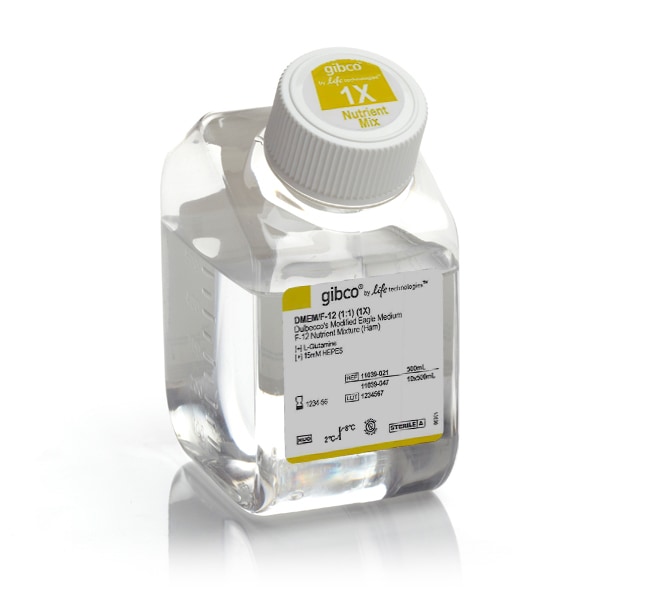
DMEM/F-12, HEPES, sin rojo de fenol
DMEM/F-12 (medio Eagle modificado de Dulbecco/mezcla de nutrientes F-12) se utiliza ampliamente como un medio basal para fomentar el crecimientoMás información
Have Questions?
Cambiar vista

| Número de catálogo | Cantidad |
|---|---|
| 11039021 | 500 mL |
| 11039047 | 10 x 500 mL |
Número de catálogo 11039021
Precio (MXN)
1,544.65
Each
Cantidad:
500 mL
Precio (MXN)
1,544.65
Each
DMEM/F-12 (medio Eagle modificado de Dulbecco/mezcla de nutrientes F-12) se utiliza ampliamente como un medio basal para fomentar el crecimiento de diferentes células de mamíferos. Las células cultivadas con éxito en DMEM/F-12 incluyen MDCK, células gliales, fibroblastos, células endoteliales humanas y fibroblastos de rata. Ofrecemos una gran variedad de modificaciones de DMEM/F-12 para diversas aplicaciones de cultivos celulares. Busque la formulación adecuada mediante la herramienta de selección de medios.
Este DMEM/F-12 se ha modificado de la manera siguiente:
Está disponible la formulación completa.
Uso de DMEM/F-12
DMEM/F-12 es una mezcla en proporción 1:1 de DMEM y Ham F-12. Esta formulación combina las altas concentraciones de glucosa, aminoácidos y vitaminas de DMEM con la amplia variedad de componentes de F-12. DMEM/F-12 no contiene proteínas, lípidos ni factores de crecimiento. Por lo tanto, el DMEM/F-12 podría requerir una suplementación, normalmente con un 10 % de suero fetal bovino (SFB). DMEM/F-12 utiliza un sistema de tampón de bicarbonato sódico y por lo tanto requiere un ambiente con un 5–10 % de CO2 para mantener el pH fisiológico.
Sistema de elaboración y calidad conforme con las buenas prácticas de fabricación actuales
Para mantener la continuidad de la cadena de suministro, fabricamos DMEM/F-12 en dos plantas distintas, una ubicada en Grand Island, Nueva York (EE. UU.) y la otra en Escocia, Reino Unido. Ambos sitios cumplen los requisitos de producción según las buenas prácticas de fabricación actuales, cuentan con la certificación ISO 13485 y se han registrado en la FDA como fabricantes de dispositivos médicos.
Este DMEM/F-12 se ha modificado de la manera siguiente:
| Con | Sin |
| • L-glutamina | • Rojo de fenol |
| • HEPES |
Está disponible la formulación completa.
Uso de DMEM/F-12
DMEM/F-12 es una mezcla en proporción 1:1 de DMEM y Ham F-12. Esta formulación combina las altas concentraciones de glucosa, aminoácidos y vitaminas de DMEM con la amplia variedad de componentes de F-12. DMEM/F-12 no contiene proteínas, lípidos ni factores de crecimiento. Por lo tanto, el DMEM/F-12 podría requerir una suplementación, normalmente con un 10 % de suero fetal bovino (SFB). DMEM/F-12 utiliza un sistema de tampón de bicarbonato sódico y por lo tanto requiere un ambiente con un 5–10 % de CO2 para mantener el pH fisiológico.
Sistema de elaboración y calidad conforme con las buenas prácticas de fabricación actuales
Para mantener la continuidad de la cadena de suministro, fabricamos DMEM/F-12 en dos plantas distintas, una ubicada en Grand Island, Nueva York (EE. UU.) y la otra en Escocia, Reino Unido. Ambos sitios cumplen los requisitos de producción según las buenas prácticas de fabricación actuales, cuentan con la certificación ISO 13485 y se han registrado en la FDA como fabricantes de dispositivos médicos.
Para uso exclusivo en investigación. No apto para uso en procedimientos diagnósticos.
Especificaciones
Línea de célulasMDCK, células gliales, fibroblastos, células endoteliales humanas y fibroblastos de rata
Concentración1 X
Calidad de fabricacióncGMP-compliant under the ISO 13485 standard
Línea de productosGibco
Tipo de productoDMEM (medio Eagle modificado de Dulbecco)/F-12
Cantidad500 mL
Duración de almacenamiento12 meses a partir de la fecha de fabricación
Condiciones de envíoTemperatura ambiente
ClasificaciónLibre de material de origen animal
FormularioLíquido
Serum LevelSuplementos de suero estándar
EsterilidadEstéril con filtro
Sterilization MethodEstéril con filtro
Con aditivosAlto contenido en glucosa, Glutamina, Ácido 4-(2-hidroxietil)piperazin-1-iletanosulfónico (HEPES)
Sin aditivosSin rojo fenol
Unit SizeEach
Contenido y almacenamiento
Condiciones de almacenamiento: De 2 °C a 8 °C (proteger de la luz)
Condiciones de envío: Ambiente
Vida útil: 12 meses a partir de la fecha de fabricación
Condiciones de envío: Ambiente
Vida útil: 12 meses a partir de la fecha de fabricación
Preguntas frecuentes
Do you offer DMEM/F12 medium without folic acid?
How long can I keep my media after supplementing with serum?
My medium was shipped at room temperature but it is supposed to be stored refrigerated. Is it okay?
How can I remove mycoplasma contamination from my cell culture medium?
I see a decrease in growth of my culture. What should I do?
Citations & References (3)
Citations & References
Abstract
A comparison between different human hepatocyte models reveals profound differences in net glucose production, lipid composition and metabolism in vitro.
Journal:Experimental cell research
PubMed ID:38499143
Identification of a contractile-responsive element in the cardiac alpha-myosin heavy chain gene.
Journal:J Biol Chem
PubMed ID:8537395
The mechanisms by which the cardiac-specific alpha-myosin heavy chain (alpha-MHC) gene responds to contractile activity was studied in cultured cardiomyocytes and in vivo. Deletion analysis of the alpha-MHC promoter transiently transfected into neonatal rat cardiomyocytes localized the contractile-responsive element within -80 to -40 base pairs of the transcriptional start site.
Activation of the canonical bone morphogenetic protein (BMP) pathway during lung morphogenesis and adult lung tissue repair.
Journal:PLoS One
PubMed ID:22916109
Signaling by Bone Morphogenetic Proteins (BMP) has been implicated in early lung development, adult lung homeostasis and tissue-injury repair. However, the precise mechanism of action and the spatio-temporal pattern of BMP-signaling during these processes remains inadequately described. To address this, we have utilized a transgenic line harboring a BMP-responsive eGFP-reporter